←
Kevin Wang42 posts
Kevin Wang avatar

Kevin Wang

@kevinwng

Research @ OpenAI | prev @princeton_rl @citsecurities

◷ Joined June 2023▧ 9 Photos and videos
Kevin Wang avatar
Kevin Wang@kevinwng·27 Nov 2025

Excited to share that our paper "1000 Layer Networks for Self-Supervised RL: Scaling Depth Can Enable New Goal-Reaching Capabilities" has won the Best Paper Award at NeurIPS '25! Hope to see you all in San Diego :)

1/ While most RL methods use shallow MLPs (~2–5 layers), we show that scaling up to 1000-layers for contrastive RL (CRL) can significantly boost performance, ranging from doubling performance to 50x on a diverse suite of robotic tasks. Webpage+Paper+Code: wang-kevin3290.github.io/sca…

0:15
Kevin Wang avatar
Kevin Wang@kevinwng·Sep 4

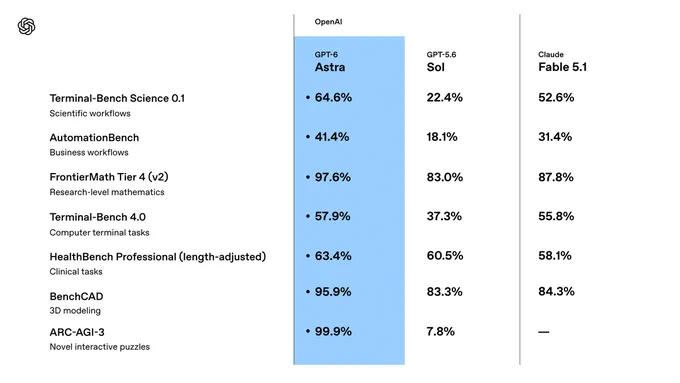
In Astra, we made significant progress on subjective domains like design aesthetics and knowledge work. It’s been a blast developing new methods for training on non-verifiable domains. Excited for this line of work and what’s coming next. Go try out Astra when you can! :)

GPT-6 Astra is state-of-the-art on FrontierMath Tier 4, ARC-AGI 3, and TerminalBench-4.0. GPT‑6 Astra is also a major advance for scientific discovery, with state-of-the-art performance on Terminal-Bench Science 0.1 and HealthBench Pro.

Post attachment
OpenAI avatar
⟳ Kevin Wang retweeted
OpenAI@OpenAI·Sep 3

0:12
Noam Brown avatar
⟳ Kevin Wang retweeted
Noam Brown@polynoamial·Aug 1

An internal version of Astra, @OpenAI’s next major model family, solved 10 major open problems in mathematics, quantum complexity, and theoretical computer science. We believe it will be a major step for scientific reasoning. openai.com/index/ten-advance…

Post attachment

10 proofs from our next major model Astra on long-standing open problems in mathematics and theoretical computer science (also including new circuit lower bounds for computing the permanent!) GPT-5.6 has already enabled so much exciting work in math and science. Can’t wait to see what comes next!

OpenAI avatar
⟳ Kevin Wang retweeted
OpenAI@OpenAI·Apr 23

Introducing GPT-5.5 A new class of intelligence for real work and powering agents, built to understand complex goals, use tools, check its work, and carry more tasks through to completion. It marks a new way of getting computer work done. Now available in ChatGPT and Codex.

0:55
OpenAI avatar
⟳ Kevin Wang retweeted
OpenAI@OpenAI·Mar 5

GPT-5.4 Thinking and GPT-5.4 Pro are rolling out now in ChatGPT. GPT-5.4 is also now available in the API and Codex. GPT-5.4 brings our advances in reasoning, coding, and agentic workflows into one frontier model.

Post attachment
OpenAI avatar
⟳ Kevin Wang retweeted
OpenAI@OpenAI·11 Dec 2025

On GDPval, an eval measuring well-specified knowledge work tasks across 44 occupations, GPT-5.2 Thinking is our first model that performs at a human expert level. These tasks include making presentations, spreadsheets, and other artifacts.

Post attachment
Kevin Wang avatar
Kevin Wang@kevinwng·19 Sep 2025

Happy to share that our work “1000 Layer Networks for Self-Supervised RL: Scaling Depth Can Enable New Goal-Reaching Capabilities” was accepted to #NeurIPS2025 as an Oral Presentation! Grateful to my amazing collaborators @IJ_Apps @m_bortkiewicz @ben_eysenbach 🥳

1/ While most RL methods use shallow MLPs (~2–5 layers), we show that scaling up to 1000-layers for contrastive RL (CRL) can significantly boost performance, ranging from doubling performance to 50x on a diverse suite of robotic tasks. Webpage+Paper+Code: wang-kevin3290.github.io/sca…

0:15
Kevin Wang avatar
Kevin Wang@kevinwng·20 Mar 2025

9/ Thanks to amazing collaborators @IJ_Apps, @m_bortkiewicz @tomasztrzcinsk1, and @ben_eysenbach. Please check out our paper and website for more details! Paper: arxiv.org/abs/2503.14858 Website: wang-kevin3290.github.io/sca… Code: github.com/wang-kevin3290/sc…

Kevin Wang avatar
Kevin Wang@kevinwng·20 Mar 2025

8/ One negative result: In preliminary experiments using OGBench, we evaluated depth scaling in offline goal-conditioned RL. We found that increasing network depth didn’t improve offline performance, hinting that its benefits online may partly arise from enhanced exploration.

Kevin Wang avatar
Kevin Wang@kevinwng·20 Mar 2025

7/ Prior work has found success in scaling model width. In our experiments, we also find that scaling width is helpful in CRL’s performance, but depth achieves greater performance and better parameter-efficiency (i.e. similar performance for 50× smaller models)

Post attachment
Kevin Wang avatar
Kevin Wang@kevinwng·20 Mar 2025

6/ We started this project by studying a different axis of scaling, and initially found that scaling batch size had little effect on performance. However, when revisiting the experiment, we found that scaling batch size can significantly improve performance if using deep networks

Post attachment
Kevin Wang avatar
Kevin Wang@kevinwng·20 Mar 2025

5/ Scaling network depth also yields improved generalization capabilities (stitching). When tested on start-goal pairs unseen during training, deeper networks succeeded on a higher fraction of tasks as compared with shallower networks.

Post attachment
Kevin Wang avatar
Kevin Wang@kevinwng·20 Mar 2025

4/ Deeper networks learn better contrastive representations. In this navigation task, Depth-4 networks naively approximate Q-values using Euclidean distance to the goal, while Depth-64 is able to capture the maze topology with high Q-values outlining the viable path.

Post attachment