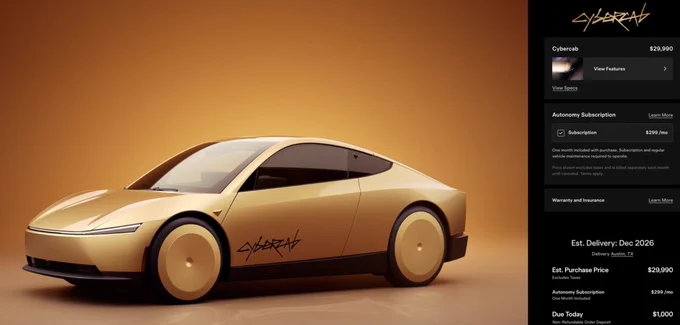
This is what happens when you take a vehicle designed for a fleet and sell it to consumers to hit a deadline. And let’s be honest, charging is probably not even in the top 5 of problems with selling the Cybercab to personal owners in its current state. Musk promised a Cybercab would be sold to a customer for under $30,000 before 2027. Technically, he’s going to make it. But on the Q3 earnings call, he also said “the vast majority” of Cybercabs will stay Tesla-owned and run as transport-as-a-service. The car was clearly engineered around that, and deleting the onboard charger is the best example. That saved Tesla money on every unit. The cost now lands on the few people buying one. If you live in Austin next to a Supercharger, you’ll manage. But think about what Tesla is actually selling here: a self-driving car that can’t drive itself to charge, can’t charge in your garage, and needs you sitting in it at a Supercharger. That’s worse than owning a Model 3 with a Wall Connector, and it costs $299 a month on top. The fix exists in Tesla’s labs. It has the pad, the patents, and the FCC approval. It needs to ship it as a product, ideally bundled with the car, or change the contract to let the Cybercab go charge on its own. Will the first Cybercab owners get a wireless pad in December, or will they spend their evenings at Superchargers? And if it launches, how much will it cost? The rare few home wireless chargers that have been sold to date have been quite expensive, and the value proposition of the Cybercab, which is currently basically a $300 a month lease with a $30,000 down payment, is already pretty awful.

Tesla needs wireless charging fast, or its $30,000 Cybercab can't charge at home electrek.co/2026/11/17/tesla… by @fredlambert