
 Open web. Clear feed.

Web3 Gamblor - Here to see if magic internet money really exist - DMs open
Your wallet activity can mean more than a list of transactions. @zerufinance uses zScore to evaluate wallet behaviour and participation across onchain activity. For users active across different DeFi protocols, this creates a way to measure more than just transaction volume. Previous activity can influence your starting position in Zaps, while qualifying trades and campaign participation give you further opportunities to earn. I find the connection between past activity and continued participation particularly useful. You don't have to build your onchain history from scratch every time you join a new opportunity. But maintaining that progress still requires meaningful activity. Simply generating transactions isn't the same as qualifying participation. The goal is to make your onchain behaviour count beyond individual protocols.

Not every connected phone contributes the same amount of computing power, and @Acurast takes that into account when calculating rewards. When a device joins as a Processor, its hardware is benchmarked across three areas: → CPU performance → Memory → Storage These results help determine its share of base ACU rewards. But hardware is only part of the equation. Processors also send regular heartbeats to confirm they're online. When a device handles an assigned workload, its reward weight can increase during that period. This means two phones with identical uptime may still receive different rewards because their hardware capabilities and actual contributions differ. Another useful detail: base rewards don't require staking. Staking ACU and committing compute are separate options for earning additional rewards. I find this model interesting because it considers more than simply connecting devices. Hardware quality, availability, and completed workloads all play a role. If you have an unused phone, it could potentially contribute computing resources instead of sitting idle. Join through my invite link, install Processor Lite on Android or iOS, and connect through the Hub. Which device would you choose to put to work first?

Turning market information into actual trading activity is an interesting direction for AI in crypto. @zerufinance is exploring this through its ZeruAI campaign on Zaps, connecting content users already follow on X and YouTube with automated trading. The campaign also introduces a measurable competition: verified onchain trading activity determines leaderboard positions, with a $50,000 reward pool shared among 1,000 participants. I see three connected parts here: → Information from content creators and market sources. → Execution through AI-powered trading. → Onchain activity that can be verified and ranked. The important distinction is that watching market analysis and acting on it are two very different things. This campaign brings those stages closer together and gives participants a way to measure their activity. Still, automation doesn't guarantee profitable trades. Strategy, execution quality, and risk management remain essential. The bigger question is how effectively AI can turn the information people consume every day into decisions that can be reviewed through real onchain activity.

Memecoin inspiration doesn't always have to come from the internet. Sometimes it starts with something completely unexpected in everyday life. @onlystreetsfun is exploring this idea by connecting real-world discoveries with Solana's onchain culture. The video gives two fun examples: coffee foam with a face becoming $FOAMFACE, and a naturally shaped rock inspiring $STONK. What matters is how these ideas are created. Users discover something in the physical world, capture it through the OnlyStreets app, and give it a name and ticker before turning it into a coin. This brings a different creative element to memecoin launches. Instead of competing to remix the same viral pictures, people get to bring their own discoveries to the community. It also makes the creator experience more accessible. You don't need advanced editing skills or a professional meme setup. You just need to notice something worth sharing. The real test will be which discoveries connect with the community, but the idea gives Solana meme culture a fresh source of inspiration. Sometimes creativity starts with simply looking around.

People often focus on how much computing power a DePIN network can provide, but there's another question worth asking: how can users trust the devices supplying it? @Acurast addresses this through hardware-backed device verification, helping establish confidence in the devices participating in its decentralized cloud. I also like that participation doesn't have to mean giving up your everyday phone for dedicated computing. Processor Lite supports regular device usage, while Processor Core is designed for dedicated Android hardware. This creates two different paths for contributing resources, depending on how much of your device you're willing to commit. For anyone considering joining, understanding device compatibility, setup requirements, and the security model should come before chasing rewards. A strong decentralized network needs more than available hardware. It needs participants who understand what they're connecting and developers who can rely on the infrastructure.

More time means more opportunities for creators to make their contributions count. @onlystreetsfun campaign has officially been extended until Friday. Building during a red market comes with challenges, but continuing to improve the product and create opportunities for the community matters even when market conditions are uncertain. Rarelist is continuing to work on its platform and creator experience while preparing for upcoming campaigns. At the same time, OnlyStreets is bringing a different concept to Solana by turning real-life moments into onchain coins through original photos captured inside its app. This extension gives creators extra time to explore the project, produce original content, and contribute to the campaign. The market may be unpredictable, but there's still room to keep building and creating together.

The @onlystreetsfun campaign on Rarelistio has been extended until Friday, giving the community more time to participate. Market conditions can make new launches challenging, but OnlyStreets is taking a different approach to meme creation on Solana. Every coin starts with a real-life photo captured directly through the app. No gallery uploads, no recycled images. The idea is to bring original street moments into onchain culture. There also a $1,000 USDT prize pool, with the top 200 participants sharing the token supply. If you haven't joined yet, there's still time to get involved before the extended deadline. Campaign: rarelist.io/r/0xdoha The streets are still cooking.

The zETH Miner race has officially ended, and the first Activity Market from @zerufinance has moved into its public auction phase on Uniswap CCA. What makes this launch different is how the supply was determined. Eligible community activity shaped the final supply, with no team or developer token allocation. The auction runs for 120 hours, including a 96-hour public bidding window after the Miners' phase. The process separates two important things: community activity determines how much zETH is available, while the auction lets market participants discover its price. Now the focus shifts from earning Miner rights to actual market demand. It will be interesting to see how buyers value the supply created through this activity-based model.

A profitable trading system is useful, but a system that can explain its mistakes gives traders something more valuable: a way to learn from each decision. @FensoryApp is moving toward this with agents that can explain the market conditions behind their trade suggestions, rather than simply reporting an execution. For example, if a BTC breakout trade closes at a loss, the agent could break down what changed: momentum weakened, the breakout failed, and the conditions supporting the entry were no longer there. It could then suggest reviewing the confirmation rules for future setups. The Alpha Vantage integration adds another market data source to the agent's workflow, giving it more information to work with. What matters here is the feedback loop: - Understand why a trade was entered. - Review what caused the outcome. - Identify which conditions may need adjustment. - Evaluate the next decision with that context. This doesn't make the agent infallible or remove trading risk. Its analysis still needs human scrutiny. But automated trading becomes much more useful when users can inspect the reasoning, challenge the conclusions, and improve their own understanding instead of blindly trusting a black box.

Every good campaign deserves a strong finish, and today is the final day for @onlystreetsfun . The project brings a fresh idea to Solana: turning real-life moments into coins that people can discover, share, and build communities around. What I appreciate is the focus on everyday creativity. You don't need to create a viral meme from scratch; sometimes a moment happening right in front of you is enough to start something. If you've been following the campaign or planning to participate, this is your last chance to give it one final push.

Stablecoins can do more than sit in a wallet. They can also become liquidity that borrowers use. @rntprotocol brings this idea to Polygon through RNT Lend, where users can deposit USDT0 and USDC into lending pools and earn variable interest based on borrowing demand. The part worth understanding is how interest builds: → APY changes with pool utilisation. → Interest accrues with every Polygon block, roughly every few seconds. → Earnings accumulate onchain instead of waiting for a daily payout. This gives depositors a way to follow their lending earnings as they build, while rates respond to activity in each pool. It's a straightforward DeFi use case, but remember that variable APY isn't guaranteed, and lending always comes with smart contract and protocol risks. Explore: lend.rnt.finance

Everyday places are constantly changing. A new mural, a shop that suddenly disappears, or a random moment that becomes part of local memory. @onlystreetsfun is exploring a way to turn those real-world discoveries into something people can share on Solana. Capture a moment through the app, give it a name and ticker, and launch it as a coin. What I find valuable about the concept is the connection between physical places and digital communities. A moment that might otherwise be forgotten can become something others discover, discuss, and remember. It gives people a different reason to pay attention to their surroundings. Sometimes, the next interesting internet story isn't created online; it starts right outside.

A simple camera rule can make a real difference in how a memecoin starts. @onlystreetsfun requires every coin to begin with a photo captured directly inside its app. That means users can't take an old viral image or something already circulating online and turn it into a new launch. It doesn't guarantee that every coin will be valuable or successful, but it creates a clear standard for how something gets launched: the moment must be captured firsthand. I think this gives the platform a distinct identity. Discovery happens in the real world first, and the community decides what deserves attention afterward. One more thing: the Rarelist campaign is in its final hours. If you've been planning to check it out, today is the last day.

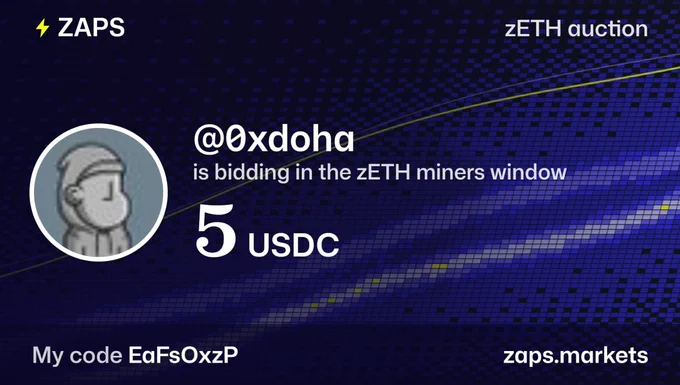
My first bid is in 5USDC on the zETH auction through @zerufinance . The miners-only window is now live, and I wanted to take part firsthand rather than just watch the launch unfold. What makes this auction different is how participants earned early access. Verified Ethereum activity determined Miner eligibility, giving qualified contributors the first 24 hours before public bidding. But early access doesn't mean free tokens. Miners still need to bid with USDC, choose their budget, and set the maximum price they're willing to pay. The auction executes purchases within those limits. A few important dates and mechanics: • Public bidding opens November 17 at 14:00 UTC. • The auction closes November 21 at 14:00 UTC. • Unsold zETH supply will be burned. • Unspent USDC can be claimed back. Qualifying purchases can also earn Zaps after settlement. I'm interested to see whether this has any impact on my current ×1.1 creator multiplier, though there's no guaranteed upgrade. I'll be tracking the results after settlement. For now, this is my first step into an ActivityFi auction. Explore the auction:zaps.markets/markets/zeth?re… I may earn referral rewards from qualifying purchases through this link. Review the auction mechanics, Ethereum gas fees, and token risks before bidding.
Your smartphone could become part of something much bigger than a personal device. @Acurast is building a decentralized compute network that turns everyday phones into resources for running applications and AI workloads. There are two ways to participate: • Processor Lite lets you contribute using your regular compatible smartphone. • Processor Core allows you to dedicate an unused Android device to the network. Security is another important part of the design. Acurast uses Trusted Execution Environments (TEE) and device attestation to protect workloads and verify trusted hardware environments. The ecosystem is also exploring autonomous computing through x402, allowing AI agents to access compute and make payments using USDC on Base. Meanwhile, the Cloud Rebellion gives participants another way to engage through the Hub app, processor activity, daily streaks, and points. With more than 350,000 phones onboarded, Acurast is demonstrating how existing mobile hardware can contribute to decentralized infrastructure. The interesting challenge ahead is turning that distributed capacity into consistent demand from developers and autonomous applications. Computing power doesn't always need to come from another data center. Sometimes, it is already sitting in someone's pocket.

