
⟳ Alexander Schäfer retweeted
2023 was the warmest year since global records began in 1850 by a wide margin. The 10 warmest years in the historical record have all occurred in the past decade (2014-2023).


Former neuro scientist @maxplanckpress and @NUSingapore. Now data scientist @Cape_Analytics
2023 was the warmest year since global records began in 1850 by a wide margin. The 10 warmest years in the historical record have all occurred in the past decade (2014-2023).

Three of the most terrifying graphs on the internet right now.


Had an insightful conversation with @geoffreyhinton about AI and catastrophic risks. Two thoughts we want to share: (i) It's important that AI scientists reach consensus on risks-similar to climate scientists, who have rough consensus on climate change-to shape good policy. (ii) Do AI models understand the world? We think they do. If we list out and develop a shared view on key technical questions like this, it will help move us toward consensus on risks. I learned a lot speaking with Geoff. Let’s all of us in AI keep having conversations to learn from each other!


New Nature paper provides evidence that science has become less innovative since the 1950s. The authors suggest reversing the trend by: 1. reading widely, 2. focusing less on quantity of papers, & more on research quality, 3. taking year-long sabbaticals. nature.com/articles/s41586-0…


1/9 Paper is out rdcu.be/cNHoL Here's some takeaways including new tidbits (good & bad!) since the preprint & even after the paper was accepted. Large sample sizes are helpful for individual-level prediction. We have known that for quite some time, but the recent...
1/5 Our new preprint doi.org/10.1101/2020.08.10.2… uses meta-learning to boost functional connectivity based prediction of *NEW* phenotypes in small samples. We achieve 100%-400% improvements in many scenarios! @hetong93 @AvramHolmes @anlijuncn @danilobzdok @AvramHolmes @INM7_ISN

Introducing Flamingo 🦩: a generalist visual language model that can rapidly adapt its behaviour given just a handful of examples. Out of the box, it's also capable of rich visual dialog. Read more: dpmd.ai/dm-flamingo 1/


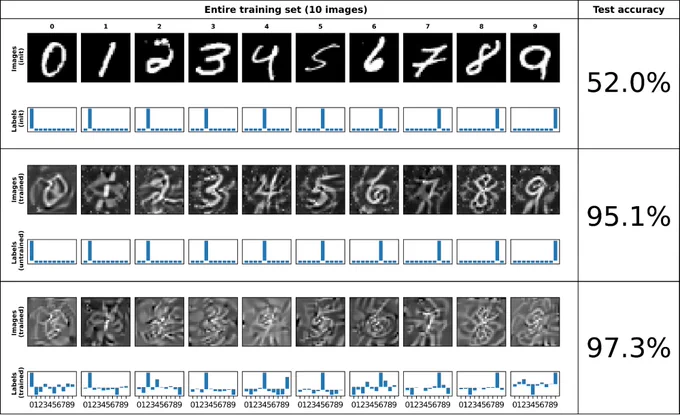
Dataset distillation enables #ML models to be trained using less data and compute. Today we introduce two novel dataset distillation algorithms and release their distilled datasets, which yield state-of-the-art results for image classification. goo.gle/3GKtomH
Today we're releasing three new papers on large language models. This work offers a foundation for our future language research, especially in areas that will have a bearing on how models are evaluated and deployed: dpmd.ai/language-modelling-a… 1/


The ongoing consolidation in AI is incredible. Thread: ➡️ When I started ~decade ago vision, speech, natural language, reinforcement learning, etc. were completely separate; You couldn't read papers across areas - the approaches were completely different, often not even ML based.

#NeurIPS2021 What's a good imputation to predict with missing values? • With powerful learners any imputation works asymptotically • Finite sample: conditional imputation (aka the one people like) is not best option • Better learn imputation openreview.net/forum?id=usxt… 🧵1/6

I am looking for a postdoc with PhD training in neuroscience, machine learning or related field. Topics are quite flexible (sites.google.com/view/yeolab…) and up for discussion. Appreciate RT.
Students are not used to iterative work processes. Please keep in mind when you work with them on their thesis.
After advising PhD & Master students for over a decade, there is one thing I find most students need to unlearn: the half-ass work mentality acquired during years of tests and homework. Let me explain (thread 🧵). 1/N #AcademicTwitter

Glad to see this out in @NatRevNeurosci ! The #default #mode #network in cognition Congrats to @the_mindwanders & @DanielMargulies for leading the effort, plus @leechbrain @BorisBernhardt Beth Jeffries ! nature.com/articles/s41583-0…

Many models bake in domain knowledge to control how input data is processed. This means models must be redesigned to handle new types of data. Introducing the Perceiver, an architecture that works on many kinds of data - in some cases all at once: dpmd.ai/perceiver (1/)

1/3 Our study on individual-specific areal-level parcellations is out academic.oup.com/cercor/adva… Multi-resolution HCP parcellations & FC matrices found here balsa.wustl.edu/study/show/P… Spearheaded by @rubykong92 @gordonneuro @zuoxinian @Nathan_Spreng @getian107 @AvramHolmes @INM7_ISN


