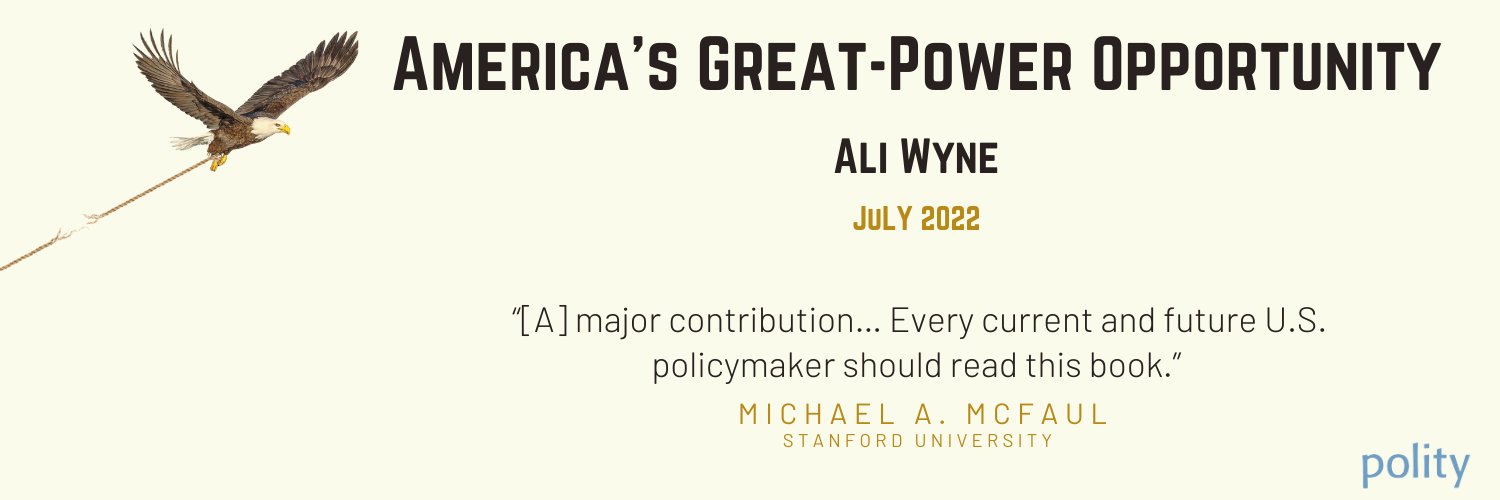
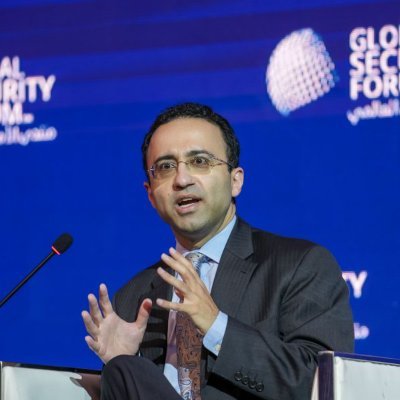
In a piece for @ForeignAffairs’s website, @ryanl_hass and I argue that President Trump’s mishandling of China policy has paradoxically created political space for a new, more durable strategy to emerge.
foreignaffairs.com/united-st…
[1/15]
President Trump considers President Xi a great friend; Xi considers Trump a useful interlocutor.
With Congress and senior members of his administration both putting more pressure on Trump to adopt a tougher approach to China, Xi will have to work harder to keep him on side.
The United States has long hoped to drive a wedge between China and Russia. Tomorrow’s summit will showcase an outcome that would’ve seemed inconceivable even a few years earlier: Washington and Moscow are both trying to curry favor with Beijing.
From @nicoleperlroth’s must-read post: “We are now entirely dependent on software systems that almost nobody understands end to end, that increasingly few people can repair, and that attackers can now probe at machine speed.”
I haven’t lived here in awhile, but I see no other way to answer the hundreds of texts/DMs asking me if the world is, indeed, ending.
In the span of six days, we’ve experienced;
11/12 — Microsoft outage
11/13 — Nationwide FAA ground stop
11/16 — Major US banking disruptions
11/17 — NSA’s classified internal network goes down
We need far more analysis of why so much is breaking at once. I don’t want to get out over my skis here, and what I am hearing does not contradict the messaging that most of this is the result of screwy updates.
But stepping back, the dots are starting to form a collective picture. We are seeing:
• An explosion in severe and critical vulnerabilities, with AI accelerating discovery to 3X the number of vulnerabilities discovered in the same period last year. This is collectively being referred to as “vulnageddon” or “the vulnpocalypse.”
• Mean time to exploit those vulnerabilities has collapsed to NEGATIVE SEVEN DAYS. AI allows attackers to find/exploit vulns far faster than software makers have time to fix them.
• Powerful AI-enabled offensive tools like ARTEX have been thrown into the hands of every third tier nation state, cybercriminal and digital arsonist, which logically creates havoc.
• This creates enormous pressure to compress patching windows and accelerate software updates, increasing the likelihood these fixes break things in unexpected, cascading ways.
• Pressure to just “AI everything” means we are rolling out automated AI tooling on top of brittle infrastructure that can’t support it.
My generation grew up in an extraordinary period of technological stability. We worked our way up the software stack, abstracting away layer after layer, until we lost a fundamental understanding of how the underlying systems actually work.
We were told to “move fast and break things.” VCS told us to celebrate the idea that “software would eat the world.” Now we’re telling ourselves we can simply “roll out AI” across everything, as though nothing underneath will buckle.
We never stopped to ask: SHOULD WE?
Should we be digitizing every last nook and cranny of our companies, infrastructure, healthcare, homes, cars, bodies, lives? Especially when the complexity, interdependence, and fragility we were introducing overwhelmed our ability to understand/secure/maintain the systems we built?
Nobody every asked: What if, in the name of progress, we were creating the ripest attack surface in human history?
We are now entirely dependent on software systems that almost nobody understands end to end, that increasingly few people can repair, and that attackers can now probe at machine speed. We are hearing that incident response firms, the 911 for breach victims, are backlogged six months. Even those paid on retainer lack the bandwidth to triage every incident. The cavalry is disappearing.
We are entering a period of unprecedented technological instability.
“Software Beirut” is an incredibly apt analogy. We are in for a period of cascading failures, whether triggered by attackers, bad updates, or our own accumulated complexity.
This, I’m sorry to say, is just the opening chapter.
Divisions over China policy will likely endure; President Trump’s successor will face a stronger China, greater anxiety among allies and partners over U.S. reliability, and a marked gap between Beltway and public views on managing tensions with Beijing.
nytimes.com/2026/11/16/us/po…
In addition, and perhaps more importantly, the United States, China, and Russia are less capable of carving up territories and otherwise dictating the terms of international order today than the United States, the United Kingdom, and the Soviet Union were in the 1940s.
[3/3]
While Trump, Xi, and Putin will meet against a turbulent backdrop, with the Russia-Ukraine war grinding on and the Middle East seemingly poised for a new round of escalation, Roosevelt, Churchill, and Stalin convened during a world war.
[2/3]
A key source of China’s leverage vis-à-vis the United States is temporal: it can cause major pain across the U.S. economy far faster by curtailing rare-earth exports than the United States can cause pain across the Chinese economy by tightening export controls on high-end chips.
The Jensen Huang scandal significantly strengthens the hand of advisors to President Trump who’ve been pressing him to pursue a more confrontational approach to China, most importantly Secretary Rubio. Whether they can persuade him to recalibrate, though, remains to be seen.
“As House Democrats debate the future of the select committee on China, some in their party are arguing for keeping it around....There’s a bipartisan push to save the committee as members consult House Minority Leader Hakeem Jeffries on its future.”
semafor.com/article/11/12/20…
Ahead of 2028, the new Congress has an opportunity to articulate alternative approaches to China policy that better reflect shifts in both the balance of global power and domestic public opinion.
The House Select Committee could help advance a more nuanced conversation.
Thanks very much for your kind words, @asliaydintasbas.
We’ll need all hands on deck over the coming two years to lay the groundwork for a more sustainable China policy, which will be a core component of a more sustainable foreign policy.
A smart piece by my @BrookingsFP colleague @ryanl_hass and @Ali_Wyne in @ForeignAffairs. It's a challenge to Washington's conventional wisdom on China, arguing for a pragmatic and sustainable relationship, rather than a return to hawkishness.
Exactly the kind of fresh thinking the moment calls for.
Post-Trump world is unlikely to be the pre-Trump world.
foreignaffairs.com/united-st…
.@thomaswright08 “Several longstanding debates between and within Democratic factions, including on some of the most important issues that the next Democratic president will face, remain unresolved, too. Chief among them is China.”
foreignaffairs.com/united-st…
“Trump sees Xi less as a determined geopolitical foe than as a transactional business rival with whom he can negotiate to stabilize bilateral ties,” write @Ali_Wyne and @ryanl_hass.
foreignaffairs.com/united-st…