←
Brun Lab4,570 posts
Brun Lab avatar

Brun Lab

@BrunLabCaulo

Yves Brun's lab, Canada 150 Research Chair in Bacterial Cell Biology. Bacteria and cool stuff they do and let us observe. @BrunlabCaulo@mstdn.science

◷ Joined October 2013▧ 1,059 Photos and videos
Dominique Beaini avatar
⟳ Brun Lab retweeted
Dominique Beaini@dom_beaini·6 Feb 2025

We're currently looking for a PostDoc position at @UMontreal and @Mila_Quebec to work on a multi-modal bacteria representation for anti-biotic discovery, including multiple modalities: - Phenomics - Transcriptiomics - Structural bio - Viability curves - ADME The work will be done alongside biologists from brunlab.com DM me for more info

Brun Lab avatar
Brun Lab@BrunLabCaulo·11 Feb 2025

Please repost: Postdoc position in AI for drug discovery in a large collaboration with Dominique Beaini, Audrey Durand, Alex Hernández-García, Anne Marinier @UMontreal @med_umontreal @IRIC_umontreal @Mila_Quebec. linkedin.com/feed/update/urn…

Brun Lab avatar
Brun Lab@BrunLabCaulo·19 Nov 2024

Excited to present our resent progress on our antibiotic discovery pipeline at the @bioMerieuxCA AMR Symposium in Toronto Nov. 20th at 11:30 AM.

Post attachment
Brun Lab avatar
Brun Lab@BrunLabCaulo·13 Nov 2024

2 days left. Asst/Assoc Prof position in bacteriology, Université de Montréal. Deadline ***Nov. 15*** come join our growing community of bacteriologists. BTW, à propos of nothing, Canada is the USA’s Bluesky!

Please RT: Nov. 15 deadline! We are building a strong bacteriology community @UMontreal @med_umontreal, including recent hires @S_vanTeeffelen @FredoLeRoux & myself. Moving to Montréal in 2018 is one of the best career decisions I made. Come join us! jobs.sciencecareers.org/job/…

Brun Lab avatar
Brun Lab@BrunLabCaulo·12 Nov 2024

Expanding our analysis, we find a distribution of elongation modes, suggesting their evolution is shaped by multiple, independent events, implying a high degree of phenotypic plasticity in the regulation of localized elongation modes. How does your favorite species elongate?

Post attachment
Brun Lab avatar
Brun Lab@BrunLabCaulo·12 Nov 2024

Not only do these three closely related species have different modes of cell elongation but they also have different morphologies. Could the elongation mechanisms in these species influence their morphology or vice versa?

Post attachment
Brun Lab avatar
Brun Lab@BrunLabCaulo·12 Nov 2024

Strikingly, we find that another closely related species, Asticcacaulis biprosthecum elongates from the new pole in addition to elongating unidirectionally from the midcell like A. excentricus.

Post attachment
Brun Lab avatar
Brun Lab@BrunLabCaulo·12 Nov 2024

Comparing FDAA dual pulse labeling without and with mecillinam shows that PBP2 is also required for the directionality (towards the new pole) of PG synthesis.

Post attachment
Brun Lab avatar
Brun Lab@BrunLabCaulo·12 Nov 2024

When we inhibit A. excentricus PBP2 with mecillinam, cells lose elongation control and bulge on the new pole side of the midcell, indicating that PBP2 is indeed required for unidirectional midcell elongation.

Post attachment
Brun Lab avatar
Brun Lab@BrunLabCaulo·12 Nov 2024

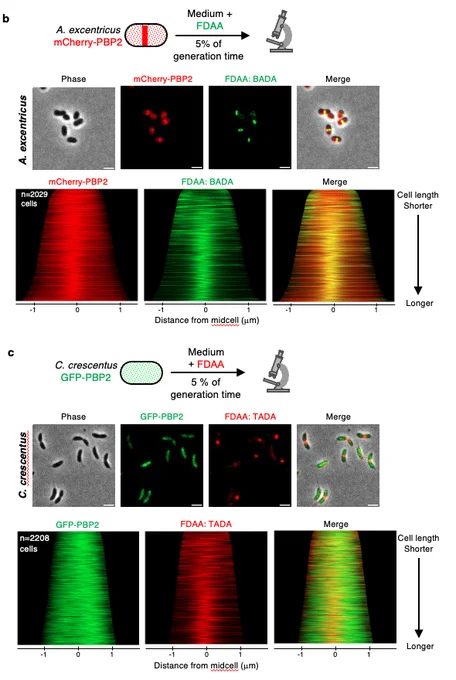
In A. excentricus, the PG transpeptidase PBP2 localizes at midcell during midcell elongation, contrasting with its dispersed pattern in C. crescentus. This spatial organization appears crucial for directing elongation patterns.

Post attachment
Brun Lab avatar
Brun Lab@BrunLabCaulo·12 Nov 2024

The dual pulse result is quite different for A. excentricus, with the first FDAA on the new pole side of the second, indicating unidirectional midcell elongation towards the new pole.

Post attachment