New work from our lab showing the human frontal lobe receives fast, low-level speech information in parallel with early speech areas! doi.org/10.1038/s41467-025-6…

Chang Lab at UCSF, human brain, speech, brain-computer-interfaces, neurosurgery

New work from our lab showing the human frontal lobe receives fast, low-level speech information in parallel with early speech areas! doi.org/10.1038/s41467-025-6…

For more than a century, scientists thought that Broca's area coordinates the muscle movements required to speak. But new @UCSF research from @ChangLabUCSF identifies the key role that the middle precentral gyrus (mPrCG) plays in this process. @jessierliu l8r.it/ua64

This work wouldn’t have been possible without our two amazing participants, Bravo-1 and Bravo-3, their family and caregivers, and the support of our team!

Rather than coding specific vocal-tract movements during attempted speech, activity at these shared electrodes could be decoded into words prior to attempted speech, supporting the emerging role of the middle precentral gyrus in speech-motor planning.

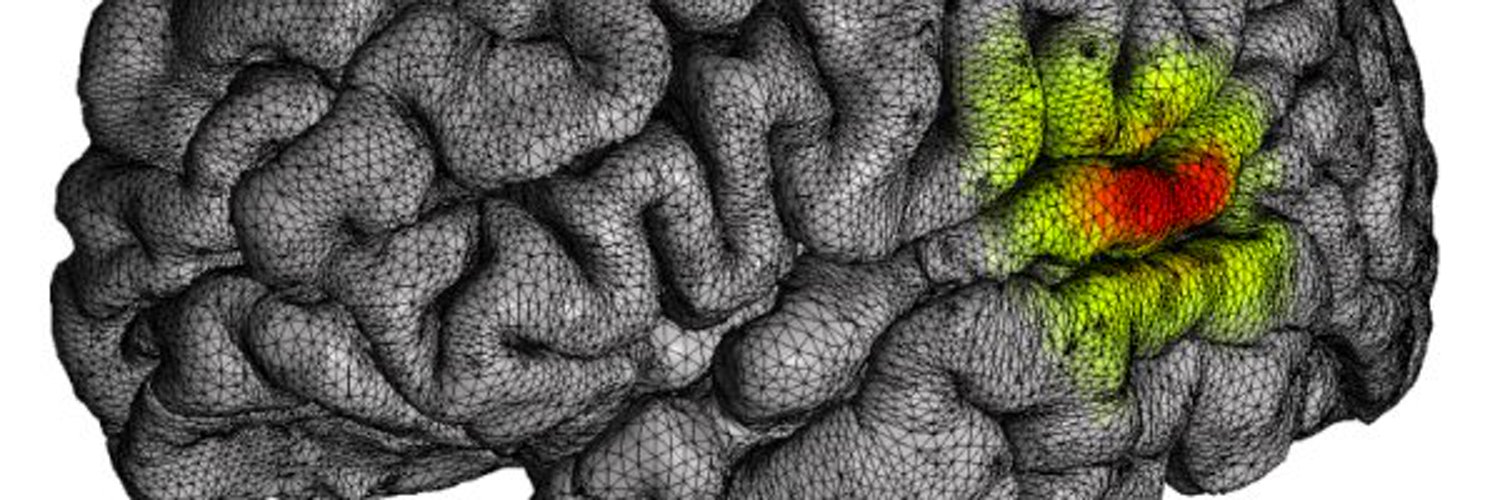
We found that electrodes with activity during all three functions (attempted speech, listening, reading) were typically in a specific part of the SMC called the middle precentral gyrus.

Specificity to attempted speech was achieved by incorporating listening and reading data into training of the speech detection model and adding a dedicated speech verification model.

In two people with severe paralysis and anarthria, we designed a speech decoding system that maintained accuracy and complete specificity (zero false positives) to volitional speech attempts over 63.2 minutes of reading, listening, and internal thought.

Developing decoders that are highly specific to volitional speech attempts, without false activations, is highly desired by potential users. Our participants indicated they largely preferred a highly specific system, even at the expense of speed.

Speech decoders are trained to decode intended speech from neural activity, oftentimes from the sensorimotor cortex (SMC). However, the SMC (and other areas) can also be involved in other common tasks like listening and reading, and could unintentionally activate a decoder.

Check out our latest work developing speech decoding systems that maintain their specificity to volitional speech attempts, co-led by @asilvaalex1 and @jessierliu iopscience.iop.org/article/1…

Our latest research on the neural basis of speech-motor sequencing is now published in @NatureHumBehav! Check out this high-level explainer video and read the full paper here: nature.com/articles/s41562-0…
New in @NatureHumBehav, @jessierliu, Lingyun Zhao, PhD & @ChangLabUCSF show that the middle precentral gyrus coordinates the muscle movements required to speak, challenging the longstanding view that Broca's area controls this process: nature.com/articles/s41562-0…

Our latest work on the neural mechanism for stopping speech production is published! See a brief summary below and the original paper linked to the post at the bottom.
In natural conversations, people can stop speaking at any time. How? Using high-density electrocorticography, Zhao et al. find a distinct neural signal in the human premotor cortex that inhibits speech output to achieve abrupt stopping. @ChangLabUcsf nature.com/articles/s41562-0…

Our models also showed stable performance without retraining for ~2 months and these results were achieved ~4 years after ECoG implantation. We hope these findings can be scaled to more patients in the near future!

We leveraged this finding to demonstrate transfer learning across languages. Data collected in a first language could significantly expedite training a decoder in the second language, saving time and effort for the user.

Cortical activity instead represented the intended vocal-tract movements of the participant, irrespective of the language. This allowed us to train a model that generalized across a shared set of English and Spanish syllables.

Despite learning English later in life, we found that cortical activity was largely shared across languages, with no clear differences in magnitude or language-selective neural populations.