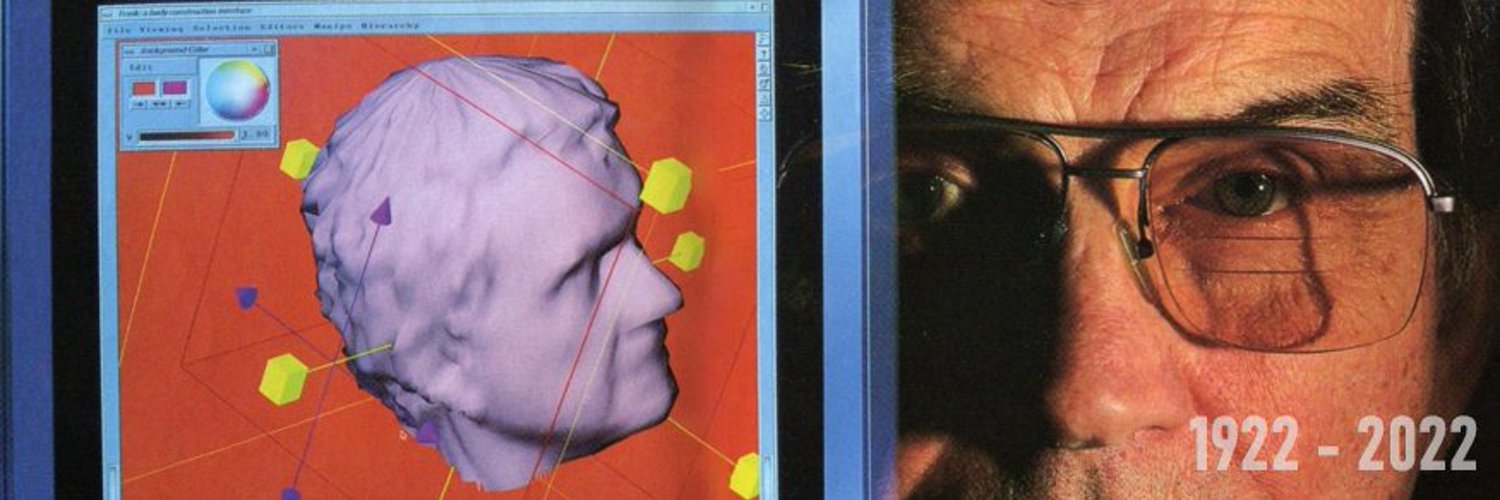
A nugget from the Csuri home…
In 1985, Chuck Jones, the animator and director best known for Bugs Bunny and the Road Runner, came to dinner at Chuck and Lee Csuri’s. My favourite part is that he drew Bugs for Caroline’s brother Steven right there on the tablecloth.
Csuri’s work at Ohio State was finding its way into all sorts of places, particularly commercial animation. Even Frank Thomas and Ollie Johnston, two of the animators behind Bambi and The Jungle Book, came to Ohio State to talk shop. They’d spent their careers working with pencil and paper, and here was Csuri’s team making characters move with code at a time when that was still a very new idea.
A Journey to Somewhere
by @cathcomputerart
Charles Csuri (1922-2022) was in at the birth of what became an entire movement. One of the earliest pioneers of digital art, over a career of nearly sixty years of innovations, he became known as the “father of computer art and animation”.
In the early-1960s, at a time when computers were rare, complex machines that required specialist expertise to operate, Csuri formulated a way to exploit the inherent qualities of digital technology, making art on equipment that was not originally designed for artistic purposes.
His unique style evolved within the tradition of modernism, guided by a visionary proficiency that combined his traditional fine art aesthetic with digital systems. In dialogue with the machine, Csuri expanded imagination and expression, creating possibilities for new kinds of forms, not seen before in art.
Thanks to the handful of artists of Csuri’s generation, the digital art movement gained a foothold in the artworld, inspiring subsequent generations and forging the field we now see.
It is clear from the Ordo series that Csuri trained as a traditional artist, indeed spent twenty years drawing and painting, before turning to the computer. His knowledge and respect for art history informed his style.
Studies of the work of Paul Cézanne broadened his understanding of colour, light and geometry in composition. Via the digital, Csuri was able to take Cézanne’s discarding of one-point perspective even further, by creating a three-dimensional space for his forms to float within the picture plane.
Searching for a visual structure, inventing challenges for himself, Csuri spoke about his attempts to break free of the logic, the carefully measured digital space where there is a predicable outcome, and move toward a process of discovery. Like Pablo Picasso, he aimed to embrace a future of curiosity and wonder.
The Ordo series of generative artworks combine glorious colour with painterly, ribbon-like forms. Using his own code, the artist created a special tool to make these smooth three-dimensional forms, first seen in his art in the 1990s and refined throughout the 2000s. Subtle variations in these layered structures combine with vibrant colours that pop with a feeling of intense activity and movement through interconnected lines and shapes.
Ordo also shows Csuri’s skill in exploiting the computer’s ability to light up each pixel individually and potentially display billions of strong colours. The viewer becomes a witness to the artist’s brushstrokes, a record of the artist’s hand, via code, as it moves through time and space. A celebration of the complexity and seemingly boundless depth of three-dimensional space.
At Ohio State University, using a cutting edge, real-time system from technology developed at the NASA space programme, Csuri became a crucial part of the foundation of modern computer graphics.
He recognised very early on the importance that this tech was having not only upon the types of art produced, but also upon the changing attitudes of art itself and its place within society. His work marks the beginning of a whole new genre, one that would expand the boundaries of art and as such human expression and communication in an age of increasing digitality.
Csuri had to take a leap of faith. Could this new tool be used creatively? He asked, “Where is the sense of place and fun in this universe of linear logic?” He found this freedom and fun in the software environment that he shaped over a long career.
Recognising that the art object could become many statements about the same thing, his code reflected his approach which allowed for numerous solutions to a problem. The Ordo series demonstrates well this process of iteration, which the computer facilitates, allowing the artist to explore innovations and express multiple ideas, by producing several outputs from one set of rules.
Csuri shows us a world of dynamic space, geometry, colour and light. Twentieth century modernism is redefined in an exciting and vital way.
Catherine Mason
21 September 2026
@cathcomputerarthistory has been recovering the history of computer and digital art since 2002 when she joined a research group at Birkbeck, University of London.
Her first book A Computer in the Art Room: the Origins of British Computer Arts 1950-1980 (JJG: 2008 & ebook 2021), is the first comprehensive account of the history of British computer art.
Over a long career she has worked in commercial galleries and public-sector arts organisations, adult education and exhibition curation. Today her main focus is research and writing; her latest book Creative Simulations (Springer 2024), tells the story of the early history of CAS, through George Mallen, one of the founders. She is a Visiting Research and Knowledge Exchange Fellow in the School of Computing at Goldsmiths, University of London.
catherinemason.co.uk/
2/ After the war, Csuri returned to Ohio State, where he trained as a painter and sculptor before becoming an art professor at 30.
He taught alongside Roy Lichtenstein, who became a close friend and, later, the best man at his wedding.
CHARLES CSURI | ORDO
This October, from @solos_gallery
A few months ago, @RagnarDigital introduced me to Caroline Csuri, digital artist and daughter of Charles Csuri - a connection I'm endlessly grateful for.
Over several conversations, Caroline shared her father's story in a way no catalogue or textbook ever could. This is what I learned.
🪡
Charles Csuri | Ordo
We are thrilled to announce Ordo - a defining series by Charles Csuri; one of the most influential figures in the history of computer art.
NB finds these incredible gems. This footage from 1969. @CharlesCsuri being the last works featured in this clip: a series titled Sine Curve Man (Sineman), created on an IBM 7094 from 1966-67.
Wonderful to be collaborating with Verse to bring this 3D generative series native to Chucks computer to the Web3 community to live permanently on the blockchain. His spirit lives through art!💙Caroline
1967: "But @CharlesCsuri has plans to go far beyond the drawn lines which he now gets from a computer… Now, he says, Shaffer has solved the programming problems to work with a computer-controlling milling machine to cut plastic or metal into sculpture."