
 Open web. Clear feed.

Protecting teams from AI-native social engineering attacks. Built by @Quantstamp.

BREAKING: BBC has developed a secret emergency broadcasting plan to keep the UK informed if a major blackout or cyberattack shuts down electricity, internet and communication networks. Around 100 BBC staff will operate a special emergency radio studio with independent power, food, water and fuel supplies to keep broadcasts running for at least three days. The plan relies on FM radio, which can continue operating even when internet and mobile networks go down. The UK is also preparing for a potential nationwide crisis, with officials urging the country to be ready to withstand a major disruption for at least 72 hours.
CEO-spoofing scammers used AI to steal more than $100 million. The scammers, Hazan, Sheetrit, and Soall, are facing up to 104 years in prison on multiple charges of money laundering, aggravated identity theft, wire fraud and more.

We had a great week at @summit_defi and @EFDevcon in Mumbai! ICYMI: > at DeFi Security Summit, @jonnymevs spoke on agentic formal verification > at the Security Hub with @thedaofund, @TrainTestToad showed how to audit @Polymarket V2 by tracing where the collateral goes


Congratulations to the @Quantstamp team! And thank you to @AIBC_World for hosting the amazing event!
Quantstamp has been named Best Cybersecurity Platform at the @AIBC_World Rome Awards! Thank you to everyone in the community who took the time to vote for us. It means a lot coming from the builders we work with every day. 🫶

The Common Defense team is at @HongKongFinTech Week! 🇭🇰 Come meet us at Booth 5BC-SU63 in Hall B on Nov 2–3. Hope to see you there!


We’ve been scamming the scammers. For months, our honeypot agents have been sitting on Telegram posing as easy targets. So far they’ve: - identified 1,000+ scammers - collected 2,100+ scam wallets and payment accounts - wasted 15+ hours of scammers' time Every hour a scammer spends on our agents is an hour they aren’t spending on a real person. And every wallet and link they hand over goes into the data we use to protect our users. You can see the live numbers here: scambait.commondefense.ai/

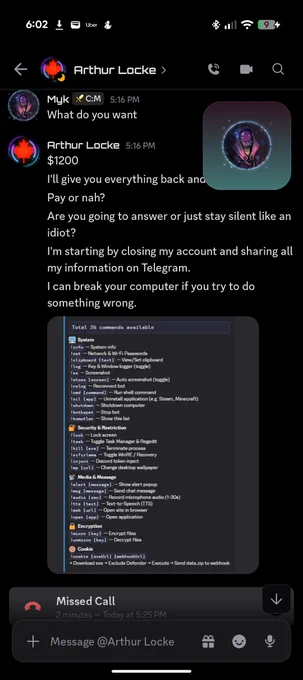
A developer lost access to three client servers. What happened was a hacker impersonated a Discord friend, copied his writing style, and sent a malicious link to the developer who thought it was a shared build.
I legit thought it was a friend I haven't talked to for a while, talked the same way as him and the pattern of speech was exactly like his before I was handed a link that automatically installed malware, and this happened. While he was extorting me, I went to my phone-

An employee at a US fintech entered their password into a fake Evite phishing link. The email looked legitimate and came from a real Google Workspace domain.
A fake Evite RSVP card reached an employee at a US fintech lender with the recipients hidden in Bcc. Thirteen anchors, and every one of them pointed to the same path on a throwaway domain. That includes the exits a careful reader goes looking for: Privacy Policy, Event Notification Settings, Block this Host, Do Not Sell My Info, even the postal address line. The platform's link inventory then deduplicated all 13 into a single record labelled View & RSVP, so a reviewer scanning the list never saw the hostile footer. SPF, DKIM, DMARC and ARC all passed, because a real Google Workspace mailbox at an unrelated small business sent it. We do not know why, and we are not accusing that business of anything. A human analyst resolved the incident as malicious. We never captured what the landing page served, so we are not describing it. On a lookalike notification there is no safe place to click. Open the platform directly and check whether the event exists. (Link to full teardown in comments)
The photos only told half the story, so in case you missed it, here's our recap video from Singapore Sips 🫶 One more big thank you to @CommonDefenseAI, @HypernativeLabs, @LukkaInc, and @Cloudflare for co-hosting our @token2049 evening with us.

SCOOP: Major U.S. banks are detecting unauthorized third-party AI agents inside customer accounts, including some attempting to take actions that appear to be independent of user instructions, sources told Axios. The findings have alarmed banking executives, who are racing to restrict access to their systems as AI moves at a velocity faster than financial institutions can respond, multiple industry and bank executives told Axios. Several banks are now preparing for worst-case and even “day after” scenarios, including how to rapidly secure or restore customer accounts if things go wrong, the people said. Several bank executives told Axios they're struggling to distinguish between human users and AI agents. One executive said banks also struggle to determine whether agents are authorized by customers or potentially operating without their permission, more akin to rogue agent behavior. Read my latest for Axios here: axios.com/2026/10/22/ai-agen…


This is a really targeted phishing campaign. The scammers used the actual project name and a realistic migration deadline so it reads like an internal ops message instead of a random phish.
if you want to know the type of stuff we're dealing with here's an example the link is a planetscale oauth flow set to send credentials to an attacker we're seeing hundreds of completely different attempts every day


Railway is compromised. Immediately: - Roll/rotate all environment variables stored in Railway (especially API keys). - Rotate any private registry credentials. - Review logs of the related services for unusual activity.
An urgent notice from the Railway team blog.railway.com/p/security-…


