Product builder vs forward deployed engineer vs forward deployed PM: who builds what?
Aakash Gupta (@aakashg0), host of The Growth Podcast and a product management coach, former VP of Product at Apollo.io, and author of the Product Growth newsletter, uses Salesforce to explain.
Product builders build the core product, like Claudeforce, for every customer. Forward deployed engineers and PMs sit with one customer and customize it.
On Ctrl Alt Podcast with Vida Patil (@Vidyangi520)
So does the AI-patch story hold up? Only in places. The strongest case is the NSA:
DNI Jay Clayton reportedly tied the classified network outage to a patch for recently discovered flaws, though the agency’s own statement mentions only “scheduled routine maintenance.”
Chase is a maybe. Bank executives reportedly told Congress that rushed fixes for AI-found flaws were to blame, but Chase itself has cited only a software bug. Two of the biggest outages don’t fit at all. Microsoft’s faulty update went out in July, months before this rush, and the company says the outage wasn’t cyber or AI related.
The FAA’s ground stop came from a physical router install, and its administrator reportedly said there was zero evidence of anything AI-related. For Apple, United and Workday, we don’t know yet.
The honest read: pressure to patch AI-found flaws may explain some of these failures, but it isn’t the thread that ties them all together.
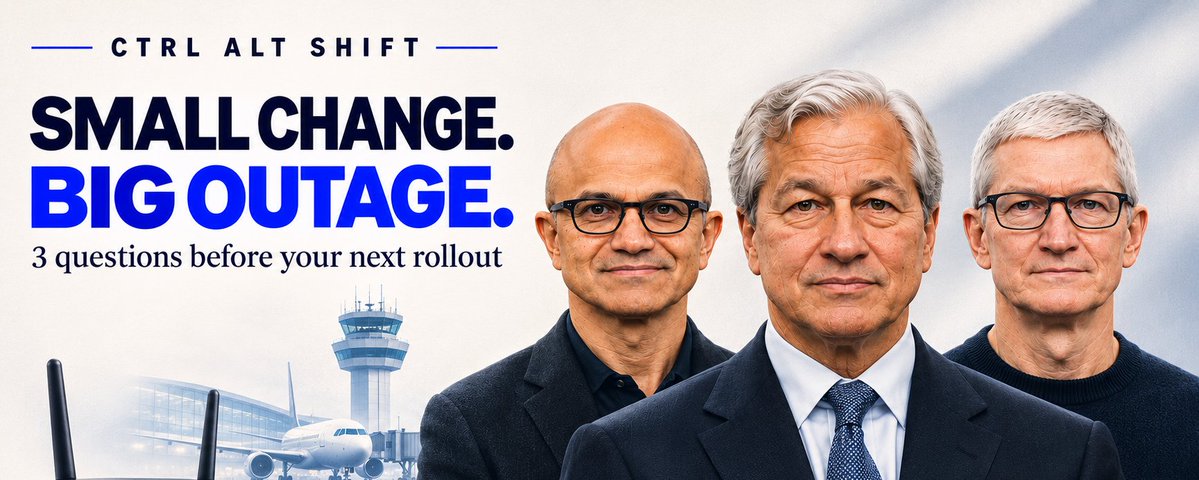
Seven outages. Six days. Zero hackers found.
Flights grounded. Outlook dark. Bank transfers crawling. The NSA's own classified network offline.
And every organization that named a cause pointed at itself
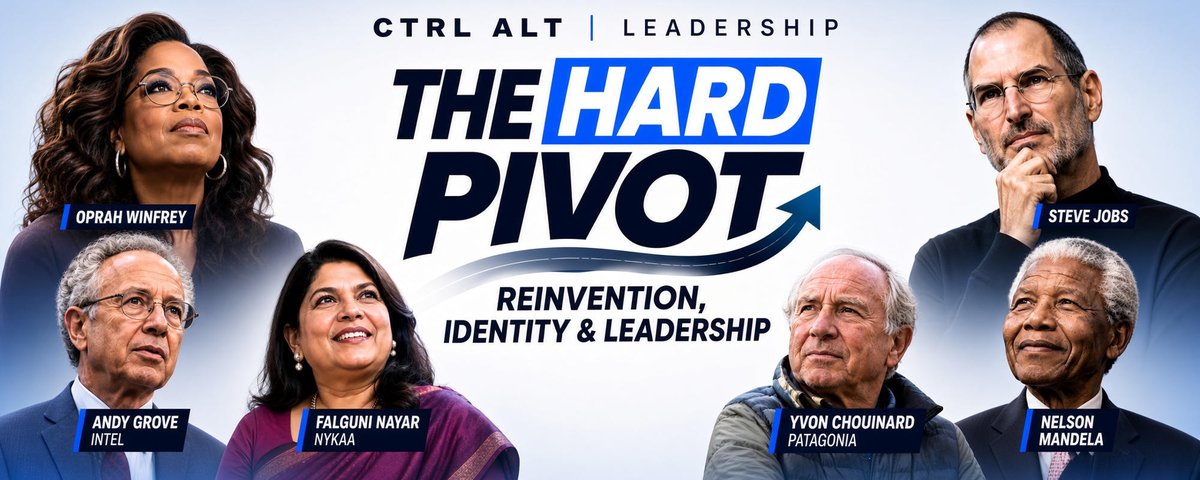
A company can lose its CEO overnight.
Losing an identity can take years to recover from. The greatest pivots of our time were not about business. They were about identity. The hardest pivot is inward
“When you deploy AI agents, and you actually point them to the right data and knowledge that they need to do their work, they still come and act more like Day 1 employees,” Jain told the editor-in-chief of The Verge, Nilay Patel, at Semafor’s Silicon Valley & The World.
A year ago, in my conversation with @jainarvind founder CEO @glean , he had mentioned that every enterprise will tend to go AI-native and it is important to train employees to get comfortable with AI.
Since this interview Glean has come a long way.
Fast Company's World's Most Innovative Companies (2025): Ranked #1 in the Applied AI category and #6 overall.
Forbes Cloud 100: Named to the list of the world's top private cloud and AI companies.
Forbes AI 50: Recognized on the annual list of top artificial intelligence companies.
CNBC Disruptor 50 (2025 & 2026): Featured for its transition into "Work AI" and multi-step agentic automation.
Gartner Emerging Market Quadrant (2025): Named an Emerging Leader in Generative AI Knowledge Management Apps and General Productivity.
Bloomberg AI Startup to Watch (2025): Highlighted for its enterprise context graph.
How much does your business really know about its customers?
John Acunto, CEO of @napster , says most companies claim the customer comes first but rarely capture what customers actually ask and want. Using a Grand Prix customer use case, he explains how conversational AI answered routine fan questions, guided buyers to a purchase, and turned conversations into customer insight.
On Ctrl Alt Podcast with Vida Patil, John Acunto walks through a Grand Prix customer use case. In his account, conversational AI answered simple questions like where the elevator is relative to a seat, then took fans from viewing their actual seat to placing it in the cart and completing the purchase. He then turns the lens on every business: if customer obsession is in the mission statement, who is actually taking notes in the store and on the website?
"How much do you think that business really knows about their customer at all?"
WHAT YOU'LL LEARN
0:00 A Grand Prix customer use case
0:13 Freeing staff from very simple questions
0:37 From seeing your seat to completing the purchase
1:01 Does your business really know its customers?
1:19 Who's taking notes in the store and on the website?
KEY INSIGHTS
* Conversational AI for customer service: John Acunto, CEO of Napster, says AI agents can answer routine questions, such as accessibility directions, that would otherwise take up staff time.
* Assisted purchase journey: In the Grand Prix use case John describes, the AI showed fans visuals of their actual seat, added it to the cart and helped the transaction close.
* Results, in John's words: He says the use case "cut hours of staff answering very simple questions" and that the metrics were "unbelievably better." He gave no figures.
* The customer knowledge gap: John argues that companies say customers matter most yet often know little about them.
* Capturing customer conversations: John's question for every business is who is taking notes when customers visit the store or the website.
* Customer-led product building: His takeaway is to learn about your actual customer and build a real product around that.
FAQ
Q: What does John Acunto mean by "who's taking the notes"?
A: He is asking whether a business actually records and learns from customer interactions in its stores and on its website.
Q: What did conversational AI do in the Grand Prix use case?
A: By John's account, it answered simple fan questions and guided customers from viewing their seat to completing a purchase.
Q: What is his advice to businesses?
A: Learn about your actual customer and build a real product around that.
NAPSTER: napster.com/
EPISODE: youtube.com/watch?v=gTHRqSL6…
CLIP: youtube.com/watch?v=DjYTC753…
JOHN ACUNTO: linkedin.com/in/johnacunto
CTRL ALT PODCAST: x.com/CtrlAltpod
VIDA PATIL: x.com/Vidyangi520 | linkedin.com/in/genaivida/
BOUT THE GUEST
John Acunto is the co-founder and CEO of Napster (formerly Infinite Reality), which builds AI agents with voice, video and memory for businesses.
ABOUT THE HOST
Vida Patil is the founder and host of Ctrl Alt Podcast with Vida Patil, where she interviews founders, investors and technology leaders from Silicon Valley.
#CustomerExperience#ConversationalAI#AIAgents#Napster#CtrlAltPodcast
Tags
John Acunto, Napster CEO, Napster, conversational AI, customer experience, AI customer service, AI agents, customer insights, know your customer, Grand Prix use case, ecommerce AI, AI sales assistant, Ctrl Alt Podcast, Vida Patil, AI podcast
@Napster is back. But this time, it's not disrupting music. It's betting on AI agents. Napster CEO JohAcunto, joins @Vidyangi520 on the @Ctraltpod to discuss Napster's transformation from the music-sharing pioneer of 1999 into an enterprise AI company building conversational AI agents and digital customer experiences.
Can Napster disrupt artificial intelligence the way it disrupted music? And can enterprise AI agents really operate for just one cent per minute? We explore Napster's acquisition, its Microsoft Azure strategy, AI agent economics, customer trust, and the leadership decisions behind one of tech's most unexpected reinventions.
🎙️ EPISODE CHAPTERS 00:00 Napster Is Back: From Music to AI
00:40 Meet John Acunto, CEO of Napster
03:25 Why Acquire Napster? The Hard Pivot
06:30 What Is the Napster Phase of AI?
09:40 Napster's AI Concierge at the Belgian Grand Prix
13:10 What Happens When AI Agents Make Mistakes? 1
6:15 Napster vs. Microsoft: What's the Competitive Advantage?
20:00 Can AI Agents Really Cost 1¢ per Minute?
23:50 Building a Sustainable Enterprise AI Business
27:10 AI, Customer Relationships & Human Intelligence
30:00 John Acunto's Contrarian View on AI Agents
💡 KEY TAKEAWAYS & QUESTIONS • Why did Napster pivot from music to enterprise artificial intelligence?
• How does Napster's AI concierge Jack work in real customer experiences? • What differentiates Napster's AI agents from foundation model providers?
• Can low-cost conversational AI become a sustainable business? • Who owns customer relationships when AI agents become the interface? • What can leaders learn from Napster's radical reinvention?
ABOUT THE GUEST John Acunto is CEO of Napster, the iconic technology brand now pursuing enterprise AI agents and AI-powered customer engagement.
ABOUT THE HOST Vida Vidyangi Patil is the founder of Ctrl Alt Productions and host of the Ctrl Alt Podcast, featuring conversations with CEOs, founders, investors, and technology leaders about AI, innovation, business strategy, and leadership.
THE BIG QUESTION The first Napster changed how we consume music. Could the next Napster change how we work?
Would you trust an AI agent to represent your business? Share your thoughts below. #Napster#AIAgents#CtrlAltPodcast -
@napster is reinventing consumer experiences! It's incredible Napster's come back story (after 4 massive pivots in four different industries, the name survives!). Napster CEO John Acunto has many strong POVs on AI agents and what they are capable of in the consumer space. Here is one.
What if the biggest thing we’re giving AI isn’t data but our ability to innovate?
What if the biggest thing we’re giving AI isn’t data but our ability to innovate?
John Acunto, CEO of @napster , asked me a question I haven’t stopped thinking about:
What does humanity own?
Every time we hand AI an idea, a creative thought, or a problem to solve, we’re helping machines generate something new.
But who owns the intelligence that comes out?
This is bigger than ChatGPT. It’s about AI, intellectual property, human creativity, and the future of innovation.
🎙️ A fascinating conversation with John Acunto on the @CtrlAltpod .
Would you trust AI with your next million-dollar idea?
In 1999, @napster taught the world music could be free. The industry sued.
Napster was shut down.
It came back as a legal streaming service.
Now it's an AI company.
And Napster CEO, John Acunto, told me this:"The right to learn isn't free."
Full circle.
@Napster is back. But this time, it's not disrupting music. It's betting on AI agents. Napster CEO JohAcunto, joins @Vidyangi520 on the @Ctraltpod to discuss Napster's transformation from the music-sharing pioneer of 1999 into an enterprise AI company building conversational AI agents and digital customer experiences.
Can Napster disrupt artificial intelligence the way it disrupted music? And can enterprise AI agents really operate for just one cent per minute? We explore Napster's acquisition, its Microsoft Azure strategy, AI agent economics, customer trust, and the leadership decisions behind one of tech's most unexpected reinventions.
🎙️ EPISODE CHAPTERS 00:00 Napster Is Back: From Music to AI
00:40 Meet John Acunto, CEO of Napster
03:25 Why Acquire Napster? The Hard Pivot
06:30 What Is the Napster Phase of AI?
09:40 Napster's AI Concierge at the Belgian Grand Prix
13:10 What Happens When AI Agents Make Mistakes? 1
6:15 Napster vs. Microsoft: What's the Competitive Advantage?
20:00 Can AI Agents Really Cost 1¢ per Minute?
23:50 Building a Sustainable Enterprise AI Business
27:10 AI, Customer Relationships & Human Intelligence
30:00 John Acunto's Contrarian View on AI Agents
💡 KEY TAKEAWAYS & QUESTIONS • Why did Napster pivot from music to enterprise artificial intelligence?
• How does Napster's AI concierge Jack work in real customer experiences? • What differentiates Napster's AI agents from foundation model providers?
• Can low-cost conversational AI become a sustainable business? • Who owns customer relationships when AI agents become the interface? • What can leaders learn from Napster's radical reinvention?
ABOUT THE GUEST John Acunto is CEO of Napster, the iconic technology brand now pursuing enterprise AI agents and AI-powered customer engagement.
ABOUT THE HOST Vida Vidyangi Patil is the founder of Ctrl Alt Productions and host of the Ctrl Alt Podcast, featuring conversations with CEOs, founders, investors, and technology leaders about AI, innovation, business strategy, and leadership.
THE BIG QUESTION The first Napster changed how we consume music. Could the next Napster change how we work?
Would you trust an AI agent to represent your business? Share your thoughts below. #Napster#AIAgents#CtrlAltPodcast -
Think about how much of your data is sold.
@napster shifted power from the music industry to listeners. John Acunto says data is next. Napster once shifted power from the music industry to listeners.
Napster CEO John Acunto says the next fight is data: “our core message is for businesses, enterprise, and even individuals to own their data.”
Listen to my full podcast with
If ideas lead to innovation, who should own them?
What if the biggest thing we’re giving AI isn’t data but our ability to innovate?
John Acunto, CEO of @napster , asked me a question I haven’t stopped thinking about:
What does humanity own?
Every time we hand AI an idea, a creative thought, or a problem to solve, we’re helping machines generate something new.
But who owns the intelligence that comes out?
This is bigger than ChatGPT. It’s about AI, intellectual property, human creativity, and the future of innovation.
🎙️ A fascinating conversation with John Acunto on the @CtrlAltpod .
Would you trust AI with your next million-dollar idea?
@Napster is back. But this time, it's not disrupting music. It's betting on AI agents. Napster CEO JohAcunto, joins @Vidyangi520 on the @Ctraltpod to discuss Napster's transformation from the music-sharing pioneer of 1999 into an enterprise AI company building conversational AI agents and digital customer experiences.
Can Napster disrupt artificial intelligence the way it disrupted music? And can enterprise AI agents really operate for just one cent per minute? We explore Napster's acquisition, its Microsoft Azure strategy, AI agent economics, customer trust, and the leadership decisions behind one of tech's most unexpected reinventions.
🎙️ EPISODE CHAPTERS 00:00 Napster Is Back: From Music to AI
00:40 Meet John Acunto, CEO of Napster
03:25 Why Acquire Napster? The Hard Pivot
06:30 What Is the Napster Phase of AI?
09:40 Napster's AI Concierge at the Belgian Grand Prix
13:10 What Happens When AI Agents Make Mistakes? 1
6:15 Napster vs. Microsoft: What's the Competitive Advantage?
20:00 Can AI Agents Really Cost 1¢ per Minute?
23:50 Building a Sustainable Enterprise AI Business
27:10 AI, Customer Relationships & Human Intelligence
30:00 John Acunto's Contrarian View on AI Agents
💡 KEY TAKEAWAYS & QUESTIONS • Why did Napster pivot from music to enterprise artificial intelligence?
• How does Napster's AI concierge Jack work in real customer experiences? • What differentiates Napster's AI agents from foundation model providers?
• Can low-cost conversational AI become a sustainable business? • Who owns customer relationships when AI agents become the interface? • What can leaders learn from Napster's radical reinvention?
ABOUT THE GUEST John Acunto is CEO of Napster, the iconic technology brand now pursuing enterprise AI agents and AI-powered customer engagement.
ABOUT THE HOST Vida Vidyangi Patil is the founder of Ctrl Alt Productions and host of the Ctrl Alt Podcast, featuring conversations with CEOs, founders, investors, and technology leaders about AI, innovation, business strategy, and leadership.
THE BIG QUESTION The first Napster changed how we consume music. Could the next Napster change how we work?
Would you trust an AI agent to represent your business? Share your thoughts below. #Napster#AIAgents#CtrlAltPodcast -
@napster gave listeners power over the music industry.
Now its CEO, John Acunto, says the next fight is over data.
On the @CtrlAltpod , we get into owning your data, edge AI, why "agent" has been hijacked, and why "the right to learn isn't free."
@Napster is back. But this time, it's not disrupting music. It's betting on AI agents. Napster CEO JohAcunto, joins @Vidyangi520 on the @Ctraltpod to discuss Napster's transformation from the music-sharing pioneer of 1999 into an enterprise AI company building conversational AI agents and digital customer experiences.
Can Napster disrupt artificial intelligence the way it disrupted music? And can enterprise AI agents really operate for just one cent per minute? We explore Napster's acquisition, its Microsoft Azure strategy, AI agent economics, customer trust, and the leadership decisions behind one of tech's most unexpected reinventions.
🎙️ EPISODE CHAPTERS 00:00 Napster Is Back: From Music to AI
00:40 Meet John Acunto, CEO of Napster
03:25 Why Acquire Napster? The Hard Pivot
06:30 What Is the Napster Phase of AI?
09:40 Napster's AI Concierge at the Belgian Grand Prix
13:10 What Happens When AI Agents Make Mistakes? 1
6:15 Napster vs. Microsoft: What's the Competitive Advantage?
20:00 Can AI Agents Really Cost 1¢ per Minute?
23:50 Building a Sustainable Enterprise AI Business
27:10 AI, Customer Relationships & Human Intelligence
30:00 John Acunto's Contrarian View on AI Agents
💡 KEY TAKEAWAYS & QUESTIONS • Why did Napster pivot from music to enterprise artificial intelligence?
• How does Napster's AI concierge Jack work in real customer experiences? • What differentiates Napster's AI agents from foundation model providers?
• Can low-cost conversational AI become a sustainable business? • Who owns customer relationships when AI agents become the interface? • What can leaders learn from Napster's radical reinvention?
ABOUT THE GUEST John Acunto is CEO of Napster, the iconic technology brand now pursuing enterprise AI agents and AI-powered customer engagement.
ABOUT THE HOST Vida Vidyangi Patil is the founder of Ctrl Alt Productions and host of the Ctrl Alt Podcast, featuring conversations with CEOs, founders, investors, and technology leaders about AI, innovation, business strategy, and leadership.
THE BIG QUESTION The first Napster changed how we consume music. Could the next Napster change how we work?
Would you trust an AI agent to represent your business? Share your thoughts below. #Napster#AIAgents#CtrlAltPodcast -
@ElonMusk has the *Idiot Index*. @JensenHuang has *Speed of Light*. @NikeshArora has *Platformization*. 3 CEOs cracked the code: most powerful strategy isn't what you say in the boardroom it's what your team repeats when you're not there. What's your word?
Nikesh Arora helped build a $250B cybersecurity giant.
But the most interesting thing about him isn't how aggressively he builds.
It's how calmly he thinks.
We tend to associate extraordinary ambition with extraordinary anxiety.
The bigger the stakes, the higher the stress. The more successful you become, the harder it is to switch off.
Nikesh Arora seems to challenge that equation.
I watched his conversation with @davidsenra , and came away thinking less about cybersecurity and more about the psychology of leadership.
Here is a CEO who has made enormous bets, acquired category leaders, and helped transform Palo Alto Networks from a firewall company into a cybersecurity platform.
Yet some of his most interesting ideas had nothing to do with technology.
Three things stayed with me.
1. Don't confuse ambition with anxiety.
You can take enormous risks without treating every outcome like an existential crisis. Staying calm isn't a lack of urgency. It's what allows you to think clearly when the stakes are high.
2. Back people, not just ideas.
Markets shift. Technologies change. Strategies get rewritten.
Exceptional teams give you the ability to navigate what you couldn't possibly predict.
3. Inspire ambition. Never impose it.
This came from his philosophy on raising children.
And I thought: isn't this just as true for leadership?
The best leaders don't manufacture ambition through pressure. They create environments where people want to do extraordinary things.
That's a very different philosophy of performance.
What fascinates me is the paradox:
Be ambitious about the outcome.
Be disciplined about the execution.
Be detached from what you cannot control.
Perhaps that's how you build something extraordinary without letting it consume you.
I distilled ten ideas from the conversation into this Ctrl Alt Intelligence Leadership Playbook.
And here's the question I've been sitting with:
Are we teaching the next generation of leaders how to succeed—or just how to withstand pressure?
Inspired by Nikesh Arora's conversation with David Senra.
@nikesharora@PaloAltoNtwks@Google@SoftBank_Group#Leadership#NikeshArora#CtrlAltIntelligence
.@NikeshArora grew Palo Alto Networks from $18 billion to $250+ billion in market value. Before that, he spent 10 years helping grow Google’s revenue from $2 billion to $62 billion.
When he joined Palo Alto, he thought cybersecurity was two words. 8 years and 35 acquisitions later, the company has more than 70 products.
His approach: buy the winning team and put its founder in charge. If a startup beat his team with fewer resources, why make its founder report to the person who lost?
Nikesh explains why he makes founders agree to a product roadmap before signing a deal, why he wanted Google to buy Netflix, and how Egon Durban kept him bidding for a cricket team at 6 in the morning.
0:00 The Oculus deal he almost did with Egon Durban
8:45 "I thought cybersecurity was two words"
11:44 Why he buys instead of builds
14:33 Why the acquired founder becomes the boss
16:21 Why he only buys number one or number two
19:30 The 30-day test before every acquisition
33:38 Egon Durban and the 29-round cricket auction
42:32 Why nothing at work stresses him out
44:28 Selling Google ads without knowing the price
49:42 Coming to America with $200
51:58 Raising kids who didn't grow up poor
54:46 Why AI hacking has been good for Palo Alto
Includes paid partnerships.
There is a reason why @mmurph is rated the #1 AI venture capitalist in the 2026 by the Strebulaev-Jackson Venture Ranking from @StanfordGSB professor @IlyaStrebulaev ! read on 👇👇
@MenloVentures has put out one of the best datasets out there, and I reviewed it.
→ $177B isn’t AI going wide. It’s going deep.
→ Agent token counts are the new page views.
→ SaaS isn’t dying. It’s leaking.
→ Blowing your budget 2.5x isn’t a flex.