(1/8)
I’m excited to share that our work is now published in The EMBO Journal!
Ki-67 shapes the nucleolus by anchoring chromatin via its amphiphilic properties
A short summary is in the thread below, or you can jump straight to the paper here.
link.springer.com/article/10…
How can you tackle emerging questions in cellular organisation, adaptation, and robustness? Let's find out together! This is your reminder to register for the EMBO | EMBL Symposium 'Cellular mechanisms driven by phase separation'! 🧬🦠
The meeting will bring together scientists from cell biology, biophysics, biochemistry, molecular biology, structural biology, developmental biology, polymer physics, and soft matter physics to study condensates in biology and disease. #EESPhaseSeparation
Whether you are returning or new to the community, we hope you can join us next year!
📅 19 – 22 May 2026
📍 Heidelberg and Virtual
👉 Submit your abstract by 10 Feb 2026: s.embl.org/ees26-08-x
How to tackle emerging questions in cellular organisation, adaptation, and robustness? To find out, join the EMBO | EMBL Symposium 'Cellular mechanisms driven by phase separation'! 🧬🦠
The meeting will bring together scientists from cell biology, biophysics, biochemistry, molecular biology, structural biology, developmental biology, polymer physics, and soft matter physics to study condensates in biology and disease. #EESPhaseSeparation
Whether you are returning, or new to the community, we hope you can join us next year!
📅 19 – 22 May 2026
📍 Heidelberg and Virtual
👉 Submit your abstract by 10 Feb 2026: s.embl.org/ees26-08-x
🎉 Big congrats to @v_sorichetti and @SaricLab!
Their simulations reveal how Ki-67’s charge distribution drives chromosomes to cluster together.
Grateful to have contributed from @EMBL, with a special shout-out to our alumni PhD student @AHA_Alberto.
📖 journals.aps.org/prxlife/abs…
Ever wondered why nucleoli often have such complex shapes—despite behaving like liquids?
If liquids tend to form spheres, why don’t nucleoli?
What shapes them? We explore this in our latest preprint @embl.
Great work led by Daja Schichler & @YH_YukiBio!
biorxiv.org/content/10.1101/…
Interested in rapid imaging-based screening or sorting of rare cell populations? A new era of cell sorting has begun! Check out our latest review in @TrendCellBio on novel flow cytometers with imaging capabilities. Congrats, @terrabyte21!
cell.com/trends/cell-biology…
EMBL Heidelberg researchers found how chromosomes switch from repelling each other to becoming sticky during cell division.
They saw that protein Ki-67 turn chromosomes’ surface into a liquid-like glue that helps in the formation of daughter nuclei.
🔛 embl.org/news/science-techno…
Our latest paper is out today @MolecularCell! Led by a @AHA_Alberto and with important contributions from @SaricLab & @EllenbergLab! We show how chromosomes shift from being repulsive to becoming attractive during mitosis. Read all about it here:
cell.com/molecular-cell/full…
Our new preprint describing how Ki-67 switches from a chromosome surfactant to a chromosome glue is online! Fantastic work lead by @AHA_Alberto@embl. Many thanks to our great collaborators from @SaricLab and @EllenbergLab.
biorxiv.org/content/10.1101/…
The EIPOD-LinC postdoctoral programme is open for applications!
Are you interested in self-designed interdisciplinary research on projects exploring life in context?
Then take a look at our fellowship programme:
embl.org/about/info/postdoct…
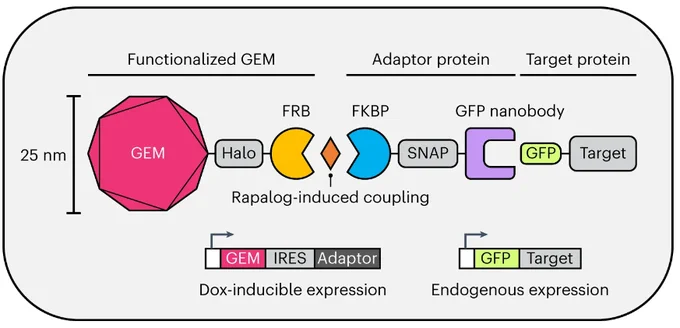
Excited to share our collaborative work with the Mahamid, Müller and @EllenbergLab! This has been a fantastic team effort @embl led by Herman Fung, @yukicosmos239 and @VeijoS.
Exciting new work on genetically encoded multimeric tags for subcellular protein localization in cryo-EM from the Cuylen-Haering & Mahamid labs. nature.com/articles/s41592-0…
Image-enabled cell sorting (ICS) – a next-generation cell sorting method – is helping EMBL researchers gain new insights into cellular function in health and disease, as well as to explore other innovative applications.
embl.org/news/science/the-po…