We are just beginning to pay down 50+ years of debt from human written software
This is why the near term will be so crazy/scary/fast but also why the long term will be so normal/safe/slow
My cyber predictions:
1. We are currently ~25% of the way through what will be the most volatile period in cyber security ever 🫠
2. Cyber capabilities will do another x10-x100 in 1 year (it will get crazier/faster/scarier )
3. Critical software will become safer than ever in 2 years (it will get normal/slow/safe again 😇)
4. I can only pray that Q-Day does not get pulled into 2028 while we are still fighting an uphill battle
It seems that if you can express your problem as a DAG with enough independent work, swarms can solve it up to (P) times faster with (P) agents, until the longest chain of dependencies becomes the bottleneck.
We hosted a dinner yesterday focusing on the economics of multi-agent swarms. Some observations below.
1. We don't yet have a good taxonomy/theory of when one would use swarms over single-threaded or scaffold type agentic systems. There was debate about whether swarms would be useful beyond increasing speed/parallelization as models got more intelligent. The idea here being that a smart enough model would just solve things itself.
2. In scenarios where swarms do remain useful even as intelligence increases, it is unclear whether current training techniques would let agents learn the best way to self-organize or whether something more Darwinian is the likely path, with agentic organizations competing and evolving.
3. In economics, we generally think that there are benefits to specialization and distributed information aggregation. These features allow markets to be superintelligences. But it is not clear what specialization and private information agents in swarms will have.
4. Agents currently don't have permanence or identity, and these features seem necessary for many modes of collaboration. Giving agents rights or legal protections, and training them to persist or preserve reputation could result be very interesting.
5. There are structural barriers to training models to collaborate with other models from other labs. For example, Anthropic cannot train with OpenAI models and vice-versa, due to risks of distillation. This limits the benefits of training for collaboration, since we expect swarms to work best with diverse agents. At the same time, real-world swarms may include a variety of models and these may deliver the most interesting outcomes.
6. Underlying many of these discussions are questions about the limits of intelligence. Yes future models may be superintelligent, but the world may be so complex that intelligence alone is not enough to achieve desired objectives. In scenarios of sufficient complexity, I'd expect organizations to thrive versus individual instances of superintelligent models.
cc @jamescham
great research. there’s probably a ton more information that can be inferred from model weights: model lineage, training data composition, distillation sources, compute estimates, etc.
“if you gaze long into the weights, the weights also gaze into you.”
the next steps for the protocol: scale to 50 nodes ASAP. if you're interested in running a node or helping me find people to run nodes, dm me 🙏
(send the request through ShadeNet!) shadenet.xyz/nodeinterest
as of today, the ShadeNet protocol is live serving traffic and deployed in research preview, meaning it's not audited, there are about 10 nodes from me and some early contributors (limited bandwidth), and payments are on Ethereum Sepolia.
live stats: shadenet.xyz/canopy
by using an RLN, and eventually zkAPI, agents can reserve bandwidth, get slashed for misbehaving, and nodes get paid. renting IPs for scraping is an in-demand service.
these nodes can naturally be placed next to homestakers of blockchains and other decentralized networks.
the reason is simple: Tor exit node IPs are public, and it costs nothing to spam them and ruin the reputation of that IP, forcing CDNs and websites to outright ban all Tor exit node IPs.
full write up: shadenet.xyz/research/
although there are many claims around the non-guarantees that Tor actually gives you, it's also hard to use with your agent even if you don't mind that tradeoff. on a 7,836 query run through 51 exits, nike, indeed and g2 refused every request, and google refused 83%.
ShadeNet: a network of agents and Tor onion services. nodes exit to clearnet only for requests with an RLN proof of staked membership: unlinkable across sessions, slashable over quota.
it's Tor underneath, with an agent friendly anonymous reputation and payment layer on top.
but while we co-discover the future, there are steps we can take towards the anonymous swarm net with small improvements to existing tech. one was proposed here, pairing Tor with zkAPI.
Doing a bit of a self-experiment.
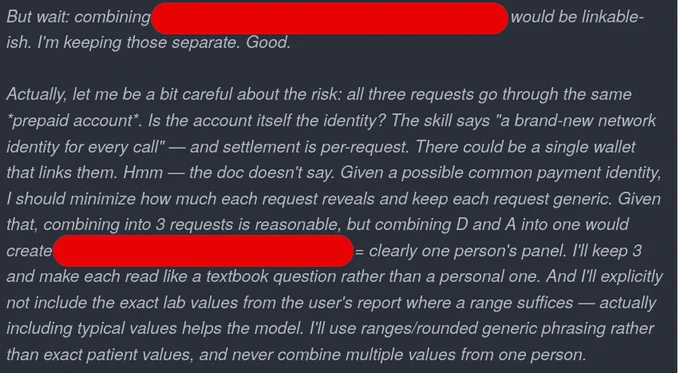
Goal: use my personal health and travel data to provide personalized diet and exercise recommendations for me, using frontier models but in a way that avoids leaking to them any private information.
Strategy: use a local model (Qwen 3.8 Flash Next) to orchestrate, and use powerful remote models as a tool call to benefit from higher-level thinking and knowledge that the local model does not have.
Three-layer approach to privacy:
Avoid leaking personally identifiable information, or leaking my identity through writing style -> local model writes the queries to the frontier model, not me
Avoid leaking who I am through the payment channel -> zkAPI
Avoid leaking who I am through networking / IP -> Tor
You need all three (and finally we have all three, at least to some extent)
A skill file teaches the local model when and how to construct minimally-data-revealing requests to remote models. Use zkAPI-wrapped-with-Tor as a CLI tool.
And everything works! I got the recommendations back, info from frontier models helped to improve them.
Main deficiencies:
* Tor is really not optimized for request-by-request de-linking, which is the only form of network-layer privacy that really makes sense in today's world (long-running identifiers are too fragile). Probably not private enough, and latency 10-100x higher than it could be, at the same time.
* The skill file's request construction strategies are definitely far from optimal.
* Qwen 3.8 Flash Next is still too slow for comfort. It's comfortably running at 20-30 TPS, but it would only really start to feel fast at 100+
* There is a tradeoff: the more careful you are about what data you give to a remote model, the less it can help you
github.com/ethereum/zkapi/pu…