
KN671 OS and HRQoL! Check it out: sciencedirect.com/science/ar…

 Open web. Clear feed.
 ✓
Medical Director of the McGill Thoracic Oncology Program; Chest surgeon; Neutrophil biologist; Cancer immunologist; Aspiring farmer
KN671 OS and HRQoL! Check it out: sciencedirect.com/science/ar…
Here’s a nice interview where I summarize the findings from the MDT BRIDGE trial presented at ESMO looking at ctDNA dynamics during neoadjuvant therapy: lungcancerstoday.com/videos/…

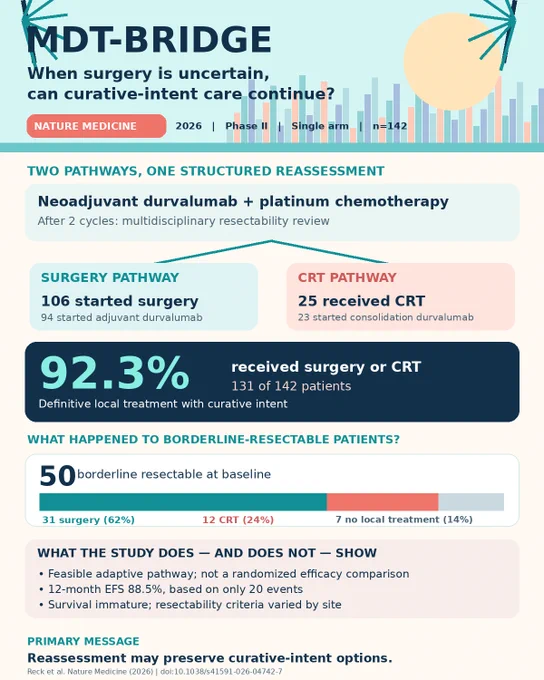
I've been reflecting on the recently published MDT-BRIDGE study and what its results tell us about the importance of multidisciplinary treatment decisions for patients with resectable NSCLC. As a radiation oncologist who has long believed that chemoradiotherapy (CRT) can achieve outcomes comparable to surgery in selected patients with low-volume stage II–III NSCLC, I see an important message in the recent publication. nature.com/articles/s41591-0… MDT-BRIDGE enrolled 142 operable patients with stage IIB–IIIB NSCLC, including 92 classified as resectable and 50 as borderline resectable. All were technically resectable, yet the borderline group was deemed more challenging to resect. Importantly, radiation oncologists participated in multidisciplinary team (MDT) assessments both before treatment and after two cycles of neoadjuvant chemoimmunotherapy. This distinguishes MDT-BRIDGE from the treatment-selection pathways commonly associated with phase III neoadjuvant chemoimmunotherapy trials, in which medical oncologists and thoracic surgeons generally drove decisions about systemic therapy followed by resection. Such an approach has been associated with 20% of patients not undergoing planned surgery, with RWE studies reporting even higher surgery-aborted rates, exceeding 40%. This begs the question of whether earlier radiation oncologist involvement can reduce the number of patients who ultimately receive no surgery or curative-intent local therapy. The MDT-BRIDGE results offer an encouraging signal. Of the 142 patients who began neoadjuvant tx: - 106 (74.6%) proceeded to surgery - 25 (17.6%) received CRT instead - Only 11 (7.7%) received neither Remarkably, all 25 patients redirected to CRT completed their treatment, and 23 (92%) subsequently initiated consolidation durvalumab. Thus, 92.3% of patients received curative-intent local therapy, despite more than one-third initially being classified as borderline resectable. These findings highlight the potential value of an MDT that includes a radiation oncologist empowered to reassess the original surgical plan and redirect patients to CRT when resection is no longer feasible or appropriate. Notably, the resulting 7.7% rate of patients receiving no local therapy was substantially lower than the approximately 20% surgical attrition rates reported in prior phase III neoadjuvant trials enrolling similar patients. Of course, MDT-BRIDGE was a single-arm phase II study, and its results do not establish the impact of radiation oncologist participation on the relatively low rate of local therapy attrition. Nevertheless, the findings raise an important hypothesis worthy of further study. Especially, since previous studies for stage I NSCLC have demonstrated better surgical outcomes at institutions offering both surgery and SBRT, suggesting that access to alternative local therapies may improve patient selection and outMA takeawaycomes. pubmed.ncbi.nlm.nih.gov/4117… pubmed.ncbi.nlm.nih.gov/3478… My updated takeaway from MDT-BRIDGE is that a radiation oncologist's value in the MDT extends well beyond delivering radiotherapy. It includes helping colleagues and patients navigate treatment decisions, reassessing the feasibility of competing approaches, and preserving opportunities for cure when the original plan changes. Even when surgery is the preferred initial strategy. I've seen this work incredibly well at my institution, and hope it's how all resectable pts are managed worldwide. For those interested in exploring the broader evidence supporting the value of MDT cancer care, I recommend this excellent review, published in 2024: sciencedirect.com/science/ar…


#McGill is hiring! Tenure-track Assistant Professor in RNA Therapeutics & Engineering | Impact+ Final week to apply. Start by June 9, 2027. Know a curious, collaborative postdoc ready to launch a lab? Please repost! mcgill.wd3.myworkdayjobs.com…—Departments-of-Biochemistry-and-Biomedical-Engineering-L000161_JR0000081675 #FacultyJobs #RNAtherapeutics #mRNA

🔥Perioperative ivonescimab ± chemo in resectable NSCLC 🆙 @NatureMedicine 🎯Primary endpoint met 🎯Cohort 2 (ivonescimab + chemo): MPR 70.1% (47/67), pCR 50.7% (34/67), RVT≤5% 97.9% (46/47) 🎯Cohort 1 (monotherapy) MPR 60.0% (6/10), pCR 30.0% (3/10), RVT≤5% 83.3% (5/6) 🎯All patients who underwent surgery achieved R0 🎯Grade ≥3 TRAEs 30.4%; no grade ≥3 hemorrhage or treatment-related death 🎙Dr. Xiaoliang Zhao #LCSM @OncoAlert @Larvol nature.com/articles/s41591-0…


🌍 @myESMO 2026 | Madrid, Spain Inspiring days at #ESMO2026, with exciting developments for the #LungCancer community! 🔬 1/5 🧬 Major attention was drawn to DeLLphi-305, bringing promising news for patients with SCLC, alongside SAFFRON and OptiTROP-Lung06. 2/5 📊 The SARON trial showed improved progression-free survival in driver-negative oligometastatic NSCLC with radiotherapy (13.9 vs. 8.9 months), although no overall survival benefit was observed. Important findings presented by @fifimcdrmh 3/5 🔪 Exciting developments for the surgical community! CTONG 1804 reported #conversion rates approaching 50%. @DoctorJSpicer presented findings from MDT-BRIDGE, highlighting the potential of ctDNA clearance as a predictor of pathological complete response (pCR) in resectable and borderline resectable NSCLC. ctDNA clearance at C2D1 showed an 83.3% positive predictive value for pCR, providing valuable insights into treatment response. 4/5 🧬 De-escalation of immunotherapy in advanced or metastatic cancer was another key topic. While reducing treatment intensity may improve quality of life and minimise toxicity, further evidence is needed before routine implementation. 5/5 🎤 Delighted to contribute to the early-stage track alongside @MarianaBrandao0 , @stephanieplsaw , Jan von der Thüsen and Suresh Senan, discussing: “Multistation N2 (N2b), T4 lesions, and pneumonectomy: Time to reconsider induction chemo-immunotherapy?” A valuable congress filled with scientific exchange, innovation and new perspectives for thoracic oncology! #ESMO #ThoracicSurgery #LungCancer #Oncology #Immunotherapy #ClinicalTrials #USZ


Report @JTOonline showing tarlatamab efficacy in pts with atypical carcinoid (n=5, RR 60%, DCR 100%, mPFS 8.8m) and large cell neuroendocrine carcinoma (LCNEC, n=7, RR 43%, DCR 88%, mPFS 5.1m). DLL3 IHC potential predictive marker here. jtocrr.org/article/S2666-364…


1/7 🫁 What happens when a patient with stage III lung cancer starts neoadjuvant chemoimmunotherapy but can no longer undergo surgery? MDT-BRIDGE, a new phase II study in Nature Medicine, addresses this important clinical dilemma. @SclcSMASHERS @FDA @LUNGevity @lungoncdoc @StephenVLiu @HHorinouchi @g_mountzios @sands_jacob @LauraAlderMD @oncodaily @OncoAlert @Latinamd @LuisPaz_Ares @RManochakian @LuisRaezMD @triparnasen @LaurenByersMD @LungCancerEu @alissajcooper @BZhangMD @NaglaAKarimMD @Annechiangmd @IASLC @NCCN @ASCO #ESMO26 @larvol @tribeMDUS @sylvestercancer @oncbrothers @chinmay @Jani_Chinmay @colazagasti @openmedicineHQ @myesmo @openmedkate @openmedben @chadinabhan @YoungLungCancer @OncodailyLung @ClinicalLung #LCSM @LungPolicy @dan_morgxen @LAGurwitch
A new publication from MD Anderson suggests similar outcomes with segmentectomy versus lobectomy for stage IA3 NSCLC measuring 2-3 cm. But not with wedge resections. annalsthoracicsurgery.org/ar…


Neoadjuvant durvalumab plus chemotherapy in resectable or borderline resectable non-small-cell lung cancer: the phase 2 MDT-BRIDGE trial nature.com/articles/s41591-0…

Remarkable results from SBRT +/- immunotherapy for unresected stage I-II NSCLC. No benefit from adding IO & surgery remains standard of care for fit pts w stage I-II, EFS of ~30m w SBRT vs 46-65m for much more advanced disease in trials of neoadj IO #lcsm ascopubs.org/doi/10.1200/JCO…


I think it might be helpful to place these findings in a broader context by comparing them with other studies and exploring some of the possible reasons why the results were not positive. For example, how do they relate to the findings from NADIM Adjuvant?


🆙#ESMO26 Poster: #LCSM 🔥A Phase II Trial of Neoadjuvant Brigatinib in Resectable ALK-Positive Non-Small Cell Lung Cancer With Single-Cell Resolution Mapping of the Immune Determinants of Pathologic Response 🎙️Dr. Dong Ki Lee 🔢2518P 🎯ORR 83.3%, MPR 58.3%, pCR 16.7% (n=12) 🎯3-Yr EFS 75.0% 🎯No Deaths at 32-Mo Follow-Up 🎯MPR Tumors Enriched for CD8+ Tem, Non-MPR for FOXP3+ Tregs ☑️NCT05361564 🔗 cslide.ctimeetingtech.com/es… @OncoAlert @Larvol @myESMO @IASLC

🆙#ESMO26 Poster: #LCSM 🔥CITADEL: Neoadjuvant Sacituzumab Govitecan Plus Pembrolizumab in Resectable Non-Small Cell Lung Cancer: Phase II Study 🎙️ @mollylisc 🔢2515P 🎯pCR 12% (3/26) and MPR 38% (10/26) in Resected Pts 🎯Not Improving on Standard Perioperative Chemo-IO 🎯Grade≥3 AEs 33% (Neutropenic Fever 8%, Diarrhoea 6%); No New Safety Signals ☑️NCT06055465 🔗 cslide.ctimeetingtech.com/es… @OncoAlert @Larvol @myESMO @IASLC


🔥 Outstanding piece of work published today in Nature Medicine! Huge congratulations to @MartinReck2 ,@NadalErnest , @DoctorJSpicer and @AndrearicFili , and the entire MDT-BRIDGE team on this important publication! 👏👏 The phase II MDT-BRIDGE trial, investigating neoadjuvant durvalumab plus chemotherapy in resectable or borderline resectable NSCLC, tackles a clinically relevant question: how can we push the boundaries of multidisciplinary treatment and offer more patients a chance of curative-intent therapy? This is exactly the kind of collaborative clinical research we need: challenging established boundaries, asking meaningful questions, and ultimately striving to improve outcomes for our patients. Congratulations to everyone involved! 👏 🔗 nature.com/articles/s41591-0… Happy to continue sharing exciting advances in lung cancer research as an #ESMOAmbassadors #ESMO26 #NatureMedicine #LungCancer #NSCLC #ThoracicOncology #Immunotherapy #ClinicalResearch #MultidisciplinaryCare #CancerResearch