€10tn sits in German private capital. Almost none of it flows to long-term startup growth.
Investors still call venture too risky, too hard to regulate, and weaker than buyout. Earlybird & 23 other VCs published the data that busts all three myths.
Recap from the GVGF Forum 👇
From scientific discovery and spatial AI to tech sovereignty and scaling European companies.
At our AGM 2026 in London, founders and industry leaders explored the opportunities and challenges shaping European tech. Ahead of the main program, our portfolio founders joined our Catalysts for a dedicated Founder's Day focused on building strong teams and ambitious companies.
More from the day in our latest Perspectives recap: go.earlybird.com/8xqrVgM8rT
Clinical trial data review is getting smarter.
Our portfolio company Rivia has launched Data Findings, an AI-powered module that automates data checks and helps clinical teams identify and resolve issues faster.
With Scancell as its first adopter, Rivia is accelerating clinical development. Congratulations to Erik Scalfaro and the entire Rivia team!
Read more details below.
From roundtables to a full-day Summit.
The first Gradient Descending Summit at Beaverbrook explored the questions shaping AI, from infrastructure and GTM to brand and pricing.
A first glimpse of the conversations below. Full film coming soon!
AI is changing the economics of software, and pricing models will have to evolve with it.
In his keynote, Mayank Pant (@stripe) explored one of the biggest challenges facing AI companies: monetization. While AI companies are reaching revenue milestones three times faster than traditional SaaS companies, unpredictable compute costs, margin pressures, and rapidly evolving products are making pricing increasingly complex.
To address these challenges, he introduced a five-step pricing framework: define the value your product delivers, select a charge metric that reflects that value, choose the right pricing model, introduce safeguards for customers, and continuously adapt pricing as the product evolves.
Together, these steps reinforce the idea that pricing should be treated as an evolving part of the product, with flexible infrastructure that allows companies to test, learn, and scale sustainably.
And with that, our stage programme from the first ever GD Summit comes to a close. Thank you to everyone who shared their perspectives and made today's conversations so engaging. We'll be sharing more highlights and takeaways from the Summit soon!
Can individual customer needs actually scale?
Anjor Kanekar, Kevin Hillier, and Boaz Francis took on that tension in a discussion on forward deployed engineering, from deeply tailored customer implementations to repeatable software.
The conversation explored where customization creates valuable product insight, when it starts to limit scalability, and how teams can turn hands-on customer work into something that compounds across the product.
Content is becoming easier to produce than ever, but building a brand people actually care about remains a different challenge.
Tilen Kegl's keynote brought brand and creativity into the AI conversation, exploring how companies can establish a distinct identity in a world increasingly saturated with AI-generated content.
Through his three-level ‘Brand Pyramid Scheme,’ he outlined what it takes to stand out: first, build a clear narrative and ensure consistent discoverability. Second, avoid generic content by creating recognizable formats and staying connected to what is happening in the world. Finally, invite audiences to actively participate through shared resources, workshops, and community-driven initiatives.
As the tools for creation become widely accessible, originality, trust, and a recognizable point of view may become even more valuable.
If AI changes how we build products, why should go-to-market stay the same?
Nina Mayer, Eugene Berson, Ellen Moeller McCormack and Vardhan Kapoor took on that question in a discussion on AI-native GTM, looking at how companies are rethinking customer acquisition, sales, and growth.
The conversation focused on what the AI shift is already changing inside GTM teams, from how they work and sell to how they build customer relationships and create sustainable growth.
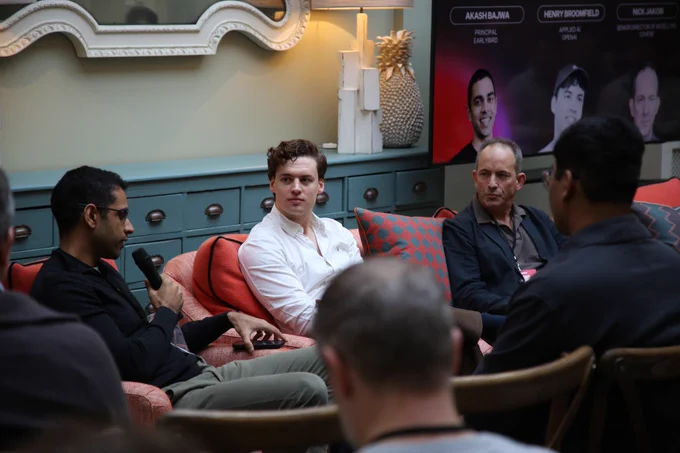
Henry Broomfield from @OpenAI and Nick Jakobi from @cohere just took the stage with Earlybird’s Akash Bajwa (@AkashBajwa96) for a fireside chat on one of the core debates shaping AI today: open weights versus closed frontier models.
They discussed the trade-offs across performance, accessibility, control, customisation, and commercial viability, and what those choices mean for companies building on top of increasingly capable models.
As AI advances and access broadens, will decisions at the model layer continue to shape lasting competitive advantage, or will differentiation increasingly move elsewhere.
The first-ever Gradient Descending Summit has begun at Beaverbrook.
After a year of Gradient Descending roundtables, today expands the series into a deeper discussion on where AI is heading, and what it takes to build enduring companies as the technology continues to evolve.
@AndreRetterath, General Partner at Earlybird, opened the day by welcoming our guests and setting the scene for the conversations ahead, while also recognising the partners supporting this year’s Summit.
More from the Summit throughout the day.
Cc: @stripe, @NotionHQ, @deel, @HSBCInnovation
From AI agent security and AI-driven sales to industrial robotics and inference economics.
October's Gradient Descending sessions took us to Turin, Berlin, Zurich, and London to explore what it takes to make technology work at scale.
Our latest Perspectives recap: go.earlybird.com/zNYeuth8Wc
oTFY is now live on @Morpho
Investors can use trade finance yield as collateral for liquidity, while keeping exposure to real commodity shipments.
Built with @TradeflowM (financing), @redstone_defi (pricing) & @RockawayX (risk).