←
The Institute for Family Studies33,691 posts
The Institute for Family Studies avatar✓

The Institute for Family Studies ✓

@FamStudies

Strengthening marriage and family life through empirical research, public policy, and public education

◷ Joined August 2013▧ 3,032 Photos and videos
The Institute for Family Studies avatar
The Institute for Family Studies@FamStudies·Aug 5

In this second installment of our two-part series on demoralized men, we look at the social lives of young men, including social integration and support, friendship and participation in organized groups, and family relations, especially with parents. Next, we consider feelings of alienation and frustration, perspectives on the American Dream and their future, and reports of mental health problems and potentially traumatic experiences. Lastly, we survey online activities, such as pornography, gaming, and gambling, and some of the trouble correlated with these. We tell a sobering tale about the predicament a significant number of young men find themselves in. As part I notes, some young men are doing quite well, but others are struggling mightily for reasons laid out in part II.

Post attachment
The Institute for Family Studies avatar
The Institute for Family Studies@FamStudies·9m

While children's mental health problems intensified during the pandemic, there were plenty of things to be concerned about leading up to it: rising rates of depressive episodes, sadness, suicidal ideation, hospital admissions for self-harm, and suicides. These problems have by no means gone away. But the good news is that the direction has shifted for the first time in 10 to 15 years: youth mental health has improved since 2021 by nearly every measure, reports @jtrothwell

Post attachment
The Institute for Family Studies avatar
The Institute for Family Studies@FamStudies·18h

Distinctively Hindu names, names with origins in the Islamic world, and names associated with Judaism or Israel have all seen increases in the United States. While Bible names still vastly exceed these names (excluding overlap cases, Hindu, Islamic, and Jewish-distinctive names add up to just 3.4% of births in 2025 vs. 20% for Bible names generally), America’s rising religious diversity is clearly on display in baby name data, finds @lymanstoneky

Post attachment
The Institute for Family Studies avatar
The Institute for Family Studies@FamStudies·21h

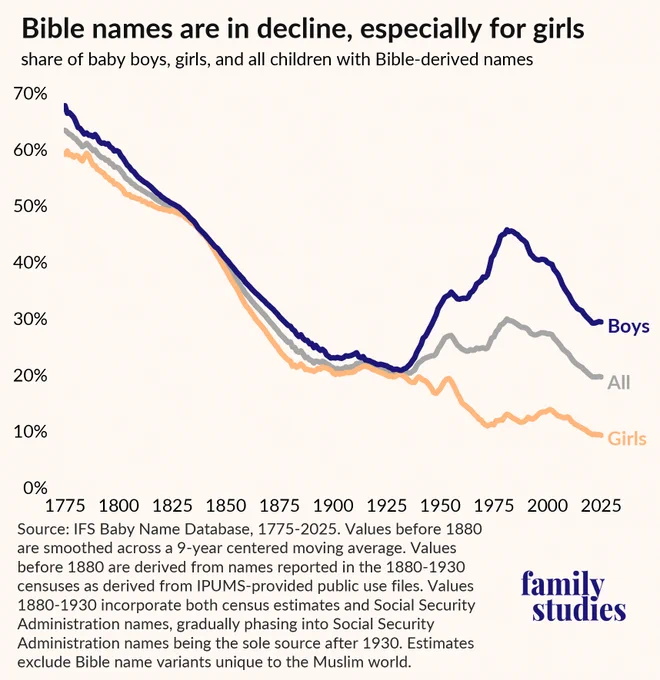
How are given names changing in America today? What can we learn from those changes? Since prior research has suggested that religious names may predict fertility behavior, we can start by looking at names appearing in the Bible. Bible names declined greatly in the 19th century, although boys’ Bible names stopped declining around 1900 and saw a resurgence in the mid 20th-century. For girls, there was a further major decline in Bible names between 1915 and 1975. @lymanstoneky

Post attachment
Lyman Stone 石來民 🦬🦬🦬 avatar
⟳ The Institute for Family Studies retweeted
Lyman Stone 石來民 🦬🦬🦬@lymanstoneky·22h

Nowadays, religion isn't in the driver's seat of American culture. Celebrities are. And their choices shape American families. How do we know American families are celebrity-influenced? Because parents name their children after pop media personalities!

Post attachmentPost attachmentPost attachmentPost attachment
Brad Wilcox avatar
⟳ The Institute for Family Studies retweeted
Brad Wilcox@BradWilcoxIFS·Nov 17

What's in a (baby's) name? ✔️Bible names: down. In 1980, @ 30% of American babies got a Bible name. Today it’s @ 20% ✔️Meanwhile, names tied to Islam, Hinduism & Hebrew are rising (tho from a small base) New @famstudies 👇

Post attachmentPost attachment
The Institute for Family Studies avatar
The Institute for Family Studies@FamStudies·Nov 17

Fertility choices, including how to name a child, are deeply personal. Because they are deeply personal, they are also highly sensitive to relationships, social influences, and ideas of the good, the true, and the beautiful, writes @lymanstoneky. In other words, baby names capture a sense of identity and culture and tell us what sorts of social forces are influencing fertility today. A big takeaway from the study of baby names is that fertility and family choices are powerfully influenced by religion, but that this influence is fading for all but a determined minority.

Post attachment
The Institute for Family Studies avatar
The Institute for Family Studies@FamStudies·Nov 16

Dads often use this time as an opportunity to support moms with recovery from childbirth and bond with their new baby, says @JoshuaTMcCabe In fact, dads with access to paid leave are five times more likely to take time off and are much more likely to be intimately involved in caring for their newborn. Overall, paid leave may help men be better husbands and dads at one of the most crucial times in family life.

Post attachment