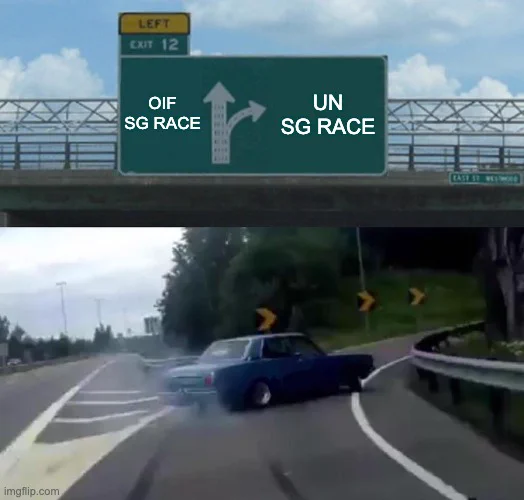
Interesting UNSG update from @MarkLGoldberg, although we are increasingly hearing that @RussiaUN might be open to Grossi as SG despite earlier criticisms.
Whatever the reality, it does feel like we are approaching crunch time. And about time.
Tomorrow's Security Council vote could reveal whether any of the three leading UN Secretary General candidates has a path to victory
globaldispatches.org/p/where…
UPDATE: A diplomatic source tells Crisis Group that the next UNSC straw poll for the SG selection is rescheduled to Friday 20 Nov.
The straw poll is still expected to involve color ballots for the P5.
The vote was originally scheduled for tomorrow, Thurs 19 Nov.
I spoke to @arabnews for a wide-ranging interview on the SG race ahead of tomorrow's ballot.
Besides offering some sober reflections, I also call it "foolish" that straw poll results leak before the Security Council announces that a vote has taken place.
arabnews.com/world/why-the-w…
The UN Security Council has a precious window to prevent a security vacuum in southern Lebanon.
In our new statement, @CrisisGroup argues that the UNSC should rally around a pragmatic, cost-effective follow-on deployment.
Read below⬇️
NEW STATEMENT | Averting a Post-UNIFIL Vacuum in Southern Lebanon
Until greater stability takes hold, some sort of international force is still needed. The UN Security Council should bridge the gap with a pragmatic follow-on deployment.
crisisgroup.org/stm/middle-e…
Things are escalating rapidly between #Iran and the United States.
🔹Over the past 24 hours, the Iranian armed forces have reported incidents involving four oil tankers in the Strait of Hormuz, resulting in explosions and fires. According to the Iranian account, the vessels struck sea mines. However, it remains unclear whether mines were actually involved or whether the incidents resulted from direct Iranian attacks using drones or cruise missiles.
🔹Meanwhile, there were reports of U.S. strikes on Qeshm Island in the late afternoon. Iranian state media and official outlets have sought to downplay the significance of the strikes, claiming that only military targets were hit. However, unofficial and local sources have reported massive explosions and several casualties.
🔹The timing of the strikes is itself noteworthy. Unlike previous U.S. attacks on Iranian coastal areas and islands, which largely took place at night, these strikes were carried out in broad daylight. This could signal a change in the pattern of U.S. military operations against Iran.
🔹The risk of the confrontation spreading further across the region is also growing. Earlier in the day, the IRGC claimed to have struck U.S. radar installations in Bahrain. Subsequently, the IRGC spokesperson issued a warning to Bahrain over its security partnership with Washington and its treatment of Shia clerics.
🔹The Iranian leadership appears particularly concerned about recent reports of lengthy prison sentences handed down to several senior Shia clerics in Bahrain. Against this backdrop, Bahrain could become one of the first countries to be drawn more directly into the renewed escalation between Tehran and Washington.
🔹There were also reports of drone strikes against positions belonging to Iranian Kurdish insurgent groups in Iraq's Sulaymaniyah province. These followed earlier reports in Iranian media of clashes between Iranian security forces and PJAK militants along the Iran-Iraq border.
🔹In the past hour, there have also been reports of drone strikes in Kuwait, which could be in retaliation for the U.S. strikes on Qeshm Island. But regardless of the immediate motivation, these incidents further highlight the growing risk of the confrontation spreading across the region, potentially drawing more countries into the conflict once again.
🔹All of this is unfolding against the backdrop of stalled diplomacy, with efforts by regional mediators so far failing to bring Tehran and Washington closer to an agreement.
🔹Today's developments should serve as an important reminder of the inherent instability of the current situation. Some within the Trump administration – and perhaps even Trump himself – may believe that Washington can maintain economic pressure and the naval blockade against Iran indefinitely while avoiding another full-scale war. But the developments of the past 24 hours demonstrate how difficult it is to sustain such an arrangement.
🔹Even if neither side intends to enter a broader confrontation, the accumulation of military incidents across multiple fronts increases the risk of miscalculation and escalation beyond what either side originally intended.
🔹Beyond the risk of unintended escalation, the longer the blockade and economic pressure campaign continue, the greater the incentive for Tehran to deliberately escalate in an attempt to break the deadlock by force.
The UNSC gave the Board of Peace until December 2027 to carry out its mission. But Palestinians cannot afford it continuing like this for another year.
@CrisisGroup’s August report lays out ways governments should step up, with or without the Board:
crisisgroup.org/rpt/middle-e…
A year has passed since the UN Security Council, with Resolution 2803, tasked the Board of Peace with implementing the Gaza ceasefire deal.
By now it should be abundantly clear that the Board has been central to the truce’s failures, trapping Gaza in further suffering and danger
Since July, @BalqiisInsights has worked to decipher what the US decision regarding UNSOS means for Somalia's security architecture. We called for swift, coordinated action from the AU and FGS, which has clearly not been forthcoming, leaving troop-contributing countries to make decisions independently. The resulting concerns for regional security have brought us to this critical juncture.
The central question now is whether the FGS will use this additional time to execute an orderly transition, or whether we will find ourselves in this exact same position in the final quarter of 2027.
What does Washington’s reversal mean for Somalia’s security transition?
US support for a one-year renewal of UNSOS and AUSSOM offers the Federal Government of Somalia a prospective 12-month reprieve. It eases the immediate threat to operational continuity, while leaving unresolved the political, financial and logistical challenges of transferring security responsibilities.
Our latest analysis examines what has changed in Washington’s position and revisits the argument in our July policy paper, No Time to Drift. The central question is how the FGS and its partners will use the additional time: to prepare for a managed transition, or to approach another deadline with the same dependencies.
Read “𝐀 𝐑𝐞𝐩𝐫𝐢𝐞𝐯𝐞, 𝐍𝐨𝐭 𝐚 𝐑𝐞𝐬𝐞𝐭: 𝐓𝐡𝐞 𝐔𝐒 𝐒𝐡𝐢𝐟𝐭 𝐨𝐧 𝐔𝐍𝐒𝐎𝐒 𝐚𝐧𝐝 𝐒𝐨𝐦𝐚𝐥𝐢𝐚’𝐬 𝐒𝐞𝐜𝐮𝐫𝐢𝐭𝐲 𝐓𝐫𝐚𝐧𝐬𝐢𝐭𝐢𝐨𝐧”:
balqiis.org/a-reprieve-not-a…
"The conditions for credible polls are not currently in place," @CrisisGroup said in a briefing for the @UN Security Council. "Rushed elections could be a decisive blow to the 2018 framework and would open the door to a return to large-scale violence." nytimes.com/2026/11/14/world…
Good news. There was real concern that AU and Somali forces would be left hanging out to dry come Jan 2027.
Another year of U.S. backing for @UNSOS_ gives Mogadishu, the AU, and the UN some more time to think responsibly about what comes next.
afp.com/en/reversal-us-fund-…
Washington’s one-year U-turn to fund UNSOS and AUSSOM buys Mogadishu temporary breathing room against al-Shabaab, yet highlights how fragile Somalia’s security remains without a credible transition plan. #Somalia#UNSOS#Securityafp.com/en/reversal-us-fund-…