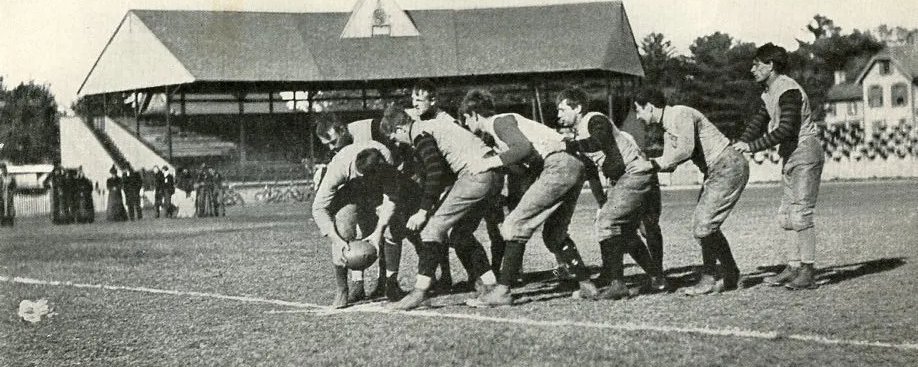
The idea that Teddy Roosevelt "saved" football is mostly myth.
If there was a man who actually saved football, it was Henry Mitchell MacCracken.
It's all here:
youtu.be/qKNFpl0xxzg
College football's postseason has always been... a bit odd.
In 1947, the Associated Press named Notre Dame college football's national champion. Then it held another vote — and got a different winner.
Notre Dame finished 9–0 and topped the final AP poll on December 8. This is when the polls were taken before bowl games. Bowl games were considered an "exhibition" and not part of the regular season.
But Michigan wasn't finished playing.
On January 1, 1948, the undefeated Wolverines demolished USC 49–0 in the Rose Bowl. The performance was so convincing that the AP conducted an extraordinary postseason survey to reconsider the two teams.
The results favored Michigan: 226 sportswriters selected the Wolverines, 119 chose Notre Dame, and 12 considered the teams equal.
There was just one problem.
The AP announced that its second vote would not replace the official December poll.
Notre Dame remained the official AP national champion, despite Michigan winning the postseason survey.
Go look it up. Notre Dame is the 1947 AP champion. Michigan claims 1947 as part of its 12 national titles.
November 27, 1891:
Yale 19, Princeton 0
Note the headline. If you're wondering whether college football fans were different years ago than now, that would be no.
People yell and act like Madmen in the rain!
The veer once shattered records and turned undersized teams into contenders.
Its story begins with Bill Yeoman, an Army center who helped reshape one of college football’s most dominant offenses. #CollegeFootball#FootballHistory
Nov. 13, 1875 — Harvard and Yale play the first “Game.”
Harvard played a rugby-style game, and Yale played something closer to soccer. They agreed on modified rugby rules with 15 players a side. Yale guaranteed Harvard $75 for travel and sold 50-cent tickets to about 2,000 spectators at Hamilton Park in New Haven. Harvard won, four goals to none.
Two Princeton students in the crowd went home and pushed their school to switch to the rugby game.
Within two decades, the game had become the biggest event on the college sports calendar. The crowds caused so much trouble in Boston and New Haven that from 1889 the game moved to neutral Hampden Park in Springfield, Mass.
Students took special trains, Boston police were sent in to help handle the crowds, and the schools fought to keep tickets away from speculators. By 1893, 25,000 people were filling the park.
The 1894 game came in the middle of a national argument over football’s brutality. Harvard president Charles Eliot had spent that year attacking the sport.
On Nov. 24, before roughly 25,000 people, Yale won 12–4 in a game papers later called the “Hampden Park Blood Bath” and the “Springfield Massacre.”
Nine players were removed for injuries or fighting, and one was unconscious for hours. The schools broke off the series, and the Game didn’t return until 1897.
Nov. 12, 2016 — Pitt 43, No. 2 Clemson 42.
Pitt came in as a 20-point underdog. Deshaun Watson threw for an ACC-record 580 yards, and Clemson led 42–34 late. Clemson rolled up 630 yards!
Then Saleem Brightwell picked Watson off and returned it 70 yards. James Conner scored from 20 out. Pitt’s defense stopped Wayne Gallman on third and fourth down and got the ball back with 58 seconds left.
Two passes to Scott Orndoff got Pitt into range. Chris Blewitt had already missed an extra point and had a kick blocked that day. He hit a 48-yarder with six seconds left.
It was Clemson’s only loss of the season. Two months later, the Tigers were national champions.
115 years ago today: Carlisle 18, Harvard 15.
Jim Thorpe kicked four field goals, one in every quarter, with Alex Arcasa holding. When Harvard sent its veterans in for the fourth, Thorpe answered with a 48-yarder.
#CollegeFootball#CFBHistory#JimThorpe
On November 11, 1911, the Carlisle Indian School went to Cambridge and beat Harvard, 18–15.
Jim Thorpe kicked four field goals that afternoon, one in each quarter. All four were from placement, with Alex Arcasa holding. Arcasa also scored Carlisle’s only touchdown to finish a 70-yard drive built on criss-crosses, line plunges by Powell, and off-tackle runs by Arcasa and Thorpe.
Percy Haughton’s Harvard team played its substitutes for three quarters and sent the regulars in for the fourth. Carlisle drove to the Harvard 40 against them anyway. Thorpe dropped back eight yards and kicked a 48-yarder to put the game away.
Harvard’s two touchdowns came off a Carlisle fumble and a blocked kick that Storer returned 40 yards.
The next day’s headline: “Gloom at Harvard When Carlisle Is Easily the Winner.”
Most people remember Thorpe for the Olympics and his running. How much did you know about him as a kicker?
The forward pass was legalized in 1906—and nearly sabotaged by rules that turned an incomplete throw into a turnover, sometimes with a 15-yard penalty too. Which rule was the worst? #FootballHistory#NFLHistory