Open web. Clear feed.

physician, programmer, and would-be pâtissier/poet. Chief Scientist at @AledadeACO and Architect for @SMARTHealthIT. Bsky: josh.mandel.md

Healthcare is fragmented, and care teams do much of the work of holding it together. They track down records, re-enter information in various systems, and follow up so patients can get care. Today we’re sharing improvements to ChatGPT to help move care forward. 🧵
AI agents can now reliably review a patient's chart -- but agentic access needs data + workflows beyond USCDI FHIR APIs. Under current rules, a practice can spend months navigating EHR partner fees, IP terms, and app registration. There's a better way...

I asked Fable 5.2 to make its SVG color choices more friendly to deuteranopes. (I'm color deficient.) We're $25 and 30min into a detailed Python simulation of human vision...

"Maybe model intelligence improvement outstrips my feature appetite such that it's fine" -- for small scale hobby projects, this is exactly how I'm experiencing things
I'm now building an "improvements" feature into all of my personal vibecoded applications: a freeform text input that's hooked up to an agent that yolo implements whatever is submitted. It's an interesting experience -- the activation energy barrier to sanding any rough edge or implementing any new feature becomes extremely low. Someone else who uses one of the applications I created has already implemented 150 improvements over the course of a few days. This pattern feels like a new kind of tool -- liquid software? -- and every application that doesn't have this feature now has a slightly rigid and anachronistic flavor. Why can't I just tell it how I want it to be different? Now, it's not obvious to me how this pattern can or should scale. Does it become unmaintainable after a while? (Maybe model intelligence improvement outstrips my feature appetite such that it's fine?) How does collaborative software work in this model? Can software designed this way be secure and reliable? Whatever the larger questions about broader deployment, it definitely works great in a personal context. It reminds me a little of the visions of Lisp/Lisp machines, Smalltalk, and HyperCard -- systems that the user can take control of and modify. Those visions never quite worked, though: the vast majority of software today is not end-user modifiable in any useful way. So, while this "liquid" affordance is a very small touch, the way it changes one's relation to the software feels a bit transgressive and empowering in a Lickliderian and Engelbartian way.

On the theme of appetite for software being much larger than historical supply... Sometimes I wake up in the middle of the night and can just tell that I won't be able to fall back asleep. At times like these I reach for a podcast (played through headphones), but fumbling with my phone and selecting it and hitting play and adjusting the volume are all little unnecessary movements (and light!) that can disturb my wife. Last night I had Claude build a replacement for the default Android screensaver -- it only activates when my phone is plugged in on its charging stand at night, and when it is active it notices if I turn on my Bluetooth headphones and automatically selects the next unplayed episode of my mindless-content-for-when-I-can't-sleep podcast and plays it after setting the volume to a quiet default. The phone screen, while still black, turns into an interface I can tap once to toggle pause/play, and horizontally drag to adjust volume within a constrained range (0-20% level). This setup supports zero-touch default case, and any manual parts are "wide targets" that I can actuate silently -- and with my eyes closed. I built the whole thing using Claude code on my phone, remoted in to my desktop on the home Wi-Fi which can connect back to my phone over ADB to install, test, and run software on the phone. 15min project!
"Can a provider use any agent of their choice to interact with the EHR's UI?" (Today of course, the most common "user agents" -- the technical term for web browsers! -- are fairly dumb but getting smarter fast.)
ONC finalized the first part of its HTI-5 rule, scaling back its proposed EHR deregulation (still waiting to see what lands re: AI Agents + Info blocking). See article for what was cut or deferred, and how it compares to our SMART Health IT comment letter.


I realize this is because thinking traces have gotten too long (and too proprietary) but the solution of hiding them almost entirely so the AI just does "magic" feels like a failure of imagination and a move towards a default of disintermediation that is worth effort challenging.
This is an exciting integration pattern, but very asymmetric: patients don't get their choice of agents. (Emmie can access MyChart capabilities that other agents can't.) See "Who Gets to be the Agent?" at
Introducing Connectors: a new way for apps to communicate with Epic. Developers can soon build Connectors that bring information from other apps into Epic, like pulling arrival time from an ambulance app so the ED can prepare without switching between apps.
Should patients be able to choose their own AI agent, or will providers proffer proprietary portal-bots? I’m at the 2nd annual Open@Epic conference today and there's a lot to be excited about. (More FHIR APIs! Better performance! Consolidated individual access in TEFCA!) One headline announcement is "Connectors": letting outside services plug into Epic’s MyChart assistant, Emmie, via MCP. This is a strong architecture and it's great to see thoughtful capabilities rolling out. But right now, the architecture only points inward: Emmie is always the host, and outside apps are background tools. If every health system expects its own bot to be the coordinator, patients just trade clicking through three portals for talking to three separate bots. Why do I think two-way access is so important? x.com/JoshCMandel/status/211…
Josh Mandel, MD @JoshCMandel Oct 21 Article Interoperability vs. Absorption: Who Gets to Be the Agent? Epic just announced "Connectors," a framework that invites outside software developers to plug their services into Epic’s AI assistants using the Model Context Protocol (MCP). Testing begins late this

Yes on Subscriptions! Let's bring US Core Patient Data Feed to bear on this (and refine/adjust as we go). The Argonaut FHIR accelerator developed that current spec with strong participation from Epic, Oracle Cerner, Athena, and Meditech on feed design. build.fhir.org/ig/HL7/US-Cor…
ChatGPT is now the largest medical record sync from hospitals to consumers, passing Apple. I'm glad we can all access our medical records through the apps we choose. Rightly so! We're working with Epic and hospitals to reduce the API load on their servers. The current setup is archaic - the equivalent of refreshing your inbox instead of getting a push when email arrives. FHIR Subscriptions can solve this & reduce strain on the system.
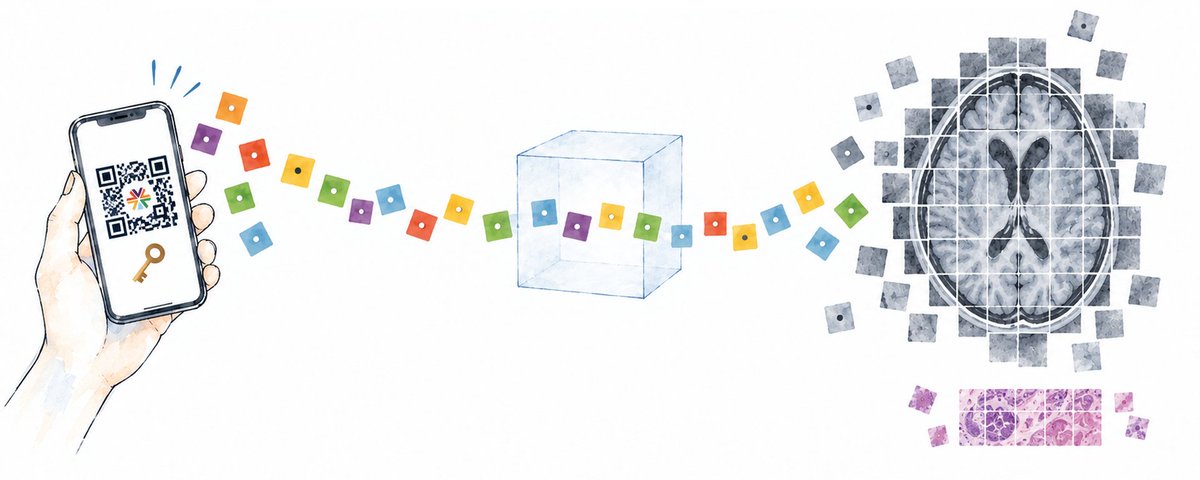
To show what that looks like for imaging, I spent <24h designing a small protocol extension to make SMART Health Links stream massive DICOM studies and building an end-to-end demo.

Assorted things I've been mulling over regarding agents in the economy: • Companies are in some sense the original superintelligence. It's often the case that they can use their amortized cognitive surplus to advance their interests against those of certain consumers: relative to the optimization capacity of companies, consumers can be inattentive, underinformed, irrational, etc. (Think, say, of some of the classic insurance upsells at the end of a booking process, which is typically priced substantially above what a regular policy would cost.) Herbert Simon introduced the idea of bounded rationality, and firms often end up benefiting from it. Thanks to personal agents, we will probably get somewhat more rational in how we engage with companies. • How exactly will outcomes change? Well, certain kinds of price discrimination will work less well (how do coupons work if every agent hunts fastidiously for them?), and certain kinds of customer cross-subsidy will change (today, people who forget to cancel subscriptions subsidize those who don't). Taken across the economy as a whole, I'm not sure what the incidence of all of this will be. • In corporate strategy, people have long debated the relative importance of distribution and product quality. Perhaps you've made something better, but does anyone know about it? Won't people just continue to buy the ACME Corp Mousetraps? Personal agents will, I think, act as a kind of structural subsidy for product quality. How would markets look different if individuals always spent at least 10 hours researching their purchases? On the margin, focusing on making a product better is, I think, going to become a more effective strategy for companies. This is good! • It true, a corollary is that information about product quality will become more important and impactful. Today, most people have very limited ability to aggregate and integrate such data, but agents will have insatiable thirst for such signals. (It's often said that data is becoming more valuable because it helps in the training of models. That's obviously true, but I think there's a secondary way in which it's more valuable simply as a complement to cheaper intelligence.) • A big question is whether agents will increase superstar effects (rational agents all settle on the same product) or increase dispersion (because everyone has slightly different tastes and preferences, which agents are good at eliciting, finally overcoming the artificial clustering we've been subjected to). • Many internet companies have monetized demand routing, which is in turn often predicated on short attention spans. "I'll click on the first thing I see." This has led to some amount of inefficiency, as companies try to propitiate capricious ranking algorithms and incur various placement fees. It's not all deadweight loss (willingness to pay is itself a kind of signal, which is valuable to buyers), but it's not great. How will the nature and value of this routing change in a world of personal agents? I don't know the answer, but I think that the effects might be pretty big. • Much of what I'm writing hinges on the assumption that personal agents will be on the consumer's side. I suspect that that will be the winning strategy, but whether it's true, and what it means to be true, involves a lot of other questions. Taken as a whole, the market is a massively parallelized, decentralized, and highly imperfect value attribution machine, and, taking stock of all of the effects, it seems to me that the quality point may well be the biggest: that agents will change the nature of the backpropagation such that the rewards for better products increase. Maybe this is too optimistic, but I suspect (and hope) that companies that make things that they're proud of will feel that the universe is a little more partisan in their favor.