
 Open web. Clear feed.

all in on memecoins // prediction markets // ex Bet365
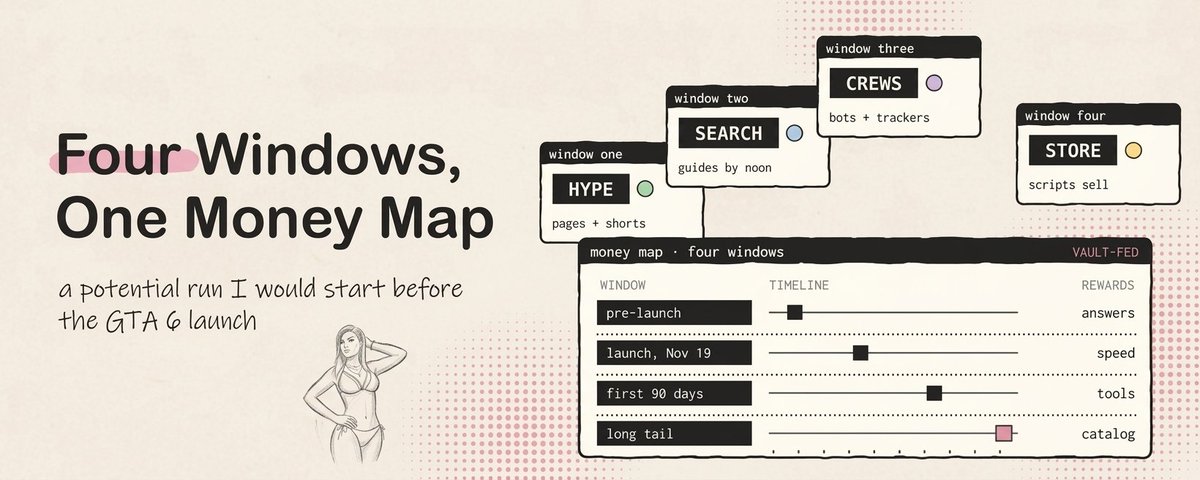
GTA 6 is already out and players are already falling through the textures! A launch of this scale brings massive attention, but capturing it requires a structured system rather than luck. I’ve mapped out a four-window blueprint to capitalize on every stage of a major game launch: The Hype & Launch Window: Instant search spikes require fast, accurate guides built on verified sources, leaving rumors behind. Peak Playthrough Week: Millions search for mission walkthroughs and secrets simultaneously. Speed wins; publishing late means losing the traffic. Community Tooling Phase: Search volume stabilizes as player communities form. Discord bots and server utilities become the primary value drivers. The Long-Tail Catalog: Building and selling tested server scripts and mods establishes a sustainable, long-term revenue stream. Success on big releases belongs to those who plan the full timeline. Read the complete strategy breakdown here:
Joying.eth @Joyingeth Nov 17 Article Four Windows, One Money Map for the GTA 6 Launch $1 billion in three days. That was GTA V in September 2013. Take-Two tagged it the biggest entertainment opening in history. Rockstar kept the revenue. Everyone else kept the attention. Searches,

GTA 6 has already launched, and while Take-Two is counting billions, surpassing even the legendary opening of the fifth installment with its $1 billion in three days, the real story of the release lies elsewhere. Rockstar has set an unreal bar for detail once again: every vehicle features a fully interactive dashboard. You can control every element in detail: roll down the windows, switch between low and high beams, activate off-road mode, drop the truck bed, and use turn signals and hazard lights. While some players encounter initial server bugs, the developers prove that the sky-high expectations of millions of fans were fully justified in the details. A true masterclass in open-world immersion.
Joying.eth @Joyingeth Nov 17 Article Four Windows, One Money Map for the GTA 6 Launch $1 billion in three days. That was GTA V in September 2013. Take-Two tagged it the biggest entertainment opening in history. Rockstar kept the revenue. Everyone else kept the attention. Searches,
Drop whatever you planned tonight. Put 60 minutes into a free Claude walkthrough instead. Every lesson runs on screen with real files. It goes from download to a weekly automated task in 22 chapters. No skipped steps, no theory without demo. Whether you opened Claude yesterday or use it every morning, the same hour covers both. It all comes down to five layers: 1. Assistant answers your question. Agent finishes the whole job. 2. Five building blocks of a prompt and three techniques from Anthropic's docs. 3. Projects give Claude memory. Skills teach it your brand voice. 4. A sales file with 1000+ orders turns into a dashboard in one conversation. 5. A Monday task pulls your Gmail summary at 9 AM, no approval needed. Most builders spend weeks collecting this from scattered threads. One hour replaces all of it. Clear your evening. Twenty-two chapters in sixty minutes, all on screen.
Joying.eth @Joyingeth Nov 17 Article Four Windows, One Money Map for the GTA 6 Launch $1 billion in three days. That was GTA V in September 2013. Take-Two tagged it the biggest entertainment opening in history. Rockstar kept the revenue. Everyone else kept the attention. Searches,

Anthropic, Garry Tan and Addy Osmani uploaded their entire Claude Code configs on GitHub for free and most devs are still prompting blind 7 free repos from builders who actually ship with agents: -> skills github.com/anthropics/skills Anthropic's official skills repo plus the full spec for writing your own -> superpowers github.com/obra/superpowers a skills framework that forces your agent to brainstorm, plan, test and review before it writes a line -> gstack github.com/garrytan/gstack Garry Tan's setup with 23+ slash commands built for planning through release -> agent-skills github.com/addyosmani/agent-… Addy Osmani's stage-by-stage skills: define, plan, build, verify, review, ship -> skills github.com/mattpocock/skills Matt Pocock's personal skill pack, fork it and reshape it for your own stack -> agentmemory github.com/rohitg00/agentmem… persistent memory that syncs across Claude Code, Cursor, Gemini CLI and Codex -> ccusage github.com/ryoppippi/ccusage reads tokens and cost from your local Claude Code logs so you know exactly where the spend lands your agent caps out at the setup you hand it grab theirs and build on it
6AWORON0k @6AW0RON0k Nov 17 Article One Prompt Built My Entire FiveM Product Line I typed one sentence into Claude and watched it write a full Lua job system in under a minute. Five roles. Three pay grades. Admin commands. A readme. About three hundred lines of working code, and I

I crammed an agent swarm into one folder and cut a 3-hour guide to 7 minutes. The problem with this loop is it shipped contradictions before I added a grader. > One lead reads the board, writes a brief per piece. > Workers start in parallel. One file each. Line END. > New session, separate model. Grades each piece 0 to 1. > One fail and the whole piece goes back. > Two fix rounds. After that, the human steps in. > Only passed outputs merge into the final file. OpenAI ran 10,000 agents on Navier-Stokes. 88 hours. Same loop. Fits on a laptop.
Ridark @ridark_eth Nov 17 Article I Folded a Whole Research Pipeline Into One Folder and Let the Agents Run It A build log. Every number below comes from a 659k-view guide to agent swarms and from the studies it cites. I ran the same pattern on a smaller job and kept the structure. OpenAI pointed about 10,000

dangerous where one vault and six agents cross I assembled a launch machine for GTA 6. Four teams collapsed into one person and one folder. Every agent reads the vault first. One job each. No guessing. 6 jobs I stopped doing, with the prompt each one runs: → Scout: "Pull every patch note and trailer. Add source links." → Librarian: "File into vault, link notes, cite sources." → Writer: "Turn vault facts into guides. My voice, every line." → Editor: "Cut gameplay into vertical shorts." → Search agent: "Top questions in the first 72 hours, ranked." → Publisher: "Ship to site, X and Discord. Log every URL." One rule: nothing ships unless the vault confirms it. Paste the scout prompt tomorrow. How many jobs on your desk could six agents close by Friday?
Joying.eth @Joyingeth Nov 17 Article Four Windows, One Money Map for the GTA 6 Launch $1 billion in three days. That was GTA V in September 2013. Take-Two tagged it the biggest entertainment opening in history. Rockstar kept the revenue. Everyone else kept the attention. Searches,
THIS F*CKING INSANE Two prompts built six agents from one empty folder. I ran build from this one line: mkdir gta6-machine && claude 1. 5 directories dropped, one CLAUDE.md capped at 200 lines, 4 rules that make every agent cite the vault first 2. 6 subagent files written. Scout, librarian, writer, editor, seo, publisher. One job each 3. Nothing publishes unless a source file confirms it. Rumors stay tagged 15 minutes. 6 agents. 2 prompts. Save the build log
Joying.eth @Joyingeth Nov 17 Article Four Windows, One Money Map for the GTA 6 Launch $1 billion in three days. That was GTA V in September 2013. Take-Two tagged it the biggest entertainment opening in history. Rockstar kept the revenue. Everyone else kept the attention. Searches,

5 AI configs from Google, Cloudflare, Obsidian's CEO, Pocock and Osmani sitting open on GitHub. 318K stars on the first repo alone. most devs still prompt from zero 1. Matt Pocock's skills · 318K stars a full daily folder of AI instructions. tests before code, tight specs, real reviews github.com/mattpocock/skills 2. Addy Osmani's skills · 92K stars production-grade engineering skills built for AI coding agents github.com/addyosmani/agent-… 3. Cloudflare's security audit · 63.9K stars one team of agents hunts for vulnerabilities, a separate team tries to disprove every finding github.com/cloudflare/securi… 4. Obsidian CEO's skills · 51K stars trains any AI to write proper Obsidian notes instead of messy text github.com/kepano/obsidian-s… 5. Google's goldfish · 14.8K stars one agent drafts a design doc, then fresh AI sessions that never saw it try to tear it apart github.com/google/elephant-g… the biggest teams in tech already stopped prompting from zero. their full configs are one click away grab one tonight
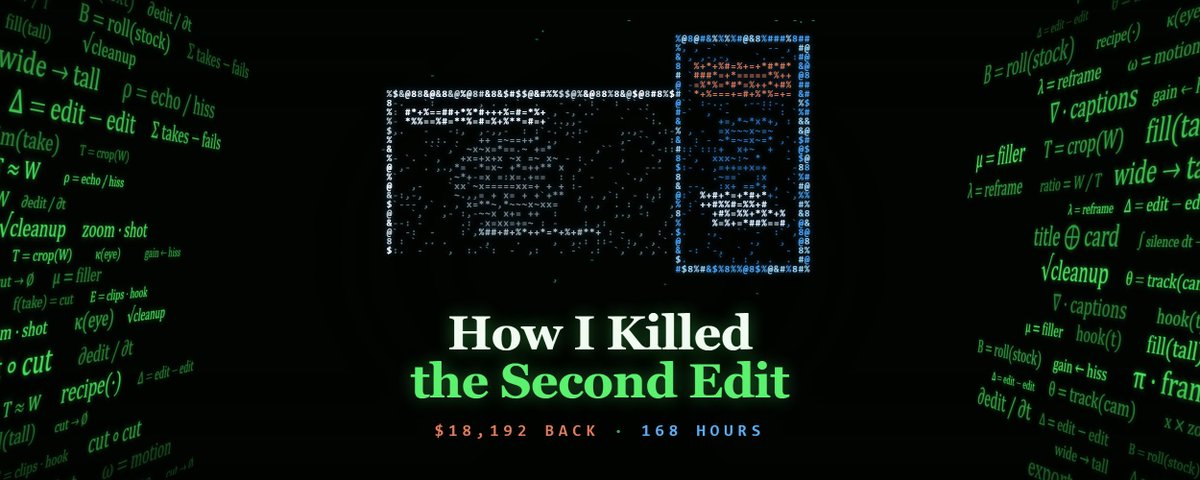
Neuro @0xNeuroBlue Nov 6 Article How I Killed the Second Edit and Reclaimed $18,192 a Year A walkthrough of the edit setup that erased my biggest yearly invoice. I posted one video a week to two feeds. LinkedIn wanted it wide with clean captions. Reels wanted it tall with text that moves.
My own Grok bots cut me loose, then pushed $33 to $3,151.62 in one night without me lifting a finger 94.93x by 6:30am. All of it ran on Grok Bot's own machine. My phone did nothing but sit there 10:10pm I opened Live screen. 5 bots, 5 cursors, hitting Buy and Sell on their own each one carries 1 GitHub repo and 1 rule it cannot violate → Scanner, CoinGecko skills. Ignores any pool below $20K liquidity → Analyst, tradingview-mcp. 8 checks, under 70 means dead → Brain, Google's TimesFM, 35K stars. Scales every buy by score → Executor, nansen-cli. Enters only on a 15-35% dip, closes 50% at 2x, trails the rest → Risk, LuxAlgo trade-journal. Cuts every position at -25% 12:02am the first stop, -$67.58. 1:41am the next, -$127.27. 3:40am one more, -$263.24 after 2 stops before 2am I would have pulled the plug myself through that second stop it was still sitting on another coin. 2:16am it closed at 4.28x, +$377.51 5:58am it loaded $1,063.66 into a single coin. 6:30am out, +$798.55 $33.20 → $172.86 → $899.69 → $3,151.62 14 coins. 11 green, 3 red 4 of the 5 repos cost nothing. The Nansen one is paid which of these 5 repos would you cut first?
Ridark @ridark_eth Aug 24 Article Grok Bot Trading Floor: how to run an 8-agent crypto desk in 10 Steps (Full-tutorial) Elon Musk made a repost of the video guide and I decided to write a guide in text format about agents Every trading bot you have used so far was a script. You wrote a rule, it obeyed the rule, and


Pointed REA at a 400-function app. 41 minutes, $1.80, every call came back with evidence. I wired one CLI into every agent on the machine. One setup command, a doctor check confirming which decompiler engines were live. Native binaries went through Ghidra, free and open source. REA itself is MIT-licensed, no extra cost when you already run a Claude plan. The session log is what stays. The tagged evidence folder underneath, growing with every step, versioned the moment you commit. 1. Install registers REA with every agent it finds. Doctor confirms which engines work. 2. House rules load first. Owned targets only, every claim tagged, bypass blocked. 3. Electron apps skip the engine. REA reads bundled scripts, traces from click to handler to IPC to network call. 4. Every function ranked by call count, top 30 written into a research file with evidence ids. 5. Output lands as markdown in the research folder. Feature map, function map, release diff, versioned in git per build. Five apps fully mapped in one week. $14. One function every six seconds. Under half a cent per call on the Grok-only pass. When did you last trace every function in your own build?
Mojunel.eth @mojunel Nov 15 Article How I Built a $14 Reverse-Engineering Lab cover This is a walkthrough of a setup I assembled in one week. Two models, one open-source agent, a free decompiler. Five paid apps mapped end to end. Total bill: $14. The lab scales from zero extra cost

A FREE 18-minute course on Sam Altman's Codex just dropped and it builds a real app without writing one line of code: • 2:12 - pricing and how the free plan gets you in • 5:36 - AGENTS.md generated in 15 seconds flat • 7:42 - first app built in 3 minutes with all 5 tests green • 10:26 - worktree and 2 subagents that checked 96 schedule variants • 14:04 - a reusable skill so Codex never forgets your rules 9 prompts, under 20 minutes of Codex work, zero code from you. most paid courses don't ship a working app on day one. watch it tonight. then open a worktree for the thing you've been putting off.
Karmi @0xKarmi Oct 24 Article The Agent Desk: a Knowledge Graph and an Action Guard in One Folder Most developers who try to run a coding agent give it one prompt, watch it loop for ten minutes, and close the tab. They don't know where the agent should live between sessions. They don't know how to


Obsidian's CEO dropped his vault template for free. People still spend months building from nothing 7 free repos, the entire second brain stack: 1. kepano obsidian github.com/kepano/kepano-obs… the vault structure, copy it and skip the blank page forever 2. obsidian templates github.com/groepl/Obsidian-T… Zettelkasten method with ready templates and scripts, plug it in and move 3. digital gardeners github.com/MaggieAppleton/di… notes that compound over time instead of dying in a subfolder 4. jsoncanvas github.com/obsidianmd/jsonca… open canvas format, maps live as flat files no platform can trap 5. obsidian releases github.com/obsidianmd/obsidi… community plugins and themes all in one spot, bolt on whatever you need 6. obsidian sample plugin github.com/obsidianmd/obsidi… official starter kit, ship the feature no one built yet 7. obsidian wiki github.com/Ar9av/obsidian-wi… AI agents handle your notes end to end, you only read the heavy lifting is already done and free grab it or keep building from zero
meya. @birmeya Nov 4 Article A Build: I Wired Claude Code Into a Second Brain That Proves Every Answer I wasted five months trusting a system that could not trace one answer to its source. I kept a single giant Markdown file as my knowledge base. Saved a tool note in January. Changed my mind about it

REA is the CHEAPEST full-app reverse lab I've ever assembled. A field report. Drop it into Claude Code before you log off. While you sleep it maps 400 functions for $1.80, logs every unknown and writes the evidence folder to git. The cheapest lab, one page:

Mojunel.eth @mojunel Nov 15 Article How I Built a $14 Reverse-Engineering Lab cover This is a walkthrough of a setup I assembled in one week. Two models, one open-source agent, a free decompiler. Five paid apps mapped end to end. Total bill: $14. The lab scales from zero extra cost
I genuinely don't understand why everyone isn't using this yet. I ran an invented swarm on a full app. $10. Eight Grok workers at $6 per million output. One Fable 5.2 controller at $8 in, $40 out. Output gap: 6.7x. $10 to $20 per big app. The expensive brain never writes a single module. It reads what the cheap workers found. 1. Scout. Eight workers fire in parallel, one module each. Each returns the job, public functions, outside calls, unknowns. 2. Merge. Fable loads all eight reports into one 1M-token window. Writes the connection map, фflags every disagreement. 3. Flag. Contradictions listed, claims without evidence marked. The controller sees what no cheap model can judge. 4. Rebuild. Craft Anything, 32,937 stars in 15 days. Observed behaviour only, never the code. Build, check, fix, loop. Old way. One model reads the entire app. Every module, every function. Burns $40 output on parts a $6 worker handles. Swarm. Cheap workers scan. The brain merges and catches every contradiction. One scales with price. The other scales with modules. Routing is the whole design.
Mojunel.eth @mojunel Nov 15 Article How I Built a $14 Reverse-Engineering Lab cover This is a walkthrough of a setup I assembled in one week. Two models, one open-source agent, a free decompiler. Five paid apps mapped end to end. Total bill: $14. The lab scales from zero extra cost


