The @ISTAART Lewy Body Dementias Professional Interest Area works to disseminate LBD information and increase research efforts through global collaboration.
Abstract submission open for International Lewy Body Dementia Conference, 16–18 Jun 2027 @karolinskainst Sweden🥳
ic-dlb.com/webinars/past-web…
Abstract submission deadline: 14 Dec 2026
@NextGenDlb pre-conference event: 15 Jun 2027
“Living with Lewy” post-conference day: 19 Jun 2027
There is limited guidance on helping women with PD before, during, and after pregnancy. Dr. Alexander Lehn shares how a recent review sought to address these gaps and help clinicians talk more confidently with their patients about family planning. @Divyani_garg@MDCP_Journalloom.ly/egNTfWY
Agent Orange and Parkinson's disease: The war ended, but the toxic exposures did not. A landmark study of 4.4 million veterans reveals a troubling connection. Agent Orange was a toxic herbicide mixture sprayed extensively during the Vietnam War. It contained 2,4-D, 2,4,5-T and contamination by dioxin, a highly toxic chemical. Gregory Scott and colleagues describe in a new landmark paper in JAMA Neurology how exposure to Agent Orange was associated w/ a substantially increased risk of Parkinson's disease and related brain disorders. Samuel Goldman, Ray Dorsey and I authored an accompanying editorial highlighting why these findings matter not only for veterans, but also for the millions of folks potentially exposed to pesticides today.
Key points:
- Among more than 4.4 million US veterans, Agent Orange exposure was associated w/ a 44% increased risk of Parkinson's disease, even after accounting for important factors including age, traumatic brain injury and other medical conditions.
- Veterans who directly handled or sprayed Agent Orange had a 99% increased risk of Parkinson's disease, suggesting that greater exposure may carry greater risk.
- The association extended beyond Parkinson's disease to REM sleep behavior disorder (78% increased risk) and dementia w/ Lewy bodies (66% increased risk), suggesting that toxic exposures may contribute to a broader spectrum of neurodegenerative diseases.
My take: This is a landmark study and an important moment for Parkinson's disease prevention. For decades, veterans have asked whether their exposure to Agent Orange contributed to their Parkinson's disease. We now have compelling epidemiological evidence supporting this association. Although observational studies cannot establish causation, the size of this investigation, the strength of the associations and the apparent exposure-response relationship are difficult to ignore.
What particularly concerns me is that the story does not end in Vietnam. In our accompanying editorial, Goldman, Dorsey and I emphasize that 2,4-D, one of the major components of Agent Orange, remains widely used today on farms, golf courses, lawns and other public spaces. More than 20 million kilograms of 2,4-D are applied annually for agricultural purposes in the US, approximately 4 times the amount of paraquat. We should not assume that today's exposures carry the same risks as the wartime mixture, but we urgently need to understand the long-term neurological consequences of these chemicals.
Here are 5 points that resonated w/ me:
1- Our veterans deserve answers. This study provides powerful evidence supporting the connection between Agent Orange exposure and Parkinson's disease and reinforces the importance of recognizing and caring for affected veterans.
2- Exposure matters. The nearly doubled risk among veterans who directly handled Agent Orange raises serious concerns about cumulative exposure and suggests that reducing toxic exposures could be an important prevention strategy.
3- Parkinson's disease may not be the only consequence. The associations w/ REM sleep behavior disorder and dementia w/ Lewy bodies suggest that environmental toxins may influence multiple diseases involving abnormal alpha-synuclein accumulation in the brain.
4- The exposure story extends beyond the battlefield. The continued widespread use of 2,4-D should prompt serious scientific investigation, stronger exposure monitoring and thoughtful regulatory scrutiny. We should not wait decades to understand the consequences of chemicals used in our communities.
5- It is time to move Parkinson's disease prevention from discussion to action. We must invest in identifying environmental risk factors, reducing preventable exposures and protecting future generations. We cannot treat our way out of an epidemic if we ignore what may be helping to fuel it.
The war ended more than 50 years ago, but its neurological consequences continue. The question now is whether we will learn from history and act before another generation pays the price.
doi.org/10.1001/jamaneurol.2…doi.org/10.1001/jamaneurol.2…
Yesterday, Latin American Psychiatrist Congress APAL 2026 (Congreso Latinoamericano de Psiquiatría APAL 2026) crowd got to hear phenomenal talks about #Lewy#LBD from our awesome members @fipobotero@mcecifer & @AarslandDag organized by our Communications Chair @fipobotero 🥳🤩
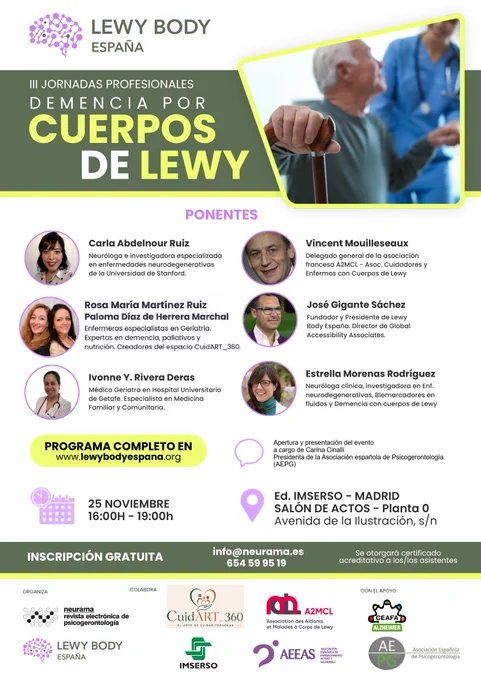
El 25 de Noviembre celebramos en Madrid las III Jornadas Profesionales sobre Demencia con Cuerpos de Lewy (DCLW)
Incluye:
Carina Cinalli - Presidenta de la Asociación Española de Psicogerontología @AEPsicoGeron@carlaabdelnour - Stanford University
@Vicent Mouilleseaux - @a2mcl
Caregiving is an act of extraordinary love. 💜
It can mean navigating medical appointments, managing daily routines, offering emotional support and advocating for a loved one through every stage of the disease. Caregivers are unsung heroes, often putting the needs of others first.
To every caregiver in our community: Thank you. We see you and are here for you.
#ThankfulThursday
Today kicks off #NationalFamilyCaregiversMonth! Join us in celebrating these real-life superheroes for their unrelenting strength. Write a tribute message in honor of a special dementia caregiver in your life at alz.org/honor. #ENDALZ
During #NativeAmericanHeritageMonth, we’re celebrating American Indian and Alaska Native Peoples and their important work to raise Alzheimer’s awareness & better health within their communities, moving us closer to a world without Alzheimer's and all other dementia. #ENDALZ
¡Juntos, pero no agregados!
Únete a@ISTAART #LewyBodyDementias PIA y haz parte de nuestras actividades para aprender, compartir ideas, conectar con colegas y crecer tu red profesional...
Together, but not aggregated!
Join @ISTAART#LewyBodyDementias PIA and take part in our activities to learn, share ideas, connect with colleagues, and grow your professional network.
Let's connect, collaborate, and advance LBD research together!
#LewyBodyDementia#LBD
There is no single treatment plan for Parkinson's that works for everyone. 🩺 Treatment decisions should be made with a care team and adjusted over time based on symptoms, goals and daily needs.
Learn more about treatments for PD by visiting: Parkinson.org/Treatment
Daylight saving time ends this weekend. ⏰ This change can be especially challenging for individuals living with Alzheimer's or another dementia. Here are a few tips to help caregivers ease the transition. 💜
Together, but not aggregated!
Join @ISTAART#LewyBodyDementias PIA and take part in our activities to learn, share ideas, connect with colleagues, and grow your professional network.
Let's connect, collaborate, and advance LBD research together!
#LewyBodyDementia#LBD
LBDA's free VuMedi channel features the U.S Based DIAMOND Lewy™ Management Toolkit – a comprehensive, clinician-focused resource for addressing the complex symptoms of #Lewybodydementia with evidence-based, on-demand guidance.
Access the channel: ow.ly/KAWg5102hpT
LBDA extends its condolences to the family and friends of Sir Patrick Stewart, the beloved actor who passed away on Wednesday, October 28 from Alzheimer’s disease and #Lewybodydementia. He was 86.
📷 Anders Krusberg / Peabody Awards, CC BY 2.0 (creativecommons.org/licenses…)
Our hearts go out to the family, friends and fans of iconic actor Patrick Stewart who died with Alzheimer's and Lewy body dementia this week.
Known for his iconic roles as Captain Jean-Luc Picard in Star Trek and Professor Charles Xavier in the X-Men franchise, Patrick was a force on screens big and small.
May his legacy of empathy, compassion and curiosity be an inspiration to us all. 🖖on.today.com/3UnMDig