We have postdoc positions at the The Institute for Soft Matter Synthesis and Metrology to work closely with scientists at @Georgetown and NIST on soft matter, broadly defined, including single molecule biophysics. Apply here academicjobsonline.org/ajo/j… by November 7!
Come to work with us! The Institute for Soft Matter Synthesis and Metrology @Georgetown is looking for Post-Doctoral Research Fellows to work closely with scientists at Georgetown and NIST on soft matter, broadly defined.
Apply here academicjobsonline.org/ajo/j…
by November 7!
New paper alert! We used optical tweezers to resolve heterogenous folding/unfolding pathways of repeat expanded huntingtin mRNA, revealing how hairpin slippage can seed inter-strand base pairing and promote aggregation. Congrats @NothinBut_Brett! 👏👏 nature.com/articles/s41467-0…
BREAKING NEWS
The Royal Swedish Academy of Sciences has decided to award the 2024 #NobelPrize in Chemistry with one half to David Baker “for computational protein design” and the other half jointly to Demis Hassabis and John M. Jumper “for protein structure prediction.”
Many thanks to Prof. Rodrigo Maillard @LabMaillard@GUChemistry for a great seminar on using single molecule methods to study allostery in protein kinases at our seminar series.
Starting the semester strong with a hike with my graduate students at Great Falls, VA! It doesn't hurt, also, that BSF (@usisraelbsf) is funding our project on PKA RIbeta in collaboration with the Ilouz lab @RIlouz
Congratulations to Dr. Ronit Ilouz from our Faculty for winning a research grant from the U.S.-Israel Binational Science Foundation (BSF).
The laboratory led by Dr. Ronit Ilouz investigates mechanisms for the formation of a unique inherited neurodegenerative disease, and gave it the name: NLPD-PKA. The disease develops in patients with a specific genetic mutation in the protein, which leads to the formation of protein clusters in the brain, similar to other neurodegenerative diseases such as Alzheimer's and Parkinson's.
The grant is in collaboration with Dr. Rodrigo Maillard from Georgetown University in the USA. The two laboratories will combine knowledge and focus on the cellular and molecular effects of the mutation on the brain, while discovering the mechanisms leading to the disease, with the aim of developing innovative and useful solutions, offering a tremendous advantage in promoting promising and applied research directions.
@RIlouz@Bar_ilan
Save the date for Single Molecule Biophysics 2025 (SMB 2025) to be held over January 5-10, 2025 (inclusive) at the Aspen Center for Physics, Aspen, Colorado. To get your name on our emailing list, contact tperkins@colorado.edu. Please RT.
jila.colorado.edu/smb/
Congratulations to Christian for being selected for induction as a Fellow in the National Academy of Inventors (NAI). See: otc.georgetown.edu/news/cele…
A few years old, but worth a read (perhaps in particular to those who do ML in BIO or take biological databases for granted)
"How Margaret Dayhoff Brought Modern Computing to Biology"
smithsonianmag.com/science-n…
Thanks to Jane Dyson, @LabMaillard, and @RuedaLab, as well as @ckinzthompson and all the other contributing speakers for an AMAZING Proteins in Motion session on Day 3 of #PS37!
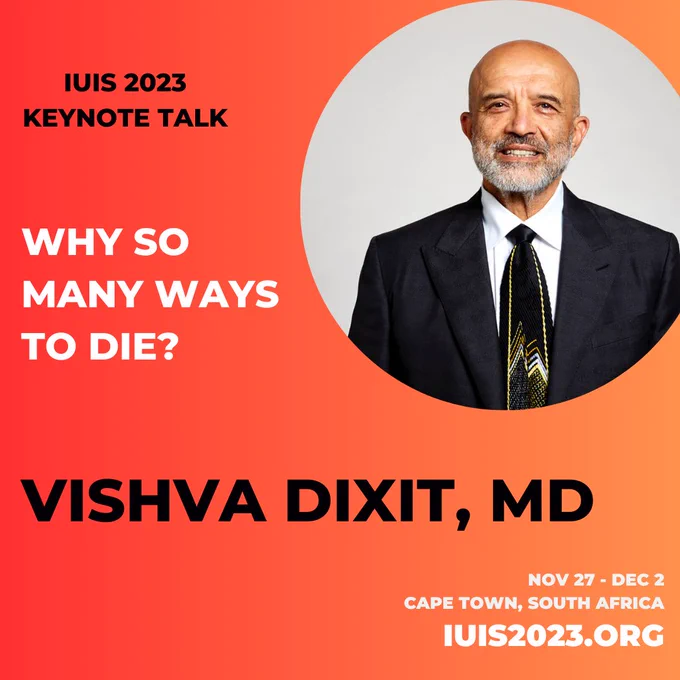
Dr. Vishva Dixit (@dixitvishva) will be joining us in Cape Town, South Africa as a keynote speaker for #IUIS2023! He will be discussing his research into various mechanisms of cell death and associated immunology.
Learn more & register at iuis2023.org! #RoadtoCapeTown
A mind-blowing paper has come out today in @Nature
In 2016, JC Venter Institute scientists trimmed a bacterial genome to its barest minimum required for life to synthesize what they called a "minimal genome" (science.org/doi/10.1126/scie…).
Today, a group of scientists from Indiana University reports how that minimal genome evolved over 2000 generations in comparison to the non-minimal genome.
The authors found that even when you reduce a bacterial genome to its absolute minimum where every nucleotide matters, the genome undergoes mutational events generation after generation as much as the non-minimal genome. One simply cannot stop the evolution.
Just over 300 days of evolution (equivalent to 40,000 years in humans) the minimal cell has gained everything it lacked in fitness on day one in comparison to the non-minimal cell.
When comparing the evolved traits between the minimal and non-minimal cells, the scientists found something striking. The evolutionary process increased the cell size of non-minimal cells but not that of the minimal cell. But that is not the striking part.
The scientists were able to identify the key mutation that resulted in cell size evolution. And it turned out that the mutation that helped the non-minimal cells to grow bigger is the same that helped the minimal cells to stay smaller. Growing bigger had a survival advantage for non-minimal cells and not growing bigger had a survival advantage for minimal cells. So, the mutation had a context-dependent effect. This just demonstrates that the evolutionary effects on traits have no absolute direction. All that matter is what is beneficial for the organism's survival.
The conclusion of the paper is metaphorically a quote from the Jurassic Park movie:
“Listen, if there’s one thing the history of evolution has taught us is that life will not be contained. Life breaks free. It expands to new territories, and it crashes through barriers painfully, maybe even dangerously, but . . . life finds a way". (scienmag.com/artificial-cell…)
nature.com/articles/s41586-0…