Job opportunity!
University Assistant/Associate Professor
We welcome applicants interested in computational approaches applicable to any crop, supporting the department's existing strengths.
Apply by 06 January 2027: tinyurl.com/azwuhr32
Sometimes big questions call for brand new tools. And when Salk scientists need a tool that doesn’t exist, they build it.
To better understand how cells recycle their worn-out parts, Payel Mondal (left) and Christina Towers (right) developed ASAP, a light-controlled tool that can rapidly and reversibly shut down the process, called autophagy.
By revealing what happens when cellular recycling stops, ASAP could help scientists understand what goes wrong in cancer, neurodegeneration, aging, and infection.
In the second photo, human cells are stained for ASAP (blue), nuclei (cyan), and two nucleoporin proteins (red and green), which the Salk team discovered are tightly regulated by autophagy.
salk.edu/news-release/light-…#SalkScience#Autophagy#CellBiology#ScientificDiscovery
Happy to announce that registration for our workshop “Transcriptional Reprogramming in Plants 🌱” is now open!!!
Featured invited speakers meet with ample talk slots for participants — for information visit: cutandrun.org#PlantScience#Workshop#cutandrun#Arabidopsis
Please help us spread the word! 📢
Our Institute is looking for a Scientific Director: oeawnr.onlyfy.jobs/de/job/u3…
Application deadline: November 15!
The @gmivienna is a truly exceptional place to do science and it is very generously funded by @oeaw ! 1/ 5
Plants need iron to grow, but so do some of the microscopic organisms that can make them sick. 🌱
Salk scientists discovered that a protein called SRF3 helps plants maintain the right amount of iron while keeping their immune response from going into overdrive. The discovery could help inform future efforts to grow hardier crops.
In this video, each spot is an individual SRF3 molecule, and the colored trails show how it moves across a plant cell’s surface over time.
Learn more: salk.edu/news-release/plant-…
Calling all postdoctoral researchers! Ready to share your discoveries, connect with leading scientists, and take the next step in your research career?
Applications are now open for Salk's 2027 Rising Stars Symposium! This two-day event brings outstanding postdoctoral researchers to the Salk Institute to present their science, exchange ideas, and connect one-on-one with Salk faculty.
Selected participants will have the opportunity to showcase their research, build professional relationships, and explore future collaborations. Travel stipends and lodging accommodations will be provided.
Interested in applying? Join our virtual workshop to learn more about the program and get application tips!
📅 Workshop: Friday, November 6, 2026 | 11 a.m.–12 p.m. PT
⏰ Application deadline: January 4, 2027 | 12 p.m. PT
⭐ Symposium: May 12–13, 2027
Current postdoctoral researchers who are approximately one to two years from entering the job market are encouraged to apply. Learn more, register for the workshop, and apply: salk.edu/about/our-community…#SalkInstitute#RisingStars#PostdoctoralResearch#ScientificCareers#ResearchOpportunities
Did you know plants have immune systems, too?
Just like humans, plants need nutrients to survive and must defend themselves against harmful invaders. But sometimes, those two priorities compete.
Iron, for example, is essential for plant growth, but harmful bacteria and fungi need it, too. So how do plants protect themselves without sacrificing the nutrients they need?
Salk scientists have discovered how a protein called SRF3 helps plants strike that balance, coordinating their immune defenses with their need for iron.
Led by Salk scientists Wolfgang Busch and Matthieu Pierre Platre, the research reveals new insights into how plants stay healthy while responding to threats. The findings could ultimately help scientists develop crops that are more resistant to disease, better equipped to handle environmental challenges, and more nutritious.
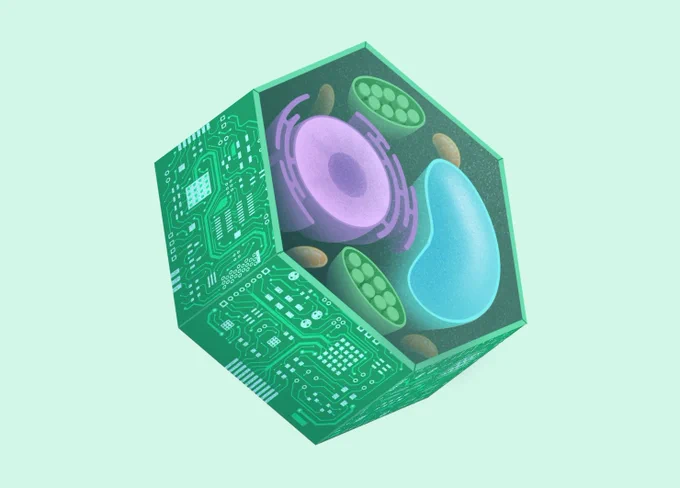
Photo: A plant cell with computer circuitry integrated into its plasma membrane illustrates the “membrane computer” concept, in which cell surfaces act as computational hubs that convert the external world into actionable signals. Credit to Amy Cao, Salk Sr. Science Illustrator.
🔗 Read more: salk.edu/news-release/plant-…#SalkInstitute#PlantScience#PlantBiology#ScientificDiscovery
Calling all college students: Your summer in science starts here! 🔬
Applications are now open for Salk's 2027 Summer Undergraduate Research Fellowship (SURF)! This paid, nine-week program gives undergraduate students the opportunity to work alongside Salk scientists, gain hands-on research experience, and explore careers in STEM. No prior research experience is required!
Interested in applying? Join one of our free virtual workshops to learn more about the program, get application tips, and ask questions.
📅 Upcoming workshops:
Friday, October 23 | 10–11 a.m. PT
Wednesday, November 18 | 2–3 p.m. PT
⏰ Application deadline: December 1, 2026.
The program runs June 7-August 6, 2027, and includes paid research experience, mentorship, and professional development.
Ready to take the next step in your science journey? Learn more, register for a workshop, and apply: salk.edu/about/our-community…#SalkInstitute#SummerResearch#STEMOpportunities#UndergraduateResearch#FutureScientists
One discovery at Salk helped change the future of cancer treatment.
In 1979, Salk scientist Tony Hunter, PhD, discovered tyrosine phosphorylation, a molecular switch that helps control how cells grow and behave. The discovery opened an entirely new field of research and ultimately paved the way for more than 100 cancer drugs used today.
Now, nearly five decades later, Hunter has received the 2026 Albany Prize in Medicine and Biomedical Research, one of the world’s most prestigious honors in science and medicine.
The $500,000 prize recognizes scientists whose discoveries have led to treatments that significantly improve patients’ lives. Hunter shares this year’s honor with UCLA oncologist Dennis Slamon, MD, PhD, for cancer biology discoveries that have helped save millions of lives worldwide.
It’s a powerful reminder of where transformative treatments can begin: with curiosity, foundational science, and an unexpected discovery.
Congratulations, Tony! Read more here: salk.edu/news-release/salk-s…#CancerResearch#CancerTreatment#FoundationalScience#SalkInstitute
Today's Nobel Prize in Physiology or Medicine began with a question about pond algae.
Peter Hegemann and Georg Nagel wanted to understand how Chlamydomonas, a single-celled green alga, swims toward light. The answer was channelrhodopsin, a protein that opens a tiny channel when struck by blue light. Karl Deisseroth then placed that protein into brain cells, giving scientists a way to switch specific neurons on and off with a flash of light.
The result is optogenetics, a tool that has transformed how researchers map the brain and study which circuits drive behavior and disease. It is also opening new paths toward treatment, including early work on restoring vision.
Decades ago, Nobel Laureate Francis Crick, a longtime member of Salk's faculty, imagined exactly this. He proposed that the ideal way to turn neurons on and off would be light, while admitting the idea seemed "rather far-fetched." Today, that far-fetched idea earned a Nobel Prize.
No one studying algae set out to change neuroscience, but that’s the power of foundational science. A curious question about how life works can become the basis for tools and therapies no one could have predicted. It's why Salk scientists, from plant biologists to neuroscientists, keep reaching across disciplines to ask those questions.
Congratulations to Karl Deisseroth, Peter Hegemann, and Georg Nagel!
#NobelPrize#Optogenetics#FoundationalScience#Neuroscience#PlantBiology
The UGA Genetics Department is hiring! Please help spread the word. We have an opening for an Associate Professor/Professor in Genetics, Synthetic Biology, and Biological Engineering. See ad for details – and join us here in Athens, GA!
Transformative opportunity for early career faculty @hhmi_science#FreemanHrabowski Scholars competition opens 11/3/2026 but you can get started NOW: view application components, establish eligibility, and unlock example applications and other resources hhmi.org/programs/freeman-hr…
Apply for a job at California Institute of Technology - Biology and Biological Engineering : Tenure-Track Faculty Position - in Biology and Biological Engineering dlvr.it/TVWCZC
Come join us! In addition to being a core member of the amazing Mol Bio department at MGH, the recruit will be a part of my department at Harvard Medical School.
Our MGH Dept of Molecular Biology is hiring. It’s an exceptional *basic* science dept with a longstanding track record for curiosity driven science, great colleagues / infrastructure and generous support.
Assistant Professor nature.com/naturecareers/job…
Stanford Bioengineering faculty search: Apply by Sept 30!
Bioengineering is defined broadly: if you are engineering at the level of biomolecules, cells, tissues, organisms, or using/developing advanced engineering techniques to study these systems - please apply!
facultypositions.stanford.ed…