⟳ MIT Stone Center on Inequality & Shaping Work retweeted
Britain, 1780 to 1840: output per worker up 46%, real wages up 12%. Simon Johnson (@baselinescene) warns that leaving AI to the market risks "a very long period of flat wages".
0:25
 Open web. Clear feed.

Economics research to revitalize labor market opportunities for workers without a college degree. Led by @DAcemogluMIT, @davidautor and @baselinescene.
Britain, 1780 to 1840: output per worker up 46%, real wages up 12%. Simon Johnson (@baselinescene) warns that leaving AI to the market risks "a very long period of flat wages".
Nobel economist @baselinescene on getting data from OpenAI, Google and Anthropic for the UK government: "We are in the driving seat." He adds: "They're not telling us what to do."

How can we compare and interpret different predictions for how AI will affect economic growth? We created this tool to let you be part of the discussion. Change the inputs and estimate TFP growth due to AI within @DAcemogluMIT's task-based model: shapingwork.mit.edu/forecast…

Why does the upper class become entrenched over time? Our postdoc Shay O'Brien describes her research, which shows that family ties are key to understanding the interconnectedness and persistence of upper class elites.
Co-director Simon Johnson is hiring for multiple positions at the UK AI Economics Institute, working to understand the economic impacts of AI and ensure this evidence informs policymakers. Learn more and apply below. Roles are based in the UK.
We are hiring at the UK AI Economics Institute for up to 15 research and analysis positions. Roles can be based in Manchester, Darlington, or London. Learn more at the link below and please spread the word! civilservicejobs.service.gov…

Passthrough businesses are central to the story of rising 1% share in the US Their original “Capitalists in the 21st Century” paper really reshaped our thinking about what was making up & driving the rise of the top 1% @omzidar & Eric Zwick’s book talk @MITshapingwork

The US tax system is biased against workers in favor of machines and algorithms, and has become more so in recent years. Our latest Substack post unpacks research from @DAcemogluMIT and co-authors: mitstonecenter.substack.com/…


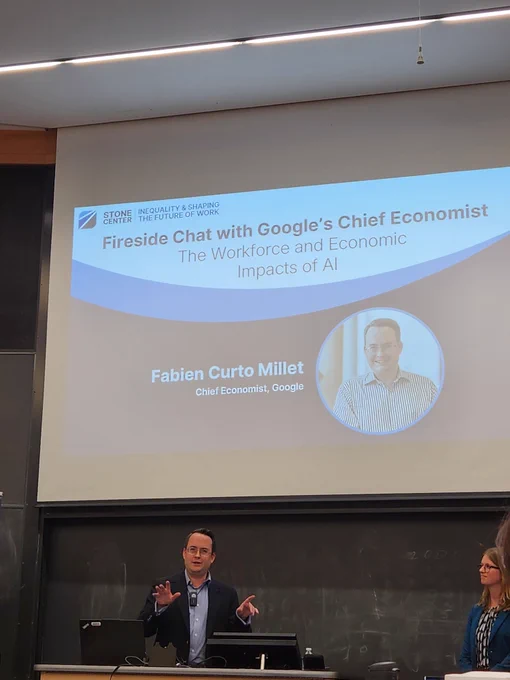
How many jobs will artificial intelligence eliminate? It’s a question that many people have been asking. But @Google's chief economist suggests that a more relevant question is how the technology will change the jobs that already exist. @MITshapingwork mitsloan.mit.edu/ideas-made-…

How will AI affect workers in lower-income countries? Co-director @baselinescene explains why he is concerned about widespread factory automation.
Watch a recording of the event: youtu.be/bKdfNztHq1k
At our recent fireside chat, co-director @DAcemogluMIT and Michael Sandel discussed how the interests of working people and liberalism came apart, why redistribution isn’t enough to repair the damage, and who has a say in the direction of AI. Full recording linked below 👇


(5/) Watch a recording of the event: youtu.be/kMe2tbR5PEg
(4/) "The most fundamental challenge of our economies today," he argued, is "the transition question. And it's one we can handle more or less elegantly and more or less intelligently, but it's coming at us at great speed."
(3/) While remaining optimistic that AI could be a net job creator, Fabien stressed the urgency of preparing for a significant transition period in the labor market.
(2/) Where will new jobs from AI come from? Fabien explained, "perhaps the better question is where all the new products are going to come from ... I am very curious about all of the latent markets with attendant employment that are going to emerge in the AI age."
(1/) Last week, we welcomed Fabien Curto Millet, Google's Chief Economist, to MIT to share his insights on the workforce and economic impacts of AI. He emphasized that the full effect of AI on jobs will include jobs lost, jobs gained, and jobs changed. 🧵