←
Mechanical Life Support1,461 posts
Mechanical Life Support avatar

Mechanical Life Support

@MLSCourse

The official twitter account for the multi-award winning 🏆 Mechanical Life Support 🫀programme. Visit our website for more information. @RBandH @GSTTnhs 🇬🇧

◷ Joined January 2022▧ 489 Photos and videos
Mechanical Life Support avatar
Mechanical Life Support@MLSCourse·Aug 26

Hello Everyone, we’re Deepak and Mohammed, intensivists in training, and we’re delighted to be joining you in the lead-up to UK SHOCK 26 as part of this year’s organising team. #UKSHOCK26 📆 Dates to highlight Early bird ends 31 Aug Abstract deadline 28 Sep (National prizes 🏆)

Post attachment
Mechanical Life Support avatar
Mechanical Life Support@MLSCourse·Nov 8

A consultant nephrologist and former RCP Vice President for Education and Training, she brings valuable insight into the challenges facing the NHS. Can clinical innovation succeed without system-wide change?

Mechanical Life Support avatar
Mechanical Life Support@MLSCourse·Nov 8

Professor Mumtaz Patel, 123rd President of the Royal College of Physicians, has played a key role in medical education, physician training and workforce development.

Post attachment
Mechanical Life Support avatar
Mechanical Life Support@MLSCourse·Nov 2

In refractory cardiac arrest, should we bring the patient to ECMO or bring ECMO to the patient? What should determine who gets access to ECPR?

Mechanical Life Support avatar
Mechanical Life Support@MLSCourse·Oct 18

From scientific discovery to clinical practice: how do we turn evidence into better outcomes? With over 2,000 publications and 250 scientists mentored, Prof Thomas F. Lüscher has helped shape cardiovascular medicine.

Post attachment
Mechanical Life Support avatar
Mechanical Life Support@MLSCourse·Oct 6

Yet ECPR use varied between ECMO centres - some centres had low ECPR volumes but good outcomes. What is the optimal number of ECPR cases for a centre? Is there a minimum volume needed to maintain expertise, or do systems, patient selection and speed to treatment matter more?

Mechanical Life Support avatar
Mechanical Life Support@MLSCourse·Oct 6

Can ECPR transform outcomes after cardiac arrest - and what does it tell us about UK shock care? A UK multicentre study co-authored by Dr Barrett examined 2,117 VA-ECMO patients, with 963 surviving at six months. Within this cohort, there were 302 ECPR runs and 92 survivors.

Post attachment
Mechanical Life Support avatar
Mechanical Life Support@MLSCourse·Sep 24

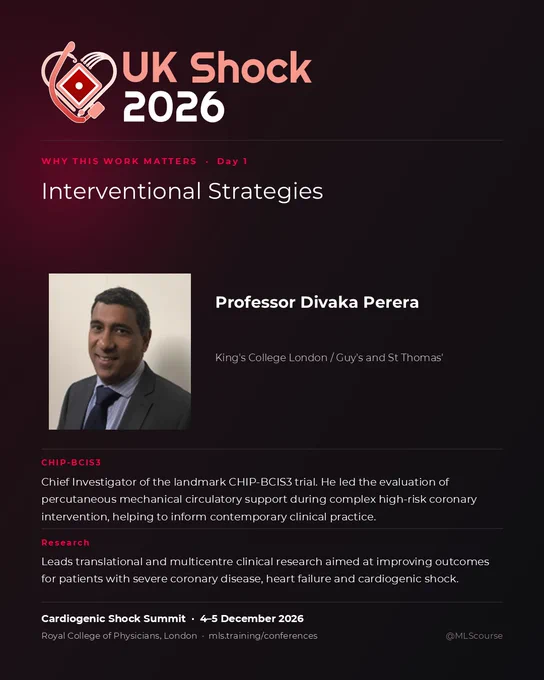
When we support the circulation during high-risk PCI, does that translate into better outcomes? At #SHOCKUK26, CHIP-BCIS3 chief investigator Professor Divaka Perera will take us through interventional strategies in cardiogenic shock.

Post attachment
Mechanical Life Support avatar
Mechanical Life Support@MLSCourse·Sep 24

CHIP-BCIS3 raises an important question: can we better identify patients most likely to benefit from mechanical support? At #SHOCKUK26🫀, chief investigator Professor Divaka Perera will take us through interventional strategies in cardiogenic shock.

Mechanical Life Support avatar
Mechanical Life Support@MLSCourse·Sep 24

Routine unloading did not improve the primary hierarchical endpoint. The mechanistic substudy found that unloading reduced inotrope use but did not improve cardiac index, filling pressures or post-PCI myocardial stunning.

Mechanical Life Support avatar
Mechanical Life Support@MLSCourse·Sep 24

Does routine mechanical support during high-risk PCI improve outcomes?🤔 CHIP-BCIS3, led by Professor Divaka Perera, randomised 300 patients with EF ≤35% and extensive coronary disease to elective Impella CP support or standard care.