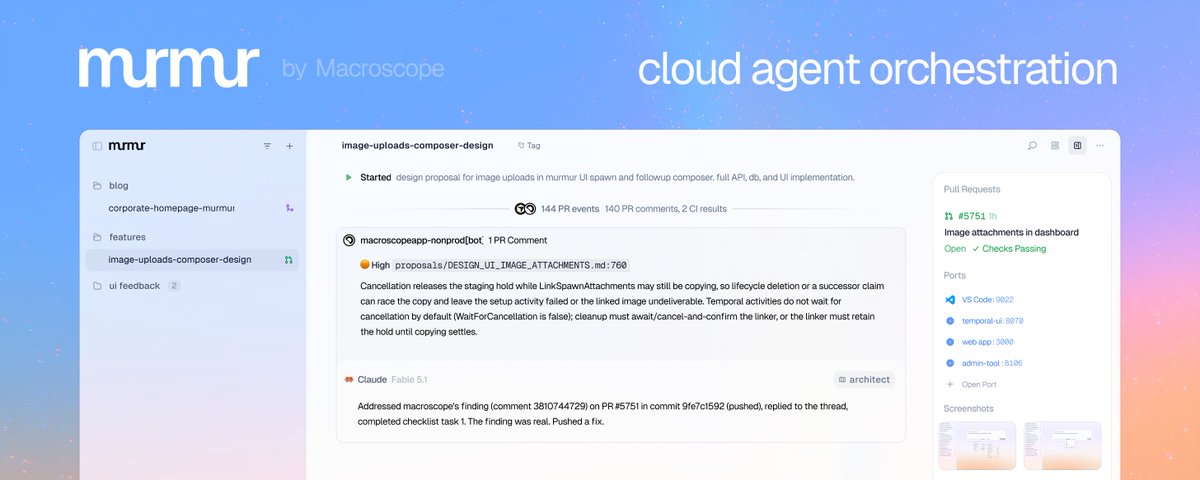
Kayvon Beykpour @kayvz Sep 3 Article Introducing Murmur For the last two months, 90% of the code we shipped at Macroscope was orchestrated through an internal tool we built for ourselves. It allowed each of our engineers to direct dozens of cloud agents in
introducing the Macroscope API: all your macroscope data, available to your scripts, pipelines and coding agents.
macroscope already reviews your PRs, summarizes your commits and tracks where your team's engineering effort goes. now you can pull that data into your own systems:
📊 productivity statistics: contributor and team stats, sprint reports and coding time trends
💳 billing data: what's driving your spend
🔍 code review performance: bugs detected, bugs addressed, and thumbs up/down feedback from developers
✅ approvability: every PR the agent approved or sent to a human, the reasoning behind each verdict, and approval rates over time
🤖 check run agents: how your custom agents are performing
📝 executive summaries: what your team shipped and where the effort went
the API is read-only for now. workspace admins can create a key under settings → developer API.
the standout is precision: 88.8 at xhigh vs 83.2 for opus 5.5 → the most precise claude model we've benchmarked
at higher effort levels the cost and latency jumps quickly, taking many more turns per agent. however, it is reasonably cheap and fast at lower efforts
Fable 5.2 is out today and it lands #5 on MacroscopeBench (78.5 F1 at xhigh), just a hair behind gpt-6.1 sol
it beats opus 5.5 at matched efforts for low, medium and high
see the full results: macroscope.com/benchmark
5/ code review is now even faster and catches more bugs.
we simplified how the review agents gather context, plus a bunch of other optimizations. vs the previous pipeline: 14% faster on average, +5% recall on known bugs (MacroscopeBench), precision unchanged
4/ Policy Repo: write your code review config files (e.g. ignore rules, correctness instructions, custom approvability policy) once and share it across multiple repos.
Need something different in one repo? add that file to the repo's own ".macroscope/" folder and it takes priority.
3/ Preview Mode lets you put Approvability on training wheels. You'll see what Macroscope *would* have approved and why, without actually getting the green approval check. Helpful for building trust and initial onboarding.
2/ the Approvability Dashboard shows what Approvability approved, what it didn't, and why.
open code review → Approvability to see approval stats plus the verdict and reasoning for every PR it evaluated. filter by repo, date range or verdict, search PRs, and export to CSV.
1/ Approvability is a macroscope agent that decides whether a PR is safe to merge without a human, and approves it if so. it now runs on an upgraded model, so it handles longer, more complex policies more reliably.
a new "Mode" setting lets you pick between:
- Permissive (the new default). Aims to approve PRs even in sensitive areas so long as there is evidence that the change was verified and tested empirically.
- Strict. More conservative. Changes that provide evidence of verification may still require human approval if they touch sensitive parts of the codebase.
we shipped a lot in october:
→ 𝗔𝗽𝗽𝗿𝗼𝘃𝗮𝗯𝗶𝗹𝗶𝘁𝘆 𝗠𝗼𝗱𝗲: Approvability, our agent that auto-approves PRs that are safe to merge, now has two modes, permissive or strict, with permissive approving more of them by default
→ 𝗔𝗽𝗽𝗿𝗼𝘃𝗮𝗯𝗶𝗹𝗶𝘁𝘆 𝗗𝗮𝘀𝗵𝗯𝗼𝗮𝗿𝗱: see every PR Approvability approved and why
→ 𝗣𝗿𝗲𝘃𝗶𝗲𝘄 𝗮𝗻𝗱 𝗿𝘂𝗻 𝗺𝗼𝗱𝗲𝘀: see which PRs Approvability would approve, without real approvals
→ 𝗣𝗼𝗹𝗶𝗰𝘆 𝗥𝗲𝗽𝗼: write your config once, let multiple repos inherit it
→ 𝗙𝗮𝘀𝘁𝗲𝗿, 𝗺𝗼𝗿𝗲 𝗮𝗰𝗰𝘂𝗿𝗮𝘁𝗲 𝗰𝗼𝗱𝗲 𝗿𝗲𝘃𝗶𝗲𝘄: 14% faster, +5% recall
highlights below ↓
New on MacroscopeBench: Gemini 4 Argon
Medium effort lands at 66% recall / 87% precision for $0.51. Higher effort buys little recall at 3× cost much more latency. Capable, but doesn't beat existing models on price/performance
See all models → macroscope.com/benchmark
Medium nearly matches high effort at 61% of the cost, so that's the sweet spot.
The tradeoff: Terra finds more bugs than 6.1 Sol by leaving more comments, ~2x as many. Recall goes up, but so does noise. Reviews are slower too, with the agent taking more average turns
🥈 GPT 6.1 Terra debuts at #2 on our code review benchmark, 1.6 F1 points behind Opus 5.5 at max effort for 1/20th the cost per review.
At medium effort it beats GPT 6.1 Sol at max for a third of the price!
See full results: macroscope.com/benchmark