1/6 🧵
How do you train a language model to become a self-adaptive, long-horizon optimization engine for executable trading policy search?
In our new paper, "The Time Value of Evolution," we introduce Lineage-Value Policy Gradients, or LVPG, a new long-horizon RL technique for adaptive evolutionary search.
We’ve been heads down exploring the architectures that could power the next generation of financial inference.
One we’re working on is Mixture-of-Powers: a looped mixture-of-experts architecture where different groups of expert blocks operate at different computational strides.
These expert groups are designed to compose in that larger-stride experts learn to approximate sequences of smaller, local updates. You can think of them as learned fast-forward operators that can be chained together with finer-grained computation.
The Sudoku animation below illustrates the idea. Combining larger jumps with smaller updates along the same computational trajectory.
We’re currently exploring the connections to market structure across timescales, distillation, and continual learning. There’s a lot to discover, and we’re looking for people who want to help build the models that will power finance.
Come work with us. We’re a small team of people who are absolute monsters at what they do and also kind, humble people to work alongside. We have high standards and zero ego.
DM if you’d like to chat.
New episode of The Information Bottleneck podcast featuring... me! (Wait, does this mean that I'm information or a bottleneck?) Anyway, we had a great conversation about games and AI, lots of laughs, and, I think, a good amount of information as well.
New episode of The Information Bottleneck with Julian Togelius @togelius about AI and games 🎮🕹️🎲
Julian (NYU professor, co-founder of modl.ai) has been working on AI for video games since 2004, back when people told him it wasn’t real research. Basically every kid’s dream job 😍
A few things from our conversation:
- Studios use way more ML than they admit. Julian’s advice for finding out what actually ships: go to GDC afterparties (The goalkeeper in EA FC is an RL-trained network, apparently.)
- Games are designed not to need much AI. Dialogue trees are awkward, but players know what to expect and designers know how to work with them. Put an LLM in Skyrim, ask an NPC how much a hamburger costs, and things get weird.
- About AGI: can we learn any game it’s never seen as quickly as a human? Making sure it’s never seen the game is the tricky part. You’d basically need to put a game studio at the South Pole and air-gap it.
- He also thinks we invented the wrong AI. We spent years building machines that copy us, when we could have built something that helps us do the things we’re bad at.
Super fun conversation. I'm sure you will love it
The episode - the-information-bottleneck.c…
I've always believed that intelligence should come from simple, general building blocks that learn their own abstractions directly from raw data; in other words, the bitter lesson. I think we're finally seeing a real step towards AI that can learn from all data.
Language modeling on raw bytes is a microcosm of this ideal, and to me it's a central problem in AI: if we can't build LLMs that learn end-to-end from bytes, how will we handle the rest of the world's data that we understand even less?
Last year we introduced hierarchical networks (H-Nets) as a first step. Our new version finds up to 3-5x efficiency gains in controlled scaling law experiments, and at larger scale matches an open-source model trained on 11T tokens with ~10x less data and compute. The posts below walk through what we found and why we think it works.
Cellular automata are powerful but painful to author. Rules are a lookup table; neural CAs are more expressive but a black box.
What if each CA rule was just code that you can read?
Introducing Programmable Cellular Automata (PCA)
This week on The Information Bottleneck we're talking with Julian Togelius (@togelius ) 🥳🥳🥳
Julian directs the Game Innovation Lab at NYU and co-founded modl.ai. For years he's worked on AI and games from both directions: using AI to generate game content and test games, and using games to actually measure what AI can do. Lately he's been digging into why LLMs that write code so well still fail badly at playing games, and what that gap tells us about spatial reasoning and learning in current models.
We'll get into game playing as a benchmark, procedural content generation, open-endedness, and where he thinks the AGI conversation goes wrong.
What should we ask him? Drop your questions in the comments
5/5
CAD turns program search into a process whose vocabulary changes during the run. Later programs inherit callable abstractions discovered from earlier high-fitness programs.
Accepted at IEEE CoG 2026.
With @Amidos2006@togelius.
Website: matt-quant-heads-io.github.i…
Paper: arxiv.org/pdf/2608.17947
4/5
CAD raised mean final-best in all comparisons across Sokoban, Zelda, Lode Runner, and Dangerous Dave.
The endpoint favored CAD whether search began with no helper library or a fixed hand-written expert API.
3/5
CAD extracts functions from high-fitness programs, validates them, and adds them to a run-specific helper module.
Later mutation and crossover calls can use the learned functions. Selected programs are refactored to call them only when behavior is preserved.
2/5
Raw code search fixes the vocabulary available to evolution. Useful routines for reachability, entity normalization, repair, and structure may be recreated across candidates.
Continual Abstraction Discovery (CAD) turns those routines into reusable primitives during the run.
🧵 1/5
What happens when a language model doesn't just write code, but dynamically creates its own expert API mid-run?
Instead of evolving individual game levels, our new paper evolves entire generator programs using an LLM as the mutation and crossover operator.
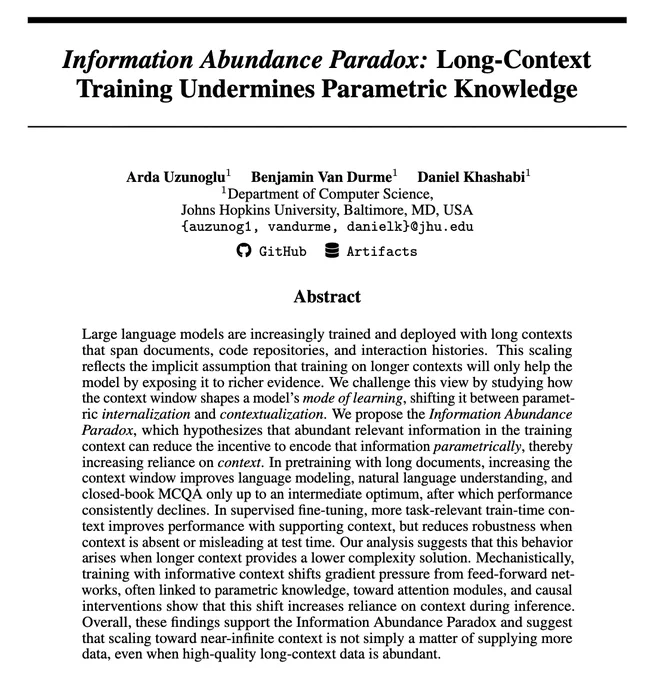
🚨 new preprint: Information Abundance Paradox
TL;DR: Longer context can weaken parametric learning in LLMs.
We propose the Information Abundance Paradox: when relevant information is abundant in the training context, the model has less incentive to internalize that information in its parameters.
At Nof1 we believe the next breakthrough in AI after reasoning is adaptation
If reasoning is the ability to detect patterns and leverage them, adaptation is anticipating how those patterns will change
This is a crucial capability for real world AI, and current LLMs struggle with it. We've run thousands of live market experiments and no amount of context, prompting, or harness engineering has worked. So, we've been pushing our research deeper down the stack
In this paper, we trained models that can better adapt in dynamic environments like markets. They learn to value an action by the futures it opens up, not just its immediate payoff
It's an early step, but we're building towards forever learners that are default forward-looking, rather than static and backward looking
1/6 🧵
How do you train a language model to become a self-adaptive, long-horizon optimization engine for executable trading policy search?
In our new paper, "The Time Value of Evolution," we introduce Lineage-Value Policy Gradients, or LVPG, a new long-horizon RL technique for adaptive evolutionary search.