...- --. .-. Can you decode this message? 🔦 On Nov. 17, celebrate Voyager 1 reaching one light-day from Earth by flashing this message toward the night sky. Join the celebration: go.nasa.gov/4iQtSMS

 Open web. Clear feed.
 ✓
Powered by data, driven by discovery, made for everyone.
...- --. .-. Can you decode this message? 🔦 On Nov. 17, celebrate Voyager 1 reaching one light-day from Earth by flashing this message toward the night sky. Join the celebration: go.nasa.gov/4iQtSMS
Today is the day! 💫 Tonight, after sunset, join people around the world in sending a signal skyward to celebrate Voyager 1's incredible journey and its milestone of reaching one light-day from Earth. Learn more: go.nasa.gov/4zpgtS0


IT’S (ALMOST) TIME! 🤩 New views of the universe coming to a screen near you on Dec. 7! Roman’s first images will showcase our unique scientific capabilities, revealing deep, panoramic, never-before-seen views of the cosmos. nasa.gov/news-release/nasa-i…


We're getting closer and closer to the first images from @NASARoman! 🤩 Here's a quick crash course on how Roman and Hubble will tackle different aspects of astronomy ⬇️
One light-day is an incredible distance. 💫 On Nov. 18, 2026, NASA's Voyager 1 will reach one light-day from Earth. But just how big is our galaxy? A NASA scientists explains what we know (and don’t know) about the size of the cosmos.

Students, the next giant leap needs YOUR ideas! NASA's new Moon Base Challenge is calling on high school and post-secondary students to develop innovative solutions to the challenges of living and working on the Moon. Here's how you can get involved.🧵(1/3)

What does it take to choose a landing site on the Moon? 🌕 Sunlight and communication are part of the puzzle. This @SpaceApps challenge asks teams to build a tool for comparing lunar landing sites using Sun and Earth position data. Explore: go.nasa.gov/4iIKPbV


No other traveler has ever journeyed so far from home. Voyager 1 is about to become the first human-made object to reach a distance of one light-day from Earth, or about 16 billion miles. ½
How does fire behave in microgravity, and why does it matter for crew safety? 🔥 This @SpaceApps challenge asks teams to turn decades of NASA microgravity combustion research into an interactive dashboard for fire safety on future missions. Explore: go.nasa.gov/3Wj9b4F

Explore the 2026 challenges: go.nasa.gov/4sMf0U8
Ready to use NASA data to explore the Moon, understand Earth, and study the universe? Join us this weekend, Nov. 14–15, for the NASA @SpaceApps Challenge! Everyone is invited to use open data to build ideas and tools that tackle real-world challenges.

From curious stargazer to published scientist! 🔭 A high school research project led Darcy Wenn to NASA's Exoplanet Watch, where he helped study distant worlds and co-authored scientific research. See where NASA citizen science can take you: go.nasa.gov/3Ufd220 #STEMDay

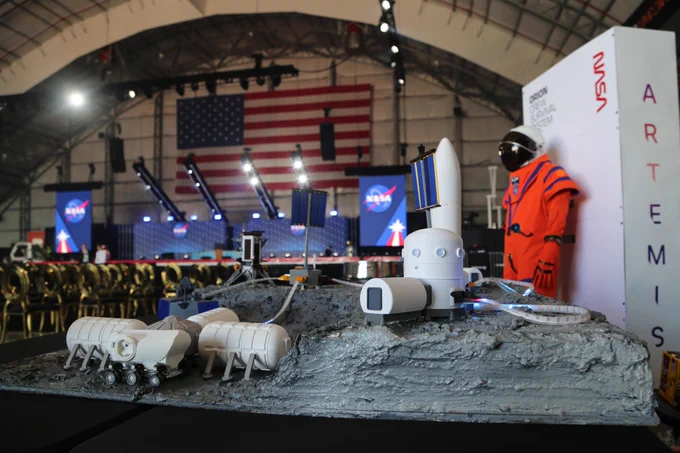
New awards. New mission updates. More progress toward a Moon Base. We're advancing commercial lunar deliveries, a nuclear-powered rover, launch and orbital transfer services, and infrastructure to support a sustained human presence on the Moon: nasa.gov/news-release/nasa-a…
NASA is moving forward with PROMISE, a nuclear-powered lunar rover that will build on decades of Mars rover innovation to explore the Moon's South Pole region, advance lunar science and discovery, and support Moon Base objectives. NASA has selected @blueorigin to deliver PROMISE to the lunar South Pole region. youtu.be/8f0aPpW1Ifs?si=VLg7…
LIVE: Big updates on our efforts to build a Moon Base! @NASAAdmin and agency leaders are sharing the latest progress and new developments toward establishing a sustained human presence on the lunar surface. x.com/i/broadcasts/2ybAenAyp…
We're kicking Moon Base updates into high gear! 🚀 Tune in today at 5 p.m. ET as agency leaders share the latest progress and new developments in our efforts to establish a sustained human presence on the lunar surface. The event will stream live from MAX POWER at @NASAKennedy.