⟳ Liangyi Chen retweeted
Behold: The full JUMP Cell Painting chemical dataset preprint! Images + 1.53 billion single-cell profiles for 115,796 compounds in human cells, made across 12 labs. All freely available 🧵 biorxiv.org/content/10.1101/…

 Open web. Clear feed.

Microscopist, biophysicist, Super-resolution microscopy, insulin secretion, vesicle trafficking, mitochondria, organelles
Behold: The full JUMP Cell Painting chemical dataset preprint! Images + 1.53 billion single-cell profiles for 115,796 compounds in human cells, made across 12 labs. All freely available 🧵 biorxiv.org/content/10.1101/…

What can live imaging of human pancreatic slices reveal about diabetes? I’ll host Herbert Gaisano (University of Toronto) at PKU on 16 Nov, 14:00–15:00 Beijing time. Islet secretion, immune injury and tissue crosstalk. B117, Research Building No. 2 #Diabetes

We propose an islet test linking molecular features, cellular secretion and biphasic insulin release. Which biological system would you choose to test whether cellular and tissue-level predictions agree with each other and with experiment?
Two models might predict the same insulin output while disagreeing about which cells produce it. A targeted perturbation could distinguish them. VITAL asks which biological information models must retain—and how to test the links between scales.

What must a model know about cells to predict how a tissue responds to intervention? Our preprint, VITAL: New Biology in the Age of AI, is now on Zenodo. A proposed research programme, open for discussion: doi.org/10.5281/zenodo.24028…

We propose an islet test linking molecular features, cellular secretion and biphasic insulin release. Which biological system would you choose to test whether cellular and tissue-level predictions agree with each other and with experiment?
5/5 We invite colleagues to explore live-cell SR-FLIM with us. If you study organelle microenvironments or develop lifetime-sensitive probes, get in touch about a pilot experiment. Thanks to all our coauthors! biorxiv.org/content/10.64898…

4/5 In living cells, we resolve probe-reported lifetime heterogeneity within and between mitochondria, and local variation in lipid environments. This opens questions about how functional differences are organized within organelles.
3/5 ~100 nm lifetime maps at 2.8 Hz over 56 x 56 µm². Across fluorophore standards, RIVE lowers lifetime SD ~3-fold relative to non-RIVE SIM-fdFLIM, with mean lifetimes consistent with calibrated widefield measurements.
2/5 Hessian-SIM, sparse deconvolution and SACD expanded our access to fine cellular structures. rFRC brought local resolution and uncertainty assessment. RIVE extends this effort to preserving the ratios used to infer function.
1/5 From resolving live-cell structures to measuring functional differences. Our preprint combines SIM-fdFLIM with ratio-preserving reconstruction (RIVE) for ~100 nm lifetime imaging. We welcome live-cell collaborations. biorxiv.org/content/10.64898…
From follistatin biology to precision diabetes care. Join us for Yang de Marinis’s talk at Peking University on 6 Nov, 10:30–11:30 Beijing time, following Patrik Rorsman’s seminar. B117, Research Building No. 2. Details on poster. #Diabetes #PrecisionMedicine

How do islet δ-cells shape hormone secretion? On 6 Nov, I’ll host Patrik Rorsman at Peking University: “Pancreatic somatostatin secretion in health and disease.” 09:30–10:30 Beijing time | B117, Research Building No. 2 #Diabetes #IsletBiology


Cognitive computational neuroscience nature.com/articles/s41593-0… 1/ Move beyond brain mapping. Mapping which brain regions activate during a task is not enough to explain cognition. We need computational models that reproduce behavior and explain how neural activity generates perception, learning, decision-making, and action. The goal is to understand the mechanism, not just the location. 2/ Build models that perform cognitive tasks. Allen Newell argued that understanding cognition requires constructing systems that actually perform the functions we want to explain. A theory of decision-making, for example, should predict choices under different conditions—not merely describe them verbally. Simulations help test whether proposed mechanisms work together to produce intelligent behavior. 3/ Integrate three disciplines. Cognitive science explains the computations underlying thought; computational neuroscience investigates how neural circuits implement those computations; AI develops algorithms that perform complex tasks. Each provides different constraints. Combining them could produce models that are simultaneously behaviorally effective, computationally explicit, and biologically grounded. 4/ Neural networks are a bridge between brains and AI. Deep neural networks learn hierarchical representations that can resemble those observed in biological sensory systems. Research has shown that networks trained for object recognition can predict aspects of visual cortical representations. However, predictive similarity does not prove that the brain uses the same algorithms. Models must also be tested against neural and behavioral evidence. 5/ Biological neurons offer more than artificial units. Most conventional artificial neural networks use simplified units that combine inputs and apply nonlinear transformations. Biological neurons exhibit action potentials, dendritic computations, recurrent signaling, oscillations, and complex temporal dynamics. Incorporating these features into task-performing models may reveal computational principles that simpler AI architectures overlook. 6/ Neural decoding is not a complete explanation. Decoding asks what information can be extracted from neural activity. Encoding models predict neural responses; representational similarity analysis compares patterns of activity; connectivity models examine interactions. These methods constrain theories, but they do not necessarily explain how the brain transforms information to solve a task. Mechanistic models must connect representations to computation and behavior. 7/ Bayesian inference offers a theory of perception and reasoning. The brain must interpret noisy sensory information using prior knowledge about the world. Bayesian models formalize this process by combining prior beliefs with incoming evidence. Generative models go further by representing how hidden causes produce observations. They offer a framework for studying uncertainty, causal reasoning, concept formation, and the ability to learn from limited experience. 8/ Learning and control require multiple strategies. Reinforcement learning provides a framework for understanding how actions and feedback shape future behavior. Model-free approaches learn values or policies from experience; model-based approaches use an internal model to evaluate possible outcomes; episodic approaches reuse specific past experiences. Understanding how biological brains combine these strategies could inform more adaptive AI systems. 9/ Combine bottom-up and top-down approaches. Bottom-up neuroscience begins with neurons, circuits, and measured activity. Top-down approaches begin with a cognitive function and ask what computations are required to perform it. Neither is sufficient alone. Strong theories should explain how biological mechanisms support meaningful behavior—and use behavioral requirements to identify which neural mechanisms matter. 10/ The future is an integrated NeuroAI. A major challenge is to connect three levels: computational goals, representations and algorithms, and neurobiological implementation. This requires collaboration across neuroscience, cognitive science, mathematics, and AI, along with shared datasets, models, tasks, and evaluation methods. The ultimate ambition is to build systems that perform intelligent tasks while explaining how brains learn, represent knowledge, and adapt. The big idea: The next leap in AI and neuroscience may come from treating the brain not simply as a source of data, but as a system whose computational principles can be tested through models that connect neural mechanisms to intelligent behavior.

How will biology, physics, computing and engineering shape the next frontier? Join Pavel Kabat, HFSPO Secretary-General, at Peking University: “Life Science Frontiers in the 21st Century” 27 Oct 2026 | 09:00–10:00 Beijing time (UTC+8) B117, College of Future Technology


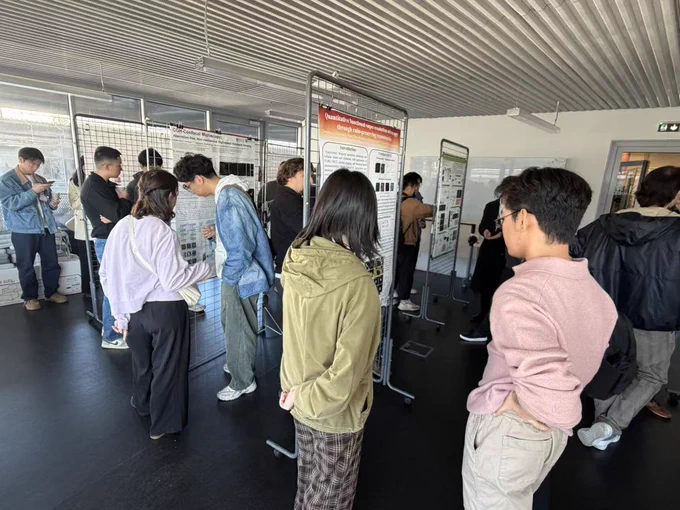
🎉 Day 2 of SFBS-2026 Scientific Symposium! Another inspiring day in Bordeaux on live-cell nanoscopy, accessible super-resolution, AI for imaging, mitochondrial dynamics, nanoscale cytoskeleton and synapses, expansion microscopy, and multidimensional single-molecule methods. Lively poster sessions and industrial exchanges further strengthened collaborations between Chinese, French and European researchers. Looking forward to the final day! 📍 Centre Broca Nouvelle-Aquitaine, Bordeaux 📅 Oct 19–21, 2026 Event info → france-bioimaging.org/news-e… About NBIC → nbic.pku.edu.cn/en/ VITAL Initiative → vital-initiative.org.cn #SFBS2026 #NBIC #BioImaging #PKU #VITAL