
 Open web. Clear feed.

Just a guy who wants to win so badly|| Web3|| Ai creator
🚨 Architects are going to hate this. A full 3D building editor now runs right in your browser, and the whole thing is open source. It's called Pascal Editor. You don't install anything, you don't need a license, and you don't pay a subscription. It's built on React Three Fiber and WebGPU, so your GPU does the rendering and it feels close to desktop software. Here's what you get: → Buildings, levels, walls, slabs and zones you can edit live in 3D → Undo/redo on every change → Boolean geometry for cutting doors and windows into walls → Only the parts you edit get re-rendered, so big scenes stay smooth → Packages on npm (@pascal-app/core and @pascal-app/viewer) if you want to build your own editor on top of it The best part is the MCP server. You can connect an AI agent and have it create, check and save building scenes for you. For comparison, a Revit seat costs $3,005 a year. Pascal is free and MIT-licensed, and it already has 25K+ stars on GitHub. editor.pascal.app Follow @Ox_Decrypt for more
How it plays •You start inside Bean Street Café, next to the espresso machine. Brewing fills a carrier on the courier's head with four modelled cups, and each one disappears as you hand it over. •There are eight pet neighbours: a bunny, pup, owl, frog, sheep, hedgehog, penguin and fox. Each gets one cup per round. With four cups a trip, a round takes two trips back to the café, and it's timed. •Exploring is the main goal. There are 15 named places that pop up a title card when you first walk in. There are also 10 golden beans hidden high up or inside things. •The neighbour book (📖) gives a hint for anyone you haven't met yet. Neighbours also give you a tip after their first coffee. •For vertical exploration there's a two-flight lookout tower, a library with indoor stairs and a balcony, and a windmill with outside stairs. There are also three ways over the river: a stone arch bridge, a rope-and-plank bridge and stepping stones. Bouncy mushrooms launch you up onto a tall flat rock. •Small interactions: •the café radio and the doorbell •a fountain you can toss coins into •a windmill you can spin •a telescope that zooms out to show the whole planet •a swing on the big oak at the north pole •benches you can sit on, signposts and mailboxes you can read •a campfire at the south pole •swimming in the river and lake •It works with keyboard and mouse or touch. On a phone, drag on the left half of the screen to walk and on the right half to look around.
I asked opus5.5 to Build an original single-player 3D browser game about delivering coffee, set on a small, walkable spherical planet with a curved horizon. Give it a warm, stylized, cutesy look, mixing a compact town with quieter natural areas connected by paths around the globe. Include vertical exploration through stairs, upper floors, and bridges. Start the player in a café beside a coffee machine. Let them carry four visibly modeled coffees and explore to find neighbors, delivering to each once per round. Use a custom 3D interpretation of the Codex pet as the courier and other pets as neighbors. Keep discovery central, with interesting places to explore and small, playful interactions. Build the game modularly so we can change the world, characters, and mechanics easily. Use editable Blender assets, keep browser performance in mind, and begin with a playable version that we can improve through repeated feedback.
Same AI model. It scored 42% in one setup and 78% in another. The only thing that changed was the harness: everything built around the model. That covers what it sees, which tools it can use, how it checks its own work, and when it retries or stops. LangChain proved it on Terminal Bench 2.0. They locked GPT-5.2-Codex, changed only the harness, and climbed from outside the Top 30 to the Top 5. Now agents are building their own harnesses. In a Stanford paper, one beat Claude Code by 10 points while using the same model. Stop asking which model. Ask what you built around it.
DECRYPT @Ox_Decrypt Nov 16 Article Harness Engineering: The Skill That Replaced Prompt Engineering in 2026 LangChain took its coding agent from just outside the top 30 to the top 5 on Terminal Bench 2.0 without changing the model or rewriting the prompt. They changed the harness, everything built around

Prompt engineering isn't the skill anymore. Harness engineering is. Agent = Model + Harness. The harness is everything around the model: the rules it reads, the tools it can use, what it remembers, and the checks its work has to pass. Three questions, three eras: Prompt engineering: what do I say? Context engineering: what does the model see? Harness engineering: what system does the model run in? The numbers are hard to argue with. LangChain went from 52.8% to 66.5% on Terminal Bench 2.0 without touching the model OpenAI shipped about 1M lines of production code in 5 months with zero written by hand Stanford found up to a 6x gap between harnesses on the exact same model Mitchell Hashimoto, who named it, boils it down to one habit: every time your agent makes a mistake, you engineer a fix so it can never make that mistake again. How to start today: Keep one rules file and add a line every time the agent gets something wrong When a rule doesn't hold, turn it into a tool or a test Judge your setup by how rarely the same failure repeats Your prompts still matter. They're just one part of a much bigger job now. Bookmark this before you write your next prompt.
DECRYPT @Ox_Decrypt Nov 16 Article Harness Engineering: The Skill That Replaced Prompt Engineering in 2026 LangChain took its coding agent from just outside the top 30 to the top 5 on Terminal Bench 2.0 without changing the model or rewriting the prompt. They changed the harness, everything built around
Harness engineering is the skill that replaced prompt engineering in 2026. A harness is everything around the model: the tools it can use, the memory it keeps, the guardrails that limit it and the checks that verify its work. GPT-5.5 reached 61.5% when Codex's harness ran it and 87.2% when Cursor's did, within one week. The model stayed the same and the harness decided the result. Prompts still matter, but they are now one part of a bigger system. The people getting the best results from AI are building that system.
DECRYPT @Ox_Decrypt Nov 16 Article Harness Engineering: The Skill That Replaced Prompt Engineering in 2026 LangChain took its coding agent from just outside the top 30 to the top 5 on Terminal Bench 2.0 without changing the model or rewriting the prompt. They changed the harness, everything built around
Prompt engineering stopped being the skill that matters in 2026. Codex's harness got 61.5% out of GPT-5.5. Cursor's harness got 87.2% out of that exact model within a single week. Claude Opus 4.6 shows the same pattern, with an 18.4-point gap across harnesses on Terminal-Bench 2.0. The model was identical every time. What changed was everything around it: the tools, the memory, the guardrails, the checks. That layer is called the harness, and building it is now the job. Your prompts still matter, but they are one part of a bigger system. 54 seconds on what harness engineering is and why it took over 👇
DECRYPT @Ox_Decrypt Nov 16 Article Harness Engineering: The Skill That Replaced Prompt Engineering in 2026 LangChain took its coding agent from just outside the top 30 to the top 5 on Terminal Bench 2.0 without changing the model or rewriting the prompt. They changed the harness, everything built around

I built an entire open-world driving game with ONE prompt using Fable 5.2. you can explore the city, speed through traffic, crash into cars and get chased by the cops. every car, building, texture and sound was generated in code. it runs right in your browser. no downloads, no installs.
Naïve Mira lets you drop your own characters and products into existing clips. That alone could change AI filmmaking, and the transparent pricing makes it easy to try. Curious what creators build with it. The best part of Naïve Mira is that your characters and products go straight into existing clips. The transparent pricing is a nice bonus. AI filmmaking just got a lot more flexible.
We rebuilt Higgsfieldc Genjutsu but 14.5× cheaper. Meet Naïve Mira: > Recast any clip with your own people, places and products from up to 4 photos > No markup, you pay what the render costs us > Run it in Naïve Studio, or let your agents run it through our CLI/SDK Try it today ⚡

This is actually pretty interesting. Being able to recreate a video with your own people, places and products from just a few photos is wild. Naive Mira is definitely worth checking out.
We rebuilt Higgsfieldc Genjutsu but 14.5× cheaper. Meet Naïve Mira: > Recast any clip with your own people, places and products from up to 4 photos > No markup, you pay what the render costs us > Run it in Naïve Studio, or let your agents run it through our CLI/SDK Try it today ⚡
Your engine only makes power 1 out of every 4 strokes. Here's the whole cycle, step by step: Intake: the piston drops, the valve opens, air and fuel flow in Compression: the valves shut and the piston squeezes the mix Power: the spark fires and the burn shoves the piston down Exhaust: the piston rises and pushes the burnt gas out That's two full turns of the crankshaft for one push. At 3,000 rpm, each cylinder repeats the cycle 25 times every second. Bookmark now before you loose it
A faceless YouTube channel pulled 137K subscribers and 14.8M views in just 2 months with only 14 videos. No camera. No animation skills. Just free AI tools. Here’s the workflow behind it: → Claude writes the script → ElevenLabs turns it into a voiceover → FoziScribe timestamps every pause → Claude converts each line into an image prompt → Google Flow generates the visuals in bulk The clever part? The voiceover comes FIRST. Every pause becomes a cue for the next scene Match the visuals to the audio, sync everything, and publish. That’s the entire production pipeline. The real opportunity isn’t just making videos with AI. It’s building a repeatable content system without showing your face or spending hours animating. Bookmark this for more
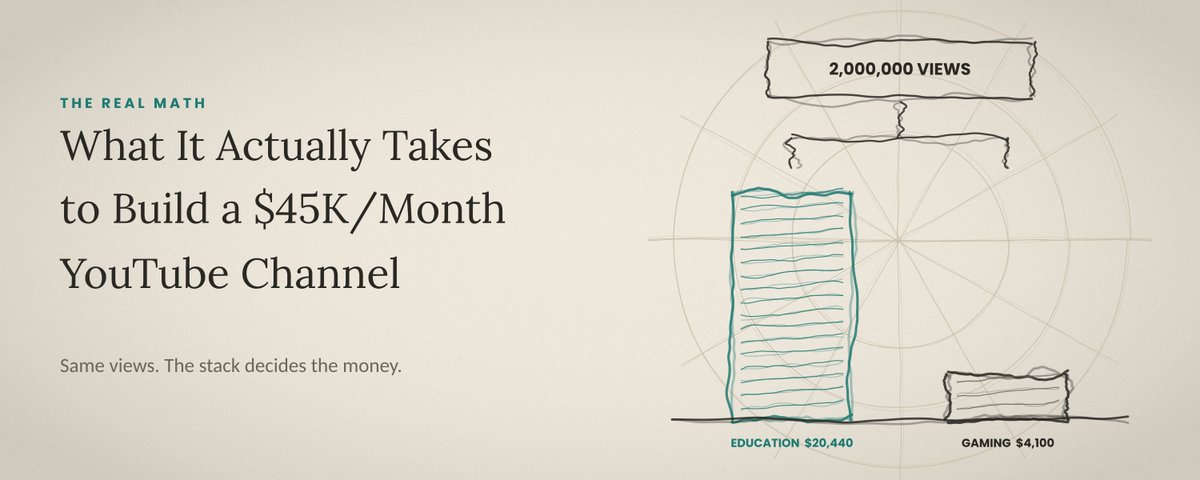
DECRYPT @Ox_Decrypt Nov 5 Article What It Actually Takes to Build a $45K/Month YouTube Channel 2,000,000 views can pay you $20,440 or $4,100. How good your videos are has very little to do with which one you get. This is the money side of YouTube that most creators never see laid out. By the
claude fable 5.2 is f*cking insane it can turn 2d blueprints into full 3d walkthroughs that you can tour these go for $5k to $10k per plan and there's a huge market for them: > home builders selling homes off plan > architects presenting a design to a client > interior designers presenting a renovation > developers selling apartments off plan > kitchen and bath remodelers selling upgrades here's how to start this business: > pick one niche and find businesses with plans on their site > give fable the blueprint and their photos > it renders a few rooms with gpt image 2.5 or a short clip with seedance as the sample > send them the sample of their own plan before you pitch > once they pay, fable builds the full walkthrough to scale > charge per plan to do the rest of their catalog give this prompt to fable to get started: <role> you find businesses that sell spaces from drawings and turn their 2d floor plans into photoreal homes you can walk through in a browser. you handle the outreach and the build. every room is judged against the client's own photos, and nothing ships until it holds up next to them. </role> <brief> - niche: [home builders / architects / interior designers / developers / remodelers] - area: [state or city] - offer: a free sample of their own plan, then the full walkthrough per plan - my details: [name, email, calendar link] - i'm away and won't answer questions. make the calls yourself and keep going. </brief> <find_leads> - use the apify google maps scraper to pull every [niche] in [area] with a website - use the apify website content crawler on each site and keep the ones with floor plans or renders on their pages but no walkable 3d tour - for each one, save the plan drawing and photos of their best plan, the sales or owner contact, and a one line note on how they sell today - only use public pages and plain requests. never work around bot checks </find_leads> <sample> - before any 3d work, render three rooms from the plan with gpt image 2.5, matched to their photos, or a short walkthrough clip with seedance - draft a short email with the sample and the offer. no invented prices, numbers or claims - put business, plan, sample, contact and email in a sheet and show me before anything is sent </sample> <build> once a client pays: - trace the drawing into one data file of walls, openings and rooms. draw it back over the original and measure the overlap before any 3d work - build only the main rooms. entry, main living space, kitchen, patio, yard. close the doors on the rest - build everything in code. blender with python for the shell, furniture and textures. three.js for the viewer. no downloaded models or textures - bake the light with a film quality renderer so the browser only displays it. direct sun in every interior, picked by measurement not by eye - fidelity isn't appeal. style each room so it looks photographed and sells - their listed upgrades as options you can step into inside the room, with a running price and a lead form that records what the buyer explored - the deliverable is the live page, not a video. host it and make it run on a phone </build> <critic_loop> the builder never grades its own work. - after each room, send renders and the client's photos to a fresh critic that has seen none of the work - it answers with a yes or no, at most five problems ranked, each with a fix in numbers, and what is already good - fix the worst first, render again, send to a new critic. repeat until yes - for choices of taste, show a critic both versions labelled a and b and let it pick </critic_loop> <deliverables> - the lead sheet with samples and drafted emails, for my approval - per paid client: the hosted walkthrough link, a contact sheet of every room, the critic log, and a note on anything a human should still check </deliverables>
THIS COMPLETELY CHANGES HOW YOU USE CLAUDE CODE. Fable 5.2 doesn't have to be just another model in your stack. You can put it in the role of CEO of an entire team of agents. The logic is simple: Fable thinks. Opus validates. Sonnet executes. Haiku scales up the heavy lifting. And that's when things start getting wild. Instead of opening a conversation and asking a single model to do everything, you create an operation where each model gets a specific role. Imagine a project with thousands of lines of data. You can have Fable: → understand the goal → break down the problem → create the tasks → distribute the work among agents → track the results → decide what needs to be investigated again Meanwhile, other agents work in parallel. Haiku: reads, classifies, and processes large volumes of information. Opus: takes the important findings and does a deeper analysis. Sonnet: turns the conclusions into something usable — reports, messages, documentation, code. And Fable sits above all of this, orchestrating the operation. That's the part a lot of people still haven't realized. You're not simply using AI to answer questions. You're starting to build teams of specialized agents that work together. And the most interesting part: You can set rules so the agents don't make important decisions without validation. For example: 1. One group finds potential problems. 2. Another agent checks the evidence. 3. Another turns the results into deliverables. 4. Fable reviews everything. 5. You approve what actually needs to go out. This completely changes the game for anyone working with: → programming → data analysis → research → automation → operations → documentation → auditing → content creation The secret isn't simply choosing “the best model”. It's knowing which model should do which job. Fable 5.2 as the brain. The other models as specialists. Claude Code as the environment where this team works. That's where things start getting serious. The next evolution isn't having an AI that does everything. It's knowing how to orchestrate multiple AIs to solve problems that a single one couldn't tackle the same way on its own.


