←
Ryan Machman14,322 posts
Ryan Machman avatar

Ryan Machman

@RMachman

Winner of Ghost Augustine’s #Paranormal contest, #synth shaman, visual artist. Film composer/electronic artist for THE GRIM RAPPER from Full Moon Features

◷ Joined September 2021▧ 2,892 Photos and videos
Ryan Machman avatar
Ryan Machman@RMachman·27 May 2024

What I present here is truly astonishing and unique: a five-minute compilation of #spirits discussing “the light” over the course of multiple #ITC spirit box sessions. I posted a much shorter compilation a few months ago, but this one is far more compelling, as it includes a greater variety of messages, several of which I’ve never shared publicly until now. As you will hear, many spirits equate the light with their religious faith. Others imply or state outright that *I* am the light. One spirit identifies itself as a “spirit of light.” At the end, you will hear two instances of a hostile spirit shunning the light. Regardless of one’s personal beliefs, “the light” is definitely something that the vast majority of spirits seem to want. I am extremely proud of this video, as “light work” is my impetus for conducting ITC. My good friend, @JGordonBramer, referred a client to me recently because of my light work, which was partly what inspired me to compile this video. This is not audio pareidolia. This is not trickery. This is 100% real, demonstrable spirit communication captured via my own proprietary ITC app that is guaranteed to never produce a false positive. The only exception is the first message (“Everybody…be with light”), which I captured via an FM radio scan on my SBox. I included it because I wanted to show that spirits can use just about any means to communicate. For more information about my app and how it works, please scroll towards the bottom of this post. All of these messages are clear and loud enough to be heard easily with the naked ear, but I’ve transcribed them below nevertheless. “Everybody…be with light.” “I’m a spirit of light!” “We caused…light.” “Just looking for the light.” “Generates the light.” “Play with light…so I go with God.” “I believe in light [unclear]!” “Light! I see it. With lights!” “Samaritan light.” “Terrific light.” “Light! Yep, but most go.” “Light: you’re my exit.” “Light source.” “Tim’s there: light.” “Light went into me. Light!” “You have it. Yes, it’s the way.” “Hey! Hi! Hi-ho, then, for the light!” “Light. His light.” “Yes.” “Five…the light.” “I want light.” “I’m going right to the source and grab it.” “Light!” “Gimme the light!” “Open the gate.” “Set it free!” “Light! This is a thing I want.” “The light!” “Ask…searching for light.” “I’m in light.” “The light!” “A bright light!” “You’re bound to see it.” “Lemme see it!” “Look, lights!” “We go back to light.” “This thing…of light!” “Light!” “Wow, we see it…good.” “Yes.” “Specifically light.” “Light…” “Right now, he creates…light!” “Fu*k light.” “Black light; I just linger.” If you found this post via a hashtag and wonder how I captured these spirit messages, then please read below. The ITC (instrumental trans-communication) app I co-created with a friend (my idea/direction and his technical expertise) is 100% guaranteed to never produce a false positive. It contains no word banks and no radio sweeps. It’s merely a collection of over 35,000 (and counting) short (as in a few milliseconds each) samples of phonetic gibberish augmented by effects such as echo, reverb, and pitch modulation. It also includes a feature that allows spirits to choose a “voice” (eg, old man, young man, girl, boy, etc.) in conjunction with the aforementioned effects. Spirits twist and cobble these sounds together in order to “speak.” If any discernible word comes through — much less a complete sentence — then that is compelling evidence. I mention this because a few folks (only a few) have asked me how I’m able to capture these messages. Some don’t even believe it’s possible! The comments they send (mainly via DM) indicate that they do not understand the technology nor how spirits utilize it. Please also note that I make not one cent doing this. I conduct ITC because it’s my passion and because I genuinely, sincerely want to help spirits. I am not driven by profit nor fame. I mention this not to virtue signal but merely to emphasize that my motive is not financial. I do, however, enjoy sharing these videos with you…so enjoy! My app is not available publicly (at least not yet), but if you are interested in pursuing ITC on your own, then I recommend one of the following apps, which *are* available and function *somewhat* like mine. I’m partial to my app, of course, but these do work. DeadWave Necrophonic Spiritus The Miracle Box Also, please consider that I have spent many years fostering a relationship with spirits, which is why I capture results such as these. Your mileage may vary, but with practice, patience, and the right frame of mind, you will eventually see/hear results. #paranormal #supernatural #spiritual #spirituality #ghost #ghosts #ghostbusters #EVP #haunted #SanAntonio #texas #occult #medium #mediumship #spirits #stars #MemorialDay #NeverForget #ArlingtonCemetery #MondayMotivations #MondayMotivation #GoodMorningMonday

5:14
Ryan Machman avatar
⟳ Ryan Machman retweeted
Ryan Machman@RMachman·9h

Behold! Your favorite synthesist spiritualist (me) has just released “After Curfew,” a slab of brooding electronic industrial menace brimming with atmospheric flourishes captured at an abandoned cemetery and repurposed into music. It’s free to listen, so please do so by clicking the link below! 👇 “After Curfew” is a holdover from THE GRIM RAPPER recording sessions. I loved the track but felt it didn’t quite work within the context of the film. If you enjoy the song, please consider sharing with likeminded listeners! As an indie artist with no label support, I rely entirely upon the quality of my music and word of mouth. If you REALLY feel like being supportive, then this awesome song can be yours in high-quality FLAC format for a mere dollar! #paranormal #ElectronicMusic ryanmachman.bandcamp.com/tra…

Ryan Machman avatar
⟳ Ryan Machman retweeted
Ryan Machman@RMachman·Nov 17

To communicate with the dead is to function at their frequency. More spirit box replies from Fort Sam Houston Cemetery. #paranormal ME: “I have my hand outreached for you.” —A: “Reach me.” —A: “Bring me some help!” —A: “All stuck over here.” —A: “White help.” —A: “The light.”

0:30
Ryan Machman avatar
⟳ Ryan Machman retweeted
Ryan Machman@RMachman·Nov 16

Amazing spirit box replies captured moments after I started an ITC session at Fort Sam Houston Cemetery in San Antonio. #paranormal ME: “Everyone who’s ever loved you will be there for you in the light.” —A: “Light!” —A: “Love” —A: “We’ve got…to go!”

0:31
Ryan Machman avatar
⟳ Ryan Machman retweeted
Ryan Machman@RMachman·Nov 15

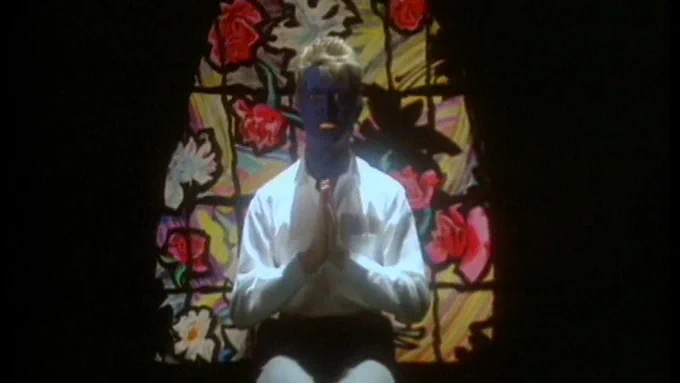
I spent part of last week writing the following analysis of “Loving the Alien” by @DavidBowieReal. The song has long been a favorite of mine, yet I’ve never encountered a satisfactory treatment of the deeper currents running through either the lyrics or the accompanying video. Readers who found value in my earlier discussions of the esoteric/occult material in “Station to Station,” “Golden Years,” and “Blackstar” may find the present piece a useful continuation of that line of inquiry. I consulted a few online sources to check for factual accuracy, but the analysis is completely my own. As with most of my articles, it’s a long read but one I hope you will find time to appreciate. —————————— “Loving the Alien” sits at an odd angle in Bowie’s oeuvre: an oft-overlooked single from his mid-eighties period (an era the artist later considered his creative nadir) whose surface is glossy yet whose core is a sustained, angry examination of how organised religion manufactures and then sanctifies the Other. Bowie was explicit about the subject. In contemporary interviews, he tied the song to the long conflict between Christianity and Islam, the Crusades, and the sense that so much of the historical record we inherit is distorted by mistranslation, power, and selective memory. He had been reading material such as Donovan Joyce’s THE JESUS SCROLL (and related speculative histories circulating in the 1970s and early 1980s), work that treated the canonical Gospel narrative as a political construction rather than straightforward revelation. The anger was personal as well as historical; he described religion as having functioned, for much of its institutional life, more as a “power tool” than as a path of understanding. His own father had been unusually open to other traditions, and that background surfaces in the song’s refusal of simple tribal certainty. The lyric works by collapsing temporal distance. Templars and Saracens move through the Holy Land “opening telegrams”; knights bearing the cross of Coeur de Lion offer “salvation for the mirror-blind”; the same cycle reappears in modern Palestine as “terror in a best-laid plan.” The juxtaposition is almost Pinteresque: the portentous and the banal sit side by side, so that the mechanisms of conflict look continuous rather than exceptional. Prayer is treated as both anaesthetic and weapon. Sins are “hooked upon the sky”; the “heathen lie” is expected to vanish under sufficient devotion; prayers “hide the saddest view” and “break the sky in two.” The repeated refrain—“believing the strangest things, loving the alien”—functions as both diagnosis and ironic invitation. From one side, the alien is simply the religious stranger (the Muslim as the Christian’s other, or vice versa). From another, it is the divine itself rendered permanently alien by the apparatus that claims to mediate it. Bowie’s later clarification that the song was not about little green men is useful, but it does not exhaust the image. The alien is whatever must be loved, feared, or projected upon in order for a closed system of belief to remain coherent. This is where the song intersects Bowie’s longer esoteric interests without becoming a straightforward occult text. His earlier work had drawn on Crowley, the Golden Dawn, and Kabbalistic imagery (most visibly in “Quicksand” and the Tree of Life movement of “Station to Station”). By the mid-eighties, that vocabulary was less explicit, yet certain habits of thought remained. The idea that official history and official scripture are systematically incomplete or inverted echoes the Gnostic suspicion of the demiurge and of institutional religion as a barrier to direct knowledge. The “mirror-blind” are those who cannot see the reflection of their own projection; the stranger they demonise is partly a fragment of what they refuse to recognise. “Loving the Alien” can therefore be read as a demand to stop externalising the numinous or the shadow. Whether the alien is the Muslim neighbor, the heretical reading of Jesus, or the unknowable divine that organised forms continually fail to capture, the ethical move is the same: cease treating difference as an object of conquest or conversion and begin to inhabit it. The crucifix Bowie had worn for years as a personal talisman rather than a confessional symbol sits comfortably with this attitude—an object of protective power stripped of institutional ownership. The 1985 video, co-directed with David Mallet and storyboarded by Bowie, extends these concerns into a deliberately non-narrative, dream-like register. The performance space is an Escher-like construction of impossible stairways, tilted planes, and expressionist cardboard architecture that recalls the oblique sets of THE CABINET OF DR. CALIGARI (1920). Bowie is flanked by musicians in stylised exotic dress, turning the song into something between ceremony and stage illusion. Other sequences fracture further. A blue-faced Bowie—skin tone that has been linked both to Hindu divine iconography and to a visual marker of altered or schizophrenic states—appears trembling or seated against saturated color. A veiled woman manipulates his head before a rotating mirror, an image that literalises the lyric’s “salvation for the mirror-blind”: the religious or authoritative figure rearranges the believer’s perception while the reflection shows a fragmented, blue-skinned self the believer cannot recognise. Black-and-white inserts suggest colonial or imperial scenes in which Bowie pins money on a Middle Eastern woman only for her to tear the notes free, a compressed dream of economic and sexual power and its reversal. Towards the end, the video places a blue-faced Bowie on a bed in a clinical room, wearing headphones and listening to the track itself. The arrival of a woman with Middle Eastern features appears to break the previous image chain, framing much of what has been seen as the content of an unstable mind. One reading treats the entire clip as a pastiche of Caligari’s asylum reveal: the “narrator” is an inmate whose religious and cultural obsessions have dissolved ordinary spatial and temporal continuity. The blue face, the mirror, the veiled manipulator, and the final institutional setting together suggest that the violence of holy war and the violence of projection are psychologically continuous. Belief, under this optic, does not merely justify external conflict; it fractures the believer. The single sleeve reinforces the visual argument: a blue-faced Bowie stands before a stained-glass window set inside a dark arch, the ecclesiastical medium now framing an alien visage. None of this requires treating the video as a coded initiation drama. Its power lies in the refusal of resolution. The Escher geometry never settles into a readable map; the asylum frame does not finally explain nor redeem the earlier images; the blue skin remains both sacred and pathological. What the clip shares with the lyric is the insistence that the alien—whether the religious other, the projected shadow, or the divine that cannot be domesticated—must be confronted rather than converted or erased. In that sense, “Loving the Alien” continues, in a more explicitly historical register, the work Bowie had already done with alien messiahs and with the Thin White Duke’s occult theater: the stranger is not an external threat to be mastered but an internal and cultural necessity with which to be lived. The song’s production may soften some of the lyric’s edge, yet the combination of text and image still leaves the viewer with the same uncomfortable invitation the chorus repeats: to notice what one is already loving, and why.

Post attachmentPost attachmentPost attachmentPost attachment
Ryan Machman avatar
⟳ Ryan Machman retweeted
Ryan Machman@RMachman·Nov 14

I still can’t tell if my next-door neighbor’s cat loves me or hates me. Either way, he sure does love to strike dramatic poses for my camera! #Caturday #CatsOfTwitter

Post attachmentPost attachmentPost attachment
Ryan Machman avatar
⟳ Ryan Machman retweeted
Ryan Machman@RMachman·Nov 13

Here’s something you won’t experience anywhere else: over three minutes of clear, conversational, paradigm-shifting spirit box messages captured via technology proven to never produce a false positive. Transcriptions further down. 👇 #paranormal I captured these messages—many of them about spiritual “light”—during an ITC session at Bandera Cemetery in Bandera Texas. They are clear enough to discern with the naked ear, but I recommend wearing headphones for utmost clarity. —————————————— “Can’t…quite…step.” “I think it’s great!” “Light!” “Should we expect her?” “Kinda insane what’s happening.” “I respect.” “It’s less about the place.” “Went into light.” “We need this light. Thank you.” “Clear and need help.” “Horrible bright…light!” “Jesus isn’t Jewish.” “Correct.” “And restored her lights.” “Say go.” “They trust him.” “People per…the light.” “We can’t. What do you want?” “I’m so dark.” “Not true.” “I see a shit. The murder of your faith.” “Mom…”

3:22
Full Moon Features avatar
⟳ Ryan Machman retweeted
Full Moon Features@fullmoonhorror·Nov 12

It's HERE! THE GRIM RAPPER - The latest #FullMoon shocker, directed by Hugo V! - "Rap icon D.A. Mann is murdered at the height of his fame and returns from the dead three decades later, driven by vengeance and the desperate hope of seeing his true love one final time." Buy it now on Blu-ray ($21.95) or DVD ($16.95) exclusively from FullMoonHorror.com #TheGrimRapper #Horror

Post attachment
Ryan Machman avatar
⟳ Ryan Machman retweeted
Ryan Machman@RMachman·Nov 11

Exciting news! The movie I helped score for @fullmoonhorror, THE GRIM RAPPER, is now available on DVD and Blu-Ray! Link below!👇 Many talented folks, including director Hugo V. and the legendary @RealCharlesBand, made this film happen. I am honored to have contributed four original songs to the soundtrack. I incorporated elements of 80s alt-rock, new wave, electronic industrial, prog rock, and hip hop. That description sounds like a potential recipe for disaster, but I’m proud of the results! I wanted the songs to work within the context of the film but also stand on their own as engaging, compelling music. Reference points included Wang Chung’s TO LIVE AND DIE IN L.A., early Gary Numan, DISENTEGRATION-era The Cure, Nine Inch Nails, Marilyn Manson, and EARTHLING-era David Bowie. I was also influenced to a certain degree by several of my favorite film composers, especially John Carpenter, Simon Boswell, and Goblin. The influences are present, but I like to think I’ve created something original from repurposed spare parts. The movie looks like a blast. I can’t wait to finally see it! Check it out! fullmoonhorror.com/products/…

Ryan Machman avatar
⟳ Ryan Machman retweeted
Ryan Machman@RMachman·Nov 10

I typically use my own proprietary ITC app for spirit communication, but I experiment with other devices. I captured these clear, conversational replies in Bandera, Texas via the Necrometer spirit box. #paranormal “Off.” “Turn off.” “Sure!” “Vince.” “Get out!”

0:48
Ryan Machman avatar
⟳ Ryan Machman retweeted
Ryan Machman@RMachman·Nov 9

I ask questions of spirits during my ITC session at Bandera Cemetery and capture sentence-length spirit box responses. #paranormal “Kinda insane what’s happening.” “I respect.” “It’s less about the place.” “Went into light.” The first response proves that even spirits are in awe of the ability of ITC to facilitate conversational exchanges between the living and the physically dead.

0:31