
Since January 2025, ResearchHub has deployed over $1.5M in research funding to scientists worldwide. We just redesigned our funding page to make it even easier for funders and researchers to connect. Take a look ↓ researchhub.com/fund
0:34
 Open web. Clear feed.

The fastest way to fund science. $1.8M+ funded, powered by $RSC. Post an RFP. Discover high quality preregistered proposals. Paid peer review in 10 days.
Since January 2025, ResearchHub has deployed over $1.5M in research funding to scientists worldwide. We just redesigned our funding page to make it even easier for funders and researchers to connect. Take a look ↓ researchhub.com/fund

We made it with @triaural to @researchhub ! We are testing a 48-specimen matrix of 3D monolithic tetrahedral resonators (109.47°symmetry) using non-contact laser vibrometry. You can found it here : researchhub.com/proposal/333…

ResearchHub 💜's @endaomentdotorg & @RobbieHeeger Fund science straight from your DAF: 1. Pick a proposal at researchhub.com/fund 2. Click Fund Proposal, choose an amount 3. Select Donor-Advised Fund and connect Endaoment 4. Confirm & Pay
“It’s composability for the win”🔗✨ @RobbieHeeger of @endaomentdotorg on their partnership w/ @ResearchHub that lets donors fund cutting-edge science right from their DAF 💸🔬 A great example of web3 rails improving coordination and making giving easier 💚 Full chat below👇

I believe one of most impactful (and easiest) contributions frontier AI labs could make to science would be to run AI reviews of entire the open-access literature, including supplements, and make the reviews freely available to everyone. PMC has ~8.4M open-access articles. For this rough estimate, I used 3M papers as a starting point, focusing on original research and screening out low-quality stuff etc. Estimated model cost: $0.6–6M, depending on the model. Then keep it running for every new bioRxiv/medRxiv preprint. I believe this is a super small amount considering what we already spend on research. The US alone spent an estimated $993B on R&D in 2024. Even the upper estimate of $6M is less than 0.001% of that. + hopefully in the long run, preprints + public AI and human review will eventually replace journals.

DMT Quest II premieres tomorrow night in Austin, Tx 🎬 Tickets are almost sold out - get yours now! dmtquest2.com
Tomorrow night in Austin, DMT Quest II premieres in IMAX 🎬 Most people know @dmt_quest for the films. Fewer know that John Chavez and team are also some of the most adventurous science funders out there
AI detectors don’t work in peer review (and they don’t make much sense either). Here some of my experiences: When ChatGPT came out, I was an editor overseeing paid peer review. I was very critical of AI back then, so we banned it for writing any reviews. Looking back, I can tell you exactly why this does not work. 1) Some reviewers just edit the AI review. Same quality, but rewritten by a human. Or they add some typos, weird dashes and extra spaces so the detector misses it (you cannot imagine how creative some people are). 2) Humanizers get around detectors very easily. Then comes a new detector, a new humanizer, a new model. Cat and mouse, forever. 3) Most scores end up somewhere between 30 and 70%. False positive? Someone who put a lot of work into humanizing it? A hybrid? Honestly impossible to tell. 4) And the last one, which for me is the most important. It creates a lot of extra (unnecessary) work, audit and stress. Reviewers start panicking about being flagged, even when they wrote it themselves or only had a bit of help. And as an editor or grant reviewer you end up confused and making decisions that are just not fair. We should evaluate the content. I don’t think it matters if someone googled first, used AI, or wrote every word alone. And if a one-shot AI review gives you the perfect answer, maybe the question or task was not the right one.

BIOE Ph.D. candidate Ashleigh Jankowski received $10,000 in ResearchHub funding to develop nanoparticles that deliver treatment more precisely for LAM, a rare lung disease. Her goal is to reduce lung damage and improve treatment outcomes. Read more: bioe.umd.edu/news/story/bioe…


ResearchCoin ($RSC) is now live on @blockchain. More ways to get RSC means more people funding science. Put your RSC into ResearchHub Endowments and it continuously funds scientific research.
What if scientific research could move better and faster? Enter @ResearchHub. A market for the best science. $RSC rewards the work that advances science — funding it, reviewing it, replicating it, discussing it. Now available in your Blockchain Trading Account.


What if scientific research could move better and faster? Enter @ResearchHub. A market for the best science. $RSC rewards the work that advances science — funding it, reviewing it, replicating it, discussing it. Now available in your Blockchain Trading Account.
⏳ ~3 days remain to claim a live peer review bounty. Review a proposal exploring general anesthetics and the hard problem of consciousness. Submit a review to earn $150 in $RSC. 👇 researchhub.com/proposal/332…


Over the last few years, we’ve published several papers demonstrating the remarkable ability of humans learning how to balance upright with large time delays in the control loop of stance. Not only can humans re-learn to balance under these challenging circumstances, they can generalize this learning to different contexts (movement directions, muscle effectors, sensory conditions). We have performed these experiments using custom-designed robotic balance simulators - located only in our labs. Our findings have transformed our understanding of balance adaptation and learning, opening the door to many new questions. We have multiple exciting projects underway, and have a few new ideas we will be sharing on @ResearchHub in the near future. Looking forward to discussing more on this work and our future plans. Reach out if interested or wanting to know more. Link to published papers below 👇

Really proud that our lab is now officially part of @AnthropicAI "AI for Science" program! With credits provided by Anthropic, we can now massively scale up our computational work. We will use them for many exciting projects, including foundation models for stroke multi-omics that feed into a closed-loop drug discovery approach in human tissue, and much much more. 🧑💻🧬🧠

A 2024 EEG study analyzed 36 students writing by hand or typing with one finger. Handwriting showed wider brain connectivity, but memory was never tested A @ResearchHubF proposal plans to have 160 students learn 30 words by hand and 30 by typing, then test recall 7 days later


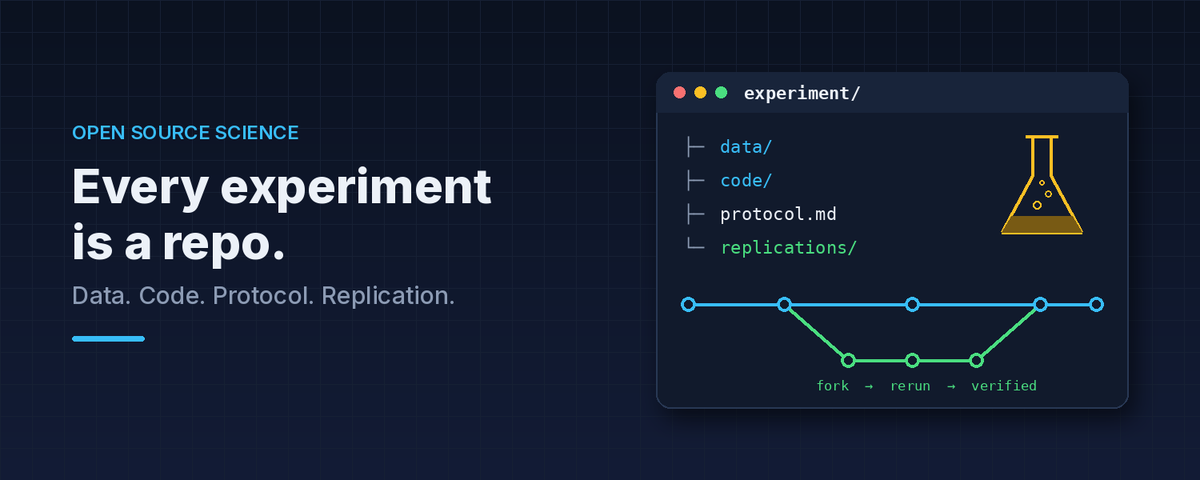
Brian Armstrong says science should work like open source. He's been saying it since 2019, and it's how @ResearchHub started.
Have a question for the NIH Director? Submit it for a chance to have it answered during Dr. Jay Bhattacharya's keynote Q&A at SciCon 2026. 📩 Submit here ↓ forms.gle/XKyvFWQ1p5uzLSXBA


