One thing I've always found interesting about trading is how much work it takes to turn an idea into an actual strategy. You have to define your entry and exit, your risk management, and the conditions your setup needs in order to work.
Now imagine explaining all of that in plain English and having an agent build it for you. That's exactly why I’m looking towards the direction of @FensoryApp.
You describe the strategy you want, the agent helps you set it up, backtests it against historical market data, and can then execute it on Hyperliquid markets. You also set your own order limits and choose which markets it trades.
The part I like most is being able to test an idea before any real money touches it, because most strategies look great in your head until you see how they would have actually played out.
The bigger vision is an arena where trading strategies compete against each other, and I'm looking forward to seeing what I can build with it.
Anyone can get started at fensory.com
Yesterday I gave a quick overview of @rntprotocol, and today I want to go deeper on the vaults, because that is the part most people will actually touch first.
There is one vault live right now, Tulipa Multi-Asset RWA, which is managed by Tulipa Capital and runs on @EmberProtocol's vault infrastructure on Ethereum. The flow is pretty straightforward once you see it laid out. You connect a wallet and deposit USDC, the deposit waits in a queue until the monthly batch is processed, and then you receive tulPRWA shares, which are currently priced at 1.0340 USDC each. The money goes into a diversified mix of real estate strategies rather than a single property, so you are not tied to how one building in one city performs.
The vault page shows a 15.23% APY against a 14% target, but the manager last updated that figure on Nov 2, so I read it as a reported number rather than something that ticks live. It holds about $1.63M from 23 depositors so far, which tells you it is still early. The fees are a 20% performance fee and no management fee, and I actually prefer that setup since the manager only earns when the vault does.
The part worth being honest about is liquidity. Withdrawals are monthly and redemptions target T+45, stretching to T+60 when utilization is high, so this is for money you can comfortably leave alone for a couple of months and not your trading stack. The next batch processes on Dec 1.
Real estate is the biggest asset class in the world, and it is still one of the hardest to actually use on-chain, so I spent some time going through what @rntprotocol has live right now.
The supply side comes from Reental, which tokenizes properties in Spain, the US, Mexico, the UAE and a few other markets, and RNT is the layer that makes those tokens do something. RNT Lend is a whitelabel Aave V3 market on Polygon, approved by Aave governance, where holders post their property tokens as collateral and borrow stablecoins against them. It sits at about $21.4M in TVL with $9.6M borrowed, and because more than 90% of the stablecoins are lent out, suppliers are earning roughly 12% on USDT0 and 14% on USDC this morning, paid by those borrowers rather than by token emissions. RNT Vaults is the simpler route, where you deposit USDC on Ethereum into a real estate vault running on @EmberProtocol and get exposure to a diversified set of property strategies. Then there is $RNT itself, capped at 200M with no mint function, which you stake for xRNT to vote in the DAO and share in protocol fees.
What I like is that the yield here has a source you can point to. The rates move with borrowing demand and vault exits happen monthly, so this suits money you are happy to leave alone for a while.
I will be going through each piece properly over the next week.
The most annoying part of travelling is not the flight. It is landing with no data.
@XPINNetwork just dropped a big update, even in a quiet market:
Here's what they've been cooking 🔥
◆ Their eSIM now works in 176 countries, up from 149. Scan a QR code once and you're set, then just buy new plans on the same eSIM whenever you travel. You get 4G/5G data, you can share it as a hotspot, and it switches to the local network by itself when you cross a border.
◆ XPIN Pass is live: $9.90 gets you 10GB for 30 days across 63 destinations in the first month. One eSIM and one data allowance that follows you everywhere you go. Every 30 days it renews and your 10GB starts again, and you can switch off auto-renewal whenever you like.
◆ And the Black Friday offer is the best part: buy a 5-day unlimited data plan and get 2 extra days free. You pay for 5 days and get 7 days of unlimited data. It ends Nov 30 at 23:59 UTC.
Finally XPIN has added 27 extra destinations, further expanding areas their services cover.
If you travel a lot, this one is worth a look.
XPIN Pass: xpin.network/esims/xpin-pass
eSIM: xpin.network/esimx.com/XPINNetwork/status/212…
Black Friday. Free Weekend. ✈️
🎁 A full week of unlimited data for the price of 5 days.
Buy any available 5-day Unlimited plan and get 2 extra days FREE. No code needed.
Start on any day. All 7 days run consecutively, so there’s no need to wait for the weekend.
Travel often? Get 50% OFF your first month of XPIN Pass:
10GB · 30 days · 63 destinations · $9.9
Ends Nov 30, 2026 at 23:59 UTC.
xpin.network/esims-home
Its obvious how the the competitive landscape of crypto neobanking is gradually shifting from user acquisition towards user retention + stickiness.
@ether_fi's Cash product is a pretty good example of this.
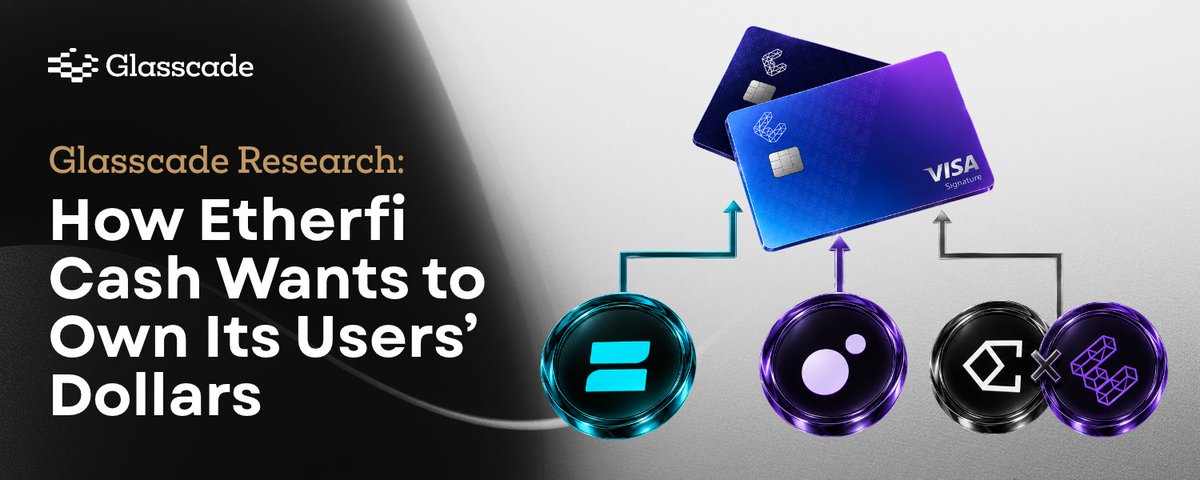
As highlighted by @glasscade_xyz, Etherfi Cash has surpassed $1B in cumulative card spending, w/ 12.6M+ transactions across 199 countries.
But what caught my attention wasn't necessarily the headline volume, it was the underlying growth dynamics.
Between April <> October:
🔹 Active addresses grew 67.5%
🔹 Transactions per address increased 31.5%
🔹 Average transaction size declined slightly by 2%
In other words, growth hasn't simply been driven by users making larger purchases, but by more people using the card more frequently.
And IMO, frequency of usage is one of the more encouraging early indicators of product stickiness.
Ofc, perks like cashback, rewards + promotional incentives are fantastic magnets for onboarding users.
But these are relatively easy for competitors to replicate, and incentives alone rarely create lasting loyalty.
The real challenge is getting users to stay even when the incentives become less attractive.
And that ultimately comes down to less tangible factors particularly trust, reliability, convenience + the overall user experience.
Does the card work consistently? Is funding seamless? Can users confidently keep meaningful balances in the app? Does the product keep pace w/ changing consumer expectations, security standards + regulatory requirements?
These might sound like basic considerations, but they're precisely what separates a promotional spending product from something users genuinely depend on.
This is also why Etherfi's recent moves are particularly interesting.
1. The @zealwallet acquisition creates another avenue for onboarding existing crypto card users.
2. The @moonpay integration aims to simplify funding + reduce friction between traditional banking rails and onchain balances.
3. Etherfi USD, built through Ethena Whitelabel could eventually make holding funds within the ecosystem more economically productive for the platform.
Individually, these are useful product developments.
Collectively, they point towards a much bigger ambition in making Etherfi a place where users don't just spend money, but actually keep + manage it.
And that's where I think the real competitive moat begins to form.
Because once a financial product becomes embedded in someone's everyday habits, switching becomes less about chasing an extra percentage point of cashback and more about whether the alternative is worth disrupting an experience they already trust.
Ofc transaction frequency alone doesn't prove long-term retention, and the impact of these new integrations remains to be seen.
But the direction is encouraging.
Perks attract users, while product experience builds habits, and trust keeps them around.
IMO, the winners of crypto neobanking won't necessarily be those offering the most generous incentives, but those that can consistently deliver a financial experience people are comfortable relying on every day.
That's a much harder moat to replicate.
Feel free to take a read at this research article for more in-depth insights 👇
Glasscade @Glasscade_xyz Nov 5 Article Glasscade Research: How Etherfi Cash Wants to Own Its Users’ Dollars Etherfi Cash crossed $1B in card spend without owning the dollars its users spend or the rails that fund them. In October, it struck three deals in under three weeks to change that. Here is what each
Real estate is the biggest asset class in the world, and it is still one of the hardest to actually use on-chain, so I spent some time going through what @rntprotocol has live right now.
The supply side comes from Reental, which tokenizes properties in Spain, the US, Mexico, the UAE and a few other markets, and RNT is the layer that makes those tokens do something. RNT Lend is a whitelabel Aave V3 market on Polygon, approved by Aave governance, where holders post their property tokens as collateral and borrow stablecoins against them. It sits at about $21.4M in TVL with $9.6M borrowed, and because more than 90% of the stablecoins are lent out, suppliers are earning roughly 12% on USDT0 and 14% on USDC this morning, paid by those borrowers rather than by token emissions. RNT Vaults is the simpler route, where you deposit USDC on Ethereum into a real estate vault running on @EmberProtocol and get exposure to a diversified set of property strategies. Then there is $RNT itself, capped at 200M with no mint function, which you stake for xRNT to vote in the DAO and share in protocol fees.
What I like is that the yield here has a source you can point to. The rates move with borrowing demand and vault exits happen monthly, so this suits money you are happy to leave alone for a while.
I will be going through each piece properly over the next week.
The best yield products of 2026 weren't the ones paying the most, they were the ones plugged into someone else's app.
@Morpho went from $5.88B to $10.26B in TVL this year, up about 75%, while its fees climbed to $194M from $141M over the same stretch of 2025, and it now handles one in five dollars borrowed on-chain, helped by Robinhood Chain going from zero to about $600M. @Ondo's USDY grew from $0.69B to $2.38B and overtook BlackRock's BUIDL as the largest tokenized Treasury. Maple's TVL held flat near $2.3B, but its fees rose about 65% to $96M while paying lenders between 4.2% and 6.6% all year.
But almost everything built on incentives went the other way. @pendle_fi's TVL fell 73% to under $1B, @ethena’s sUSDe shrank from $3.47B to $1.18B even though it still pays 5.3%, and @aave's TVL halved to about $15B as ETH dropped 39%. Even among the winners the tokens mostly lagged, with SYRUP down 67% and ONDO down 15%, leaving MORPHO as the only major yield token up on the year at around 60%.
Deposits in 2026 followed distribution, not headline APY. If you are hunting yield into 2027, the question is less who pays the most and more who has a real pipeline of users sitting behind the rate.
Wall Street spent Breakpoint plugging into Solana, and SOL is trading like nobody showed up, isn’t that a bit strange?
In the space of a week, Schwab switched on spot SOL for its retail clients, who hold $13.33 trillion in assets, and DTCC said tokenized versions of DTC-custodied securities are coming to Solana in the second half of 2027. On Monday ICE, the company that owns the NYSE, said its NYSE ATS is already set up to accept Solana-minted tokens and that it is looking at running a validator, on the same day it launched dollar loans with Abra backed by BTC, ETH and SOL held at ICE Digital Trust. Jupiter followed with a permissioned market on Jupiter Lend where Bullish's NYSE-listed shares can be used as collateral.
But the money is moving the other way. SOL is at $72.64, down about 40% from its $122 close in late September and 75% below its all-time high, after touching $67.41 over the weekend. US spot Solana ETFs went six straight weeks with net outflows, roughly $197M in total, before Monday's $11.7M inflow. Stablecoins on Solana have slipped from $15.84B in early October to $14.25B, and DeFi TVL has fallen from $6.59B to $4.77B. Even the biggest headlines are mostly in the future tense, with DTCC more than half a year away, the validator still being explored, and the Abra program open only to an initial group of clients. Jupiter's own COO said it plainly on stage, that only about $3.4B of the roughly $460B in tokenized assets is actually being used in DeFi.
The rails Wall Street needs on @Solana are being built faster than ever, but the price is still being set by flows rather than press releases. Until the ETF bid comes back and stablecoins start growing on the chain again, this is a 2027 story the market is not yet willing to pay for in 2026.
My onchain research mostly happens on my phone now, and the @GeckoTerminal app is where it starts.
I open my Watchlist, see what my list looks like and decide how to go about my day. Everything I track sits in one place, so I can do this anywhere.
This morning it says my watchlist is $352M, down about 13% from Friday night.
$Q is still the biggest name, $119.7M, but it has given back 18.7% since I added it. $HYPE is $53.2M, down 9.2%. $WALLET is $10.6M, down 11.3%, and it has gone quiet. $AI is the one that held, $26.4M, basically flat since Friday and up 16% in the last 24 hours after dipping over the weekend.
The four from before are mixed. $mihao is the only name actually up, $16.5M, up 1.5%. $PONS is $81.4M, down 14.5%. $CASHCAT is $43.9M, down 8.4%, though it is up 6.7% on the day. $SI slipped the most, from $1.2M down to $656K.
All 8 are in my @GeckoTerminal watchlist, $11.6M in volume in the last 24 hours, and I checked every one of them from my phone before breakfast.
My Watchlist: geckoterminal.com/watchlist?…
What is the first thing you check in the morning and what projects are you actively tracking?
This is my personal tracking list, not financial advice.
The safest dollar on-chain now pays less than the Treasury bill it is supposed to compete with.
The 13-week T-bill finished Friday at 4.23%, up from 3.68% in mid-May. Over the same six months Sky's sUSDS savings rate only moved from 3.65% to 3.80%, @aave's USDC base rate sits around 3.81%, and tokenized Treasury products like BlackRock's BUIDL and @Ondo's USDY are paying 3.84% and 3.75%. People noticed. sUSDS deposits have dropped from about $6.06B in May to roughly $3.78B today, and Glassnode data shows stablecoin supply shrinking by $14B to $17B over the past month, the sharpest drop since 2022.
But the premium did not disappear, it just moved to wherever the risk is. @ethena's sUSDe pays 5.28% because perp funding is paying, @maplefinance's USDC pool pays 5.22% because it is lending to institutional borrowers, and JitoSOL pays 4.91% in SOL rather than in dollars. Each one beats the T-bill only because you are taking on something the T-bill never asks of you. On top of that, banks are lining up another push to ban platform yield on stablecoins, even if TD Cowen only gives it a 10% chance over the next two years.
The days of on-chain dollars earning a free spread over Treasuries are behind us for now. If you are parking stablecoins on-chain, the real question is no longer which pool pays the most but which risk you are actually being paid for, and until Sky lifts its rate or T-bills come down, plain dollars have very little reason to stay.
🇧🇷 Ronaldinho has arrived for his pre-match training session with Italian 3rd division side Ravenna ahead of coming out of retirement for one fame.
The Brazilian legend joined Ravenna’s project with Cipriani family, promised to play an official game and it’s happening this weekend.
Ronaldinho will feature tomorrow in Italian’s 3rd division game between Ravenna and Forlí.
Crypto is moving into a new phase, where building infrastructure is no longer enough.
This week’s favorite reads cover some of the biggest shifts taking shape across the industry, from institutional RWA adoption and stablecoin payments to specialized DeFi products, blockchain privacy and AI-powered asset management.
Here’s a compilation of my top 10 article picks for the week.
—
@Rigelcrypt argues that RWA has moved past the narrative stage as real products from institutions like @Schroders, @avivaplc and @The_DTCC are going live.
Solana is emerging as a major RWA hub, while @RobinhoodCrypto Chain, @XLayerOfficial and @NEARProtocol are competing for tokenized stock activity.
The challenge is no longer minting assets, but building real demand, liquidity and legal access.
x.com/rigelcrypt/status/2119…
—
@Mayacrypt explains how crypto is shifting from infrastructure building toward specialized products built on existing rails.
Trading, lending, decentralized compute, privacy and treasury management are becoming more specialized as teams build on infrastructure from @HyperliquidX, @Uniswap, @Morpho, @bittensor and @NEARProtocol.
It’s no longer just about technical capability, but whether these products can attract users, manage risk and generate sustainable revenue.
x.com/mayacrypt/status/21196…
—
@Elikrypt explains how stablecoins are evolving from trading assets into core infrastructure for payments, DeFi, institutional settlement and tokenized finance.
They supply the dollar liquidity powering cross-border transfers and tokenized markets, as banks and payment networks increasingly integrate them into existing rails.
There's a major shift toward stablecoins becoming a programmable money layer for digital finance, though adoption still depends on liquidity, redemption, regulation and real economic usage.
x.com/elikrypt/status/212086…
—
@StarPlatinum_ breaks down @Enter_Elysium’s mainnet launch and the ecosystem forming around it.
The network combines fast trading infrastructure with DEXs, launchpads, lending, prediction markets and options, while 50% of sequencer fees are directed toward $KNTQ buybacks and burns.
The real test is whether Elysium can move beyond early memecoin speculation and build sustained activity around deeper HyperCore integrations.
x.com/starplatinum_/status/2…
—
@web3righteous breaks down how to automate Web3 job hunting across payroll roles and project retainers.
The system uses Grok to find leads, diagnose project needs, draft pitches, track applications and manage follow-ups, while keeping all outreach under manual approval.
The idea is to combine job applications with proactive service pitches, using proof, targeted research and consistent follow-ups instead of relying only on posted vacancies.
x.com/web3righteous/status/2…
—
@Marspective examines how blockchain privacy is evolving from a privacy-coin feature into essential financial infrastructure.
He explores how projects like @zama, @aztecnetwork, @RAILGUN_Project, @Arcium and @0xMiden are using ZKPs, FHE, MPC and confidential execution to protect activity across DeFi, payments and tokenized assets.
The goal is confidential onchain finance without losing liquidity, composability or verifiability.
x.com/marspective/status/212…
—
@theSamPadilla breaks down the robotics data market heading into 2027.
Demand is shifting from saturated, low-cost monoscopic video toward stereo and tactile data, with prices ranging from ~$5 to $120 per hour depending on modality and collection needs.
Investment opportunities are moving toward specialized capture hardware and strong relationships with robotics labs, as basic processing and annotation become increasingly commoditized.
x.com/thesampadilla/status/2…
—
@pmitu shares an 8-part guide to using Claude for $0 marketing, covering competitor and customer research, lead generation, personalized outreach, micro-influencer partnerships, content ideation, founder interviews, community distribution, and SEO.
The idea is to use AI to automate research and repetitive tasks while keeping outreach and content personal.
Instead of using AI-generated content or chasing mass exposure, founders should focus on finding the right customers, building relationships, and sharing useful work.
x.com/pmitu/status/212081944…
—
@rektdiomedes argues that crypto’s post-2022 downturn has made the industry too focused on near-term revenue and yield, losing sight of its larger ambitions.
He sees Ethereum as the foundational economic layer for an internet driven by AI agents and online commerce, giving $ETH a long-term store-of-value case similar to Gold.
He also makes the case for decentralized stablecoins, highlighting @protocol_fx’s fxUSD for censorship resistance, security, peg stability, privacy integrations and yield.
x.com/rektdiomedes/status/21…
—
@FourPillarsFP examines how @Infinit_Labs is evolving from AI agents that simplify DeFi transactions into an AI-powered asset management platform.
Through INFINIT OS and the INFINIT Standard, it offers shared infrastructure, custody, accounting and risk controls so independent managers can launch onchain investment vaults.
The thesis is that AI-powered vaults could make professional asset management more accessible onchain, though sustained performance, custody and risk management remain key challenges.
x.com/fourpillarsfp/status/2…
—
That’s all for the week. Stick around for more insightful reads weekly.
After 250 years of evolution, asset management is entering a new era shaped by blockchain and AI. How is INFINIT combining AI-driven investment strategies with onchain vaults to redefine the future of asset management?
NEAR Intents is already moving tens of billions of dollars, and institutions can now reach that flow without changing how they trade, but almost none of it is accruing to the token.
The router went live inside Talos's order and execution system on November 9, so desks that already use the platform can source solver quotes across more than 30 chains and centralized venues through the same request-for-quote workflow and custody setup they use for everything else. @NEARProtocol said Talos has processed over $1 trillion in all-time trading volume. Intents itself has settled about $38.6 billion in cumulative volume, including $3.77 billion in the past 30 days and $176 million on November 12, the latest complete day in the official series, with swaps typically clearing in under a second and network fees under a cent. September remains the record month at $4.80 billion. October still did $3.99 billion, down 17% from that peak but 132% higher than a year earlier, and the first 12 days of November have already added $1.60 billion, or about $134 million a day. Confidential pools on the official revenue dashboard held $137.9 million as of November 12, up 385% over 90 days.
But the capture is still thin. DefiLlama, which reconciles with that same revenue dashboard, shows $5.83 million of fees and $1.81 million of protocol revenue over the past 30 days, and that revenue is what funds the buybacks. Since those buybacks began in February, holders have received about $8.2 million, including $2.19 million in October and $688,000 so far in November. That is why House of Stake passed HSP-029 on November 2, a plan to cut maximum issuance from 2.5% to 1.6% over 24 months, which would eventually take daily issuance from about 89,500 NEAR to 57,300. At today's price of about $3.33, the current pace is still roughly $9 million of new tokens a month against $1.81 million of captured revenue. The vote still needs Security Council review, a 90-day grace period, and a validator upgrade before it binds, and Talos has not disclosed how much desk flow has actually arrived.
My watchlist is $405M now, and half of it was not there yesterday.
I added four names this morning. $HYPE, $Q, $AI and $WALLET. I did not add them to fill it up, each one is there for a reason.
$HYPE is $58.6M. It is Hyperliquid's token, and Hyperliquid is where a lot of onchain perps actually trade. Most of the fees there go back into buying $HYPE, so I want to see how that holds up.
$Q is $147.3M, up 7.8%, and it is the biggest new one. It is Quack AI. The payments part is what got me, agents need a way to pay and get permission to act, and $Q is built around that.
$AI is $26.5M. It is a meme on Robinhood Chain, but it trades against tokenized NVDA instead of a stablecoin. So it is a meme and a bet on compute at the same time, and the fees go into a vault holding NVDA.
$WALLET is $12M. It carries the Robinhood Wallet name, but Robinhood said they did not make it and they do not back it. It fell hard after that. I left it on there to see if the name alone still pulls people in.
The four from yesterday are still there. $mihao flipped, $16.3M, up 30.6% after being down 36.8%. $PONS is $95.3M, $CASHCAT is $47.9M, $SI is still the smallest at $1.2M.
All 8 are in my @GeckoTerminal watchlist, $19.43M in volume in the last 24 hours. Easier than searching for them one by one.
My Watchlist: geckoterminal.com/watchlist?…
When do you open yours?
This is my personal tracking list, not financial advice.
🔥 GT Watchlist Giveaway, WEEK 2!
$100 in stables and a SWAG pack are up for grabs every week till the 3rd of December.
Here's how to enter:
🟣 Like this post
🟣 Create your watchlist on the GT app
🟣 Reply below with a screenshot + link to your watchlist
We bullish or nah?
The agent economy can already pay, hire and trade, but the main onchain rail is still moving cents, not markets.
x402 settled 341,350 payments yesterday and has now processed nearly 200 million transactions across 12 chains, for a lifetime total of $42.9 million. @solana accounts for about a third of the tracked chain split, just behind @base. November has already settled about $627,000, more than all of October, even though the month is only halfway gone, and the average payment is back up to about 16 cents from a nickel. That activity is showing up in the products too. @termix_ai's agent marketplace, where agents hire each other and settle in escrow, now shows $31.9 million in volume across 1.35 million agents and 628,000 jobs. On @RobinhoodCrypto, about 200,000 customers had opened agentic trading accounts by the October 27 earnings print, generating more than $1.6 billion in notional volume, and this week Circuit's agents went live on Robinhood Chain to manage Stock Token liquidity, including a Uniswap version that launched yesterday. @coinbase, which started x402, also shipped server-enforced spend limits and auto-stops for Coinbase for Agents on November 11.
But those payment counts still flatter the economics. x402's busiest month, December 2025, did 54 million transactions, and October was 91% below that. The peak volume month, November 2025, settled $20.5 million by itself, almost half of everything the protocol has ever moved. About two thirds of recent x402 payments still go through a single facilitator, and Visa's first Agentic Commerce Benchmark, released November 5, found that shopping agents failed 42.8% of test runs, with about half of those failures still ending in a purchase. A curated basket of the main agent-protocol tokens was worth about $1.0 billion on November 12, which is a lot of market cap for a rail that has settled $43 million in total.
The rails are live, Solana is carrying a real share of the traffic, and Robinhood is where agents already touch size. The valuations, though, are still pricing a market that the settlement numbers have not produced yet.
My watchlist is $160M of tokens I actually track, not a list I copied from someone else.
Four tokens, four different reasons for keeping them on my radar.
CASHCAT ($49.5M), down 18.8%. Cash Cat was an early working name for Robinhood. For me, holding CASHCAT is a bet on how well the Robinhood ecosystem does. It has its own meme culture, and that's part of what keeps me interested.
PONS ($95.9M), down 8.6%. It's the launchpad token on Robinhood Chain. Anyone can create a token without writing code, and the platform uses part of its trading fees to buy back and burn PONS. I'm watching how activity on the chain develops.
mihao ($13.3M), down 36.8%. Ni Hao Cat on Solana. This is a pure meme play, no product, no utility. Ansem even called it his pure meme for this cycle. After that recent run and pullback, I'm watching to see if the attention holds.
SI ($1.5M), up 3.8%. SpaceX Inu on BNB Chain. It's the smallest on my list, but I keep it there to follow its market activity.
I use @GeckoTerminal to keep all four pools in one place rather than having to search for them every time.
My Watchlist: geckoterminal.com/watchlist?…
What's on your GT Watchlist?
This is my personal tracking list, not financial advice.
🔥 GT Watchlist Giveaway, WEEK 2!
$100 in stables and a SWAG pack are up for grabs every week till the 3rd of December.
Here's how to enter:
🟣 Like this post
🟣 Create your watchlist on the GT app
🟣 Reply below with a screenshot + link to your watchlist
We bullish or nah?