Roskosmos posted a video update on the Luna-26 (Luna-Resurs-1 OA) orbiter status, saying that 9 of its scientific instruments (instead of 13 as of 2024) undergone or finishing autonomous tests. No launch date mentioned, but the latest official goal was 2028. Context on the site.
Voyager got some rare coverage in the USSR, including color reproductions of its Saturn closeups in the Tekhnika Molodezhi magazine which was not very easy to get. Glossy photos in the Amerika monthly were for a selected few with access to black market ;) Scans from my archive:
Why Shenzhen 🇺🇸🇨🇳🇷🇺will be no Yalta 2.0. Two of the three powers are bogged down in wars against much weaker opponents that they can’t win, and the third is facing economic headwinds at home. “It’s really a summit of the three weaknesses,” said Italian Sen. Carlo Calenda. “All three are in a much more precarious position than it seems.” My analysis in @WSJwsj.com/world/why-this-weeks…
...Assuming there is another passenger on the opposite side of the payload adapter beyond the frame of this unfortunately cropped photo (bottom left), one could speculate that the best candidate for it is the rumored Marafon-IoT satellite. Context: russianspaceweb.com/koen-kin…
On 11 Nov around 7:07 UTC, #KOSMOS2612 made a small manoeuver lowering its orbit a few hundred meters to bring it closer to the orbital altitude and period of ICEYE-X36 again. It is still at 600-700 km distance to ICEYE-X36.
COSMOS 2611 now has its orbit plane lined up with ICEYE-X37. Our rendezvous job puts the angle between their planes at 0.018° as of 13 Nov 12:00 UTC.
Matching ICEYE-X37's orbit from here would cost 2611 0.61 m/s for the altitude change and 2.37 m/s for tilting the plane. Our maneuver processing shows no burns from 2611 since 5 Nov.
COSMOS 2613 is in a similar spot. Matching ICEYE-X37 would cost it 6.67 m/s today, and that figure has stayed between about 6.3 and 7 m/s since our last post on 5 Nov. No burns from 2613 either.
For reference, COSMOS 2612, from the same April launch, made its burns on 12 Oct right as its plane lined up with ICEYE-X36. The cost for both 2611 and 2613 should stay low for a while yet, so any move doesn't have to come today.
Early today, COSMOS 2613's orbital plane came as close to ICEYE-X37's as it will get, 0.05° apart. At that point our predictive rendezvous job put the cost of matching X37's orbit at about 6.9 m/s. Since no maneuver followed, the planes are now slowly drifting apart.
On the other hand, COSMOS 2611 is still closing on X37, with their planes 0.03° apart today. With the current propagation, we estimate their planes come closest around 13 Nov, about 0.02° apart, and matching the plane would take about 2.6 m/s at that point.
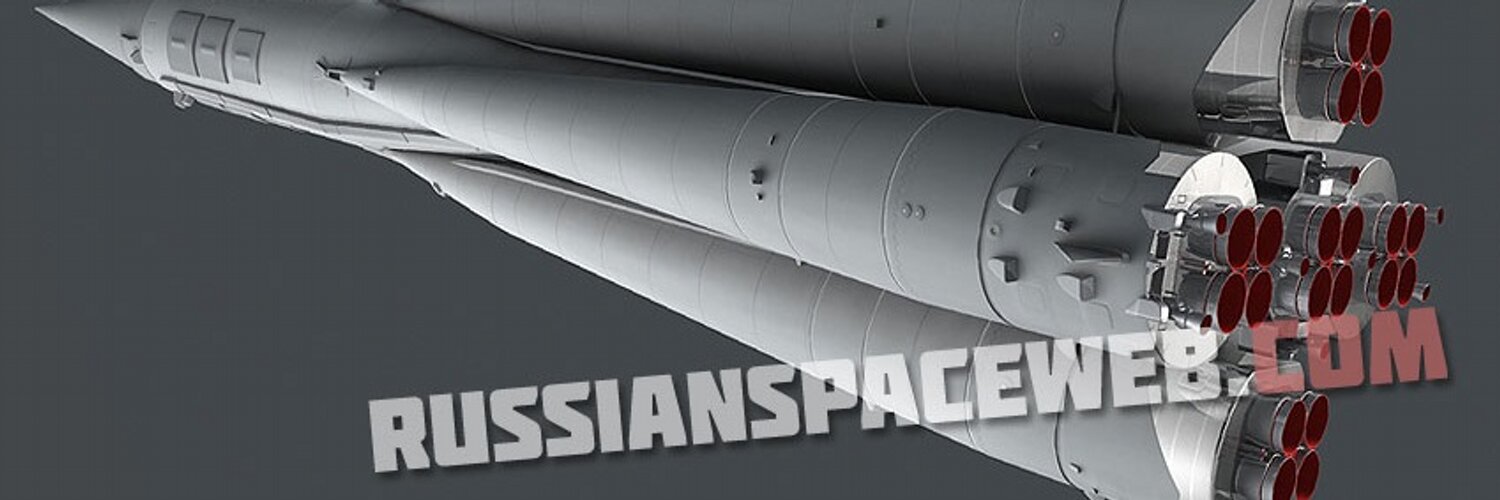
A little-known precursor to the Soviet N1 Moon rocket served as an early rival to the Proton rocket on the drawing board. Full story and more visualizations on the site (subscription):
...and last but not least: it was the 131st mission of the Fregat which is the upper stage delivering GLONASS satellites from a suborbital trajectory to their deployment orbit some 19,000 kilometers above Earth: russianspaceweb.com/fregat.h…
...another piece of statistics: this is the 70th mission to deploy and replenish the GLONASS constellation (the Soviet/Russian equivalent of the GPS system): russianspaceweb.com/glonass_…
...It was also the 198th mission for the Soyuz-2 series of rockets (by my calculations, excluding now-retired Soyuz-2-1v variant): russianspaceweb.com/soyuz2_l…