←
SpaceComputer1,269 posts
SpaceComputer avatar

SpaceComputer

@SpaceComputerIO

Solving the scalability & interoperability problem in orbit with secure compute processing and cybersecurity 🛰️

◷ Joined May 2024▧ 312 Photos and videos
SpaceComputer avatar
SpaceComputer@SpaceComputerIO·Nov 16

We're excited to announce our third mission in 2027 with Aptos Orbital! 🚀 On a D-Oribt rideshare mission, Space Fabric will connect directly to Aptos Orbital’s cEDGE box, communicating over the Iridium satcom network. SpaceComputer's secure processing and cryptographic security will demonstrate how payloads can share compute and comms resources without exposing themselves to threats. Read the full article by Payload below.👇

A new security standard is headed to orbit. @SpaceComputerIO , the Singapore-based in-orbit digital security startup, will fly its Space Fabric secure-compute payload aboard a D-Orbit ION mission next year. The mission aims to test the company’s ability to add a security layer into a satcom network. Payload's @Douglas__Gorman spoke with SpaceComputer officials about what the missions mean for the future of in-orbit security.

Post attachment
frezabek avatar
⟳ SpaceComputer retweeted
frezabek@rezabfil·Nov 17

Recent research has highlighted security limitations in parts of the Iridium radio link. That raises a broader question: how can we provide strong security assurances to a user even when the communications network itself isn’t part of their trust boundary? That’s one of the things we want to demonstrate in our third 2027 mission with Aptos Orbital. Space Fabric, our security-first hardware and OS for on-orbit computing, will connect with Aptos Orbital’s cEDGE box and use Iridium as part of the communications path. Our goal is to add application-layer security on top of existing communications infrastructure, isolating sensitive workloads, remotely verifying what software is running, and providing cryptographic provenance for where and how data was processed. Rather than relying on the security of every individual component between orbit and the end customer, we want those assurances to travel with the workload and its output. It’s not about replacing the security of the underlying network. It’s about showing how application-layer security, secure compute, remote attestation, and provenance can strengthen the end-to-end system built on top of it. 🚀 Huge thanks to both teams for making this mission a reality!

A new security standard is headed to orbit. @SpaceComputerIO , the Singapore-based in-orbit digital security startup, will fly its Space Fabric secure-compute payload aboard a D-Orbit ION mission next year. The mission aims to test the company’s ability to add a security layer into a satcom network. Payload's @Douglas__Gorman spoke with SpaceComputer officials about what the missions mean for the future of in-orbit security.

Post attachment
semicondurian 👽🌳💛 avatar
⟳ SpaceComputer retweeted
semicondurian 👽🌳💛@semicondurian·Nov 16

How can Orbital Data Centers scale? How can cross constellation links be cryptographically secure? We hardware enabled trust fabric and that’s what we will be flying with @SpaceComputerIO hardware on a mission with Aptos Orbital connecting to remote regions operation using @IridiumComm (@RocketLab co) First if it’s kind LEO for Space Fabric aboard the @D_Orbit hosted payloads

A new security standard is headed to orbit. @SpaceComputerIO , the Singapore-based in-orbit digital security startup, will fly its Space Fabric secure-compute payload aboard a D-Orbit ION mission next year. The mission aims to test the company’s ability to add a security layer into a satcom network. Payload's @Douglas__Gorman spoke with SpaceComputer officials about what the missions mean for the future of in-orbit security.

Post attachment
danidelta avatar
⟳ SpaceComputer retweeted
danidelta@danidelta8·Nov 16

Mission #3! LEO infrastructure is about to be secure.

We're excited to announce our third mission in 2027 with Aptos Orbital! 🚀 On a D-Oribt rideshare mission, Space Fabric will connect directly to Aptos Orbital’s cEDGE box, communicating over the Iridium satcom network. SpaceComputer's secure processing and cryptographic security will demonstrate how payloads can share compute and comms resources without exposing themselves to threats. Read the full article by Payload below.👇

danidelta avatar
⟳ SpaceComputer retweeted
danidelta@danidelta8·Nov 14

If you can't verify and attest the process that occured, the platform from where it originated and the security of the communication channel used, is your data an asset or a liability? Secure your orbital operation with SpaceComputer, check all boxes and eliminate liabilities.

It's hard to verify the data your satellite sends down hasn't been tampered with. What if you could verify all your data was processed and communicated securely? That’s what we’re bringing to Space Tech Expo Europe in Bremen, November 17th to 19th. Our technical BD Lead @zkpedrongmi will be heading to the conference to discuss bringing more security and verifiability onboard your next mission. We're ready to discuss your applications, biggest data security challenges, and missions that need secure onboard processing. Let’s see how we can integrate. Want face time with Pedro? Send us a message at spacecomputer.io/contact and we'll get you connected.

Post attachment
Pedro avatar
⟳ SpaceComputer retweeted
Pedro@zkpedrongmi·Nov 13

Bremen is the biggest space tech conference in Europe, and I’m beyond excited to attend it Talk to me about orbital computing, hardware, security, privacy, sovereignty, or any other nerdy topic 🚀

It's hard to verify the data your satellite sends down hasn't been tampered with. What if you could verify all your data was processed and communicated securely? That’s what we’re bringing to Space Tech Expo Europe in Bremen, November 17th to 19th. Our technical BD Lead @zkpedrongmi will be heading to the conference to discuss bringing more security and verifiability onboard your next mission. We're ready to discuss your applications, biggest data security challenges, and missions that need secure onboard processing. Let’s see how we can integrate. Want face time with Pedro? Send us a message at spacecomputer.io/contact and we'll get you connected.

Post attachment
SpaceComputer avatar
SpaceComputer@SpaceComputerIO·Nov 13

The safest place a high value signing key can be is where nobody can touch it. We’re taking our Key Management Service (KMS) into orbit in 2027, to provide the (literal) highest hardware security guarantees possible, and better tamper-resistance than you can get behind the door of a data center on Earth. A key management service generates, stores, and uses cryptographic keys on hardware in orbit, where applications request a signature and receive the result while the key stays on the satellite. If you're curious why you would need to put a KMS on a satellite, link is in the comments 👇

Post attachment
SpaceComputer avatar
SpaceComputer@SpaceComputerIO·Nov 10

We're making orbital compute securely reusable, interoperable, and scalable. Here's how 👇

What if you didn’t have to launch your own satellite just to run compute in space? Today, using orbital compute often means building dedicated hardware, securing a launch slot, and waiting months or years before your workload can run. But that creates a different problem: now your code, data, and IP are running on infrastructure you don’t own. For shared orbital compute to work, users need to be able to trust the environment without having to trust the satellite operator with everything inside their workload. That is where security becomes an enabler of scalability and interoperability, not just a defensive layer. If workloads can be isolated, remotely attested, and cryptographically verified, satellites can start looking less like single-purpose missions and more like shared infrastructure. That’s the direction we’re building: making orbital compute securely reusable, interoperable, and scalable.

2:04
SpaceComputer avatar
SpaceComputer@SpaceComputerIO·Nov 10

How can you verify that the satellite Earth imagery you receive is authentic? In this walkthrough demo with @zkpedrongmi, BD Lead at SpaceComputer, explore how we produce “fingerprinted” proof that your image hasn’t been tampered with. This verification flow works much like how we’ll be able to help verify Earth Observation (EO) images in orbit after our first satellite launch in early 2027. We will be running the same demo this week at Web Summit. Visit Booth G1-05 to try it and pick up your own take-home souvenir!

1:28
SpaceComputer avatar
SpaceComputer@SpaceComputerIO·Nov 9

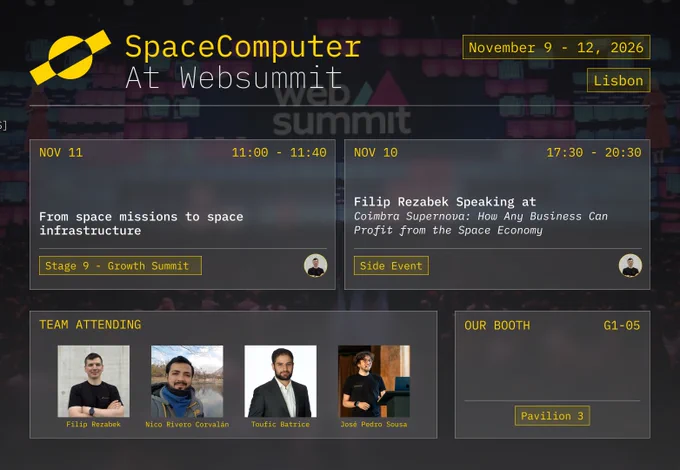
Olá, terráqueos em Lisboa! 🇵🇹 The SpaceComputer team has touched down at @WebSummit! @zkpedrongmi, @utocif and Nico will be at booth G1-05 from November 10th to 12th, bringing you insights on secure orbital computing, our key management service, and (of course) the future of cryptography in space. Come visit us! 👋

Post attachmentPost attachment
SpaceComputer avatar
SpaceComputer@SpaceComputerIO·Nov 5

You heard it here first: The SpaceComputer team is headed to @WebSummit in Lisbon! 📍 Lisbon, Portugal 🗓️ November 9 - 12 At our booth we'll be showcasing: 🛰️ Space Fabric hardware and OS verification & data provenance capabilities 🔐 Our key management service for sensitive applications and agent signing Check out where you can meet up with us during the conference👇 See you there!

Post attachment