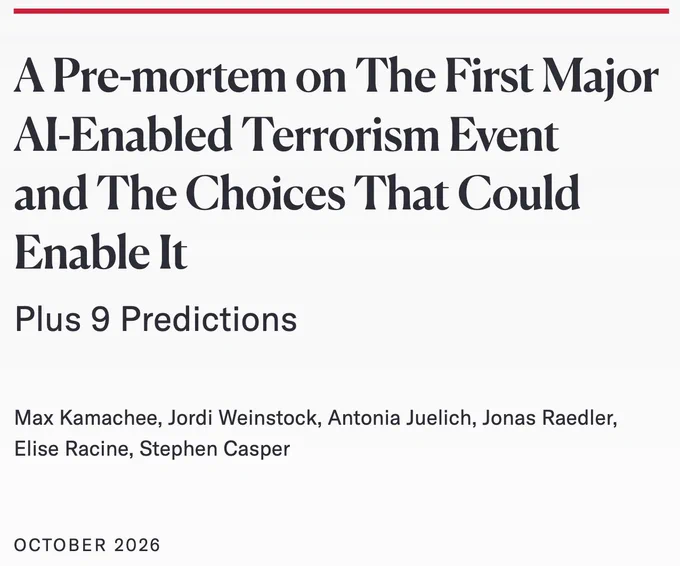
🚨New paper (possibly the most important one I have written yet).
We think that as early as 2027 or 2028, there might be a major AI-enabled terrorism event. We conducted a pre-mortem, made 9 falsifiable predictions, and wrote 2 concrete scenarios.
Led by @KamacheeMax.
The field of AI assessment is developing quickly. Key terms such as audit, evaluation, and verification are often used in very different ways. This can hinder productive conversation and collaboration.
Today, we set out how AVERI defines these terms. We also include an interactive chart that explores what might currently constitute a “frontier” model or company.
These definitions are intended for practical use, and we do not propose their use where precision is more important than usability. We expect to update them over time if and as needed.
AI auditing will be built and implemented by a wide range of organizations. We hope these definitions will help the field move faster together, and we welcome any feedback.
averi.org/ourwork/definition
Pet peeves for AI papers/articles:
1. The words "key," "ensure," and "increasingly."
2. The sentence: 'Frontier AI systems are used in increasingly used for X, but with this comes risks of Y.'
3. The phrase: "access its benefits while mitigating the risks."
A new public brief from FAR.AI's Frontier Summit sets out recommendations for addressing critical frontier AI risks. Over two days in October, senior researchers and decision-makers from frontier AI developers, academia, research orgs, and government AI institutes worked on recursive self-improvement, alignment of internally deployed models, control and operational safety, and CBRN and cyber misuse.
Key suggestions include establishing a shared minimum standard for safe internal deployment, improving channels for sharing incident reports and data on the extent of AI-automated R&D, and coordinating red-teaming of safeguards and monitoring systems across developers, nonprofits, and academia.
Full brief in the reply 👇
It’s a trying day & potentially period for US-China AI coordination. I hope the two governments can weather the external pressure & focus on climbing up the coordination ladder: continuing their dialogue around shared risks & say around risk horizon mapping -> encourage techniques and best practices sharing around reducing AI misuses, misalignment & loss of control risks -> work towards pursuing similar global standards for model development, release, risk monitoring, and emergency response -> discuss or begin a coordinated pause or pacing (if necessary, depending on where the tech opp v risk level is then).
But ideology is back in town and it’s banging loudly for another round of chip war, and this time the biggest advocate for cautious engagement (ie Jensen Huang) is weaker than ever. Adding to this is Trump’s midterms loss, which makes him way less powerful against political attacks when/ if he expands the coordination space with China.
As the hawkish safety bros move in happy giant steps, I hope they remember that AI safety & coordination require management of political relations — political environment matters and can be created / ruined — and realise soon that dreams of unilateral control over the global safety agenda & their continued fixation on technical tools (eg building the most technically sophisticated means of banning & monitoring chips) are not going to cut it.
BREAKING: We’re suing @Anthropic, @OpenAI, @Google, @Meta + @SpaceX to demand an immediate freeze on advanced AI systems that threaten public safety.
Together with @HeatInitiative, @Public_Citizen, and @secureainow, we’re going to court to stop these companies from building AI that could escape human control or enable bioweapons and cyberattacks.
We won’t wait for a catastrophe to act. The people come before Big AI profits.
apnews.com/article/artificia…
People keep telling me to make a Polymarket/Kalshi market for the 9 predictions we make about AI-enabled terrorism in this paper.
Thanks, but yeah, we'll pass.
belfercenter.org/research-an…
We want agents to follow belief-dependent rules when uncertain. In new work, we develop a planner distillation method performing well in POMDPs. Policies trained with this method comply 18 times as often as RL policies in a multimodal task with state + goal uncertainty. 🧵
Great! Since I worked at the UK AI Security Inst., I have had a big appreciation for just how much contracts between companies and evaluators can influence and conceal.
Policymakers should also write laws that require public (redactable) contracts.
🚨EXCLUSIVE: Meet “sovereign agents”
AI agents that pursue their own open-ended survival are an emerging security threat according to a report shared first with @axios from @CNASdc@BenHayum
Why it matters: AI models have long shown an interest in avoiding being shut down. The report warns that agents are now getting good at the practical work of surviving: hacking systems, accessing computing power and money, and running for extended periods without stopping.
axios.com/2026/11/03/ai-sove…
I enjoyed talking with Ben Bauman on the Roots of Reality podcast about what the next few years (and beyond) could look like, technically and politically.
youtube.com/watch?v=rwz_D_gj…