Jim Bolen was a highly decorated Special Forces Green Beret who served with the highly classified Military Assistance Command, Vietnam – Studies and Observations Group (MACV-SOG) during the Vietnam War. He led over 40 dangerous, top-secret missions into Laos and Cambodia, primarily targeting the Ho Chi Minh Trail and Sihanouk Trail.Bolen's expertise included infiltration, intelligence gathering, and prisoner snatch operations, often under heavy enemy fire
New Interview with Jim -youtube.com/live/Bik9J3ZOH8g…
One of the 4 SOG Combat Halo jump vets. We’ve had on…
*** Currently Interviewing a Major who worked at Long Thanh and was the CAMBODIAN target officer
MACVSOG HALO vet's entry into MACVSOG via CCC youtu.be/LIQEoihUGEs?is=FoNq… via @YouTube
He can order his crew to bail out into the valley, guaranteeing capture or death at the hands of the Viet Minh encirclement. Or he can try to drag the failing aircraft across the jagged, 4,000-foot mountains into neutral Laos.
He chooses Laos.
For approximately 40 excruciating minutes, McGovern and Buford nurse the smoking C-119 southward. They cover roughly 75 miles, following the winding path of the Sang Ma River, steadily losing altitude. The drag from the frozen prop forces McGovern to fight the heavy flight yoke with every ounce of his strength just to maintain forward momentum.
Above them, another CAT pilot named Steve Kusak flies top cover. Kusak desperately scans the dense jungle canopy for a place to put the massive cargo plane down. The terrain below is unforgiving. It is a sea of sharp limestone karst ridges and triple-canopy jungle, completely devoid of flat ground.
Kusak spots a tiny, abandoned dirt airstrip nestled in a valley near the Nam Ma River. He keys his radio, sending the coordinates down to McGovern's stricken aircraft.
"Turn right," Kusak transmits, guiding his friend toward the only clearing for miles.
McGovern wrestles the heavy yoke. The C-119 is bleeding altitude rapidly. The hydraulics are failing, and the crippled cargo plane handles like a falling brick. The airstrip is just half a mile away, but the jungle canopy is rising up rapidly to meet them.
McGovern keys his microphone one last time. His voice is perfectly calm, completely devoid of panic. It is a transmission that will be reported and remembered by the pilots who survived the airlift."Looks like this is it, son," he tells Kusak over the radio.
The left wingtip catches a tree ridge. The C-119 violently cartwheels into the Laotian hillside, instantly erupting into a massive fireball.
Inside the fuselage, the impact is devastating. James McGovern and Wallace Buford are killed instantly. Two of the French servicemen in the cargo bay also die on impact. Incredibly, two of the French kickers survive the horrific crash and are taken prisoner by Laotian forces. One of those survivors will succumb to his injuries a few days later. Only one of the four Frenchmen aboard the aircraft will ultimately return home.
The very next day, the guns at Dien Bien Phu finally fall silent. The French defensive position collapses completely, and the garrison surrenders to the Viet Minh.
For decades, the wreckage of the C-119 lay hidden in the remote Laotian jungle. In 2005, the CIA held a ceremony unveiling a painting of Earthquake McGoon’s final flight. At that ceremony, the French Ambassador presented the Legion of Honour to five of the surviving CAT pilots who flew the Dien Bien Phu airlift. The honour was a recognition of the massive, covert American effort that kept the garrison fighting until the bitter end.
Meanwhile, recovery efforts were already underway. A joint American-Laotian team had located the crash site in 2002. They recovered aircraft wreckage and human remains from an isolated burial site. Using DNA testing and dental comparisons, the Defense P Meanwhile, recovery efforts were already underway. A joint American-Laotian team had located the crash site in 2002. They recovered aircraft wreckage and human remains from an isolated burial site. Using DNA testing and dental comparisons, the Defense POW/MIA Accounting Office (DPMO) formally identified James McGovern in 2006.
On May 24, 2007, more than half a century after his aircraft cartwheeled into a hillside, Earthquake McGoon was finally laid to rest with full military honours at Arlington National Cemetery. He and Wallace Buford officially went down in history as civilian pilots working for a proprietary airline. But their sacrifice holds a much heavier distinction in the annals of American military history.
James McGovern and Wallace Buford are officially recognised as the first two Americans killed in combat in the conflict that would eventually become known as...
the Vietnam War
Earthquake McGoon’s Final Flight:
The CIA at Dien Bien Phu
1430 hours. A Fairchild C-119 Flying Boxcar groans under the weight of high-explosive artillery shells, flying straight into a wall of concentrated 37-millimeter anti-aircraft fire. Below the twin-boom aircraft lies the besieged valley of Dien Bien Phu.
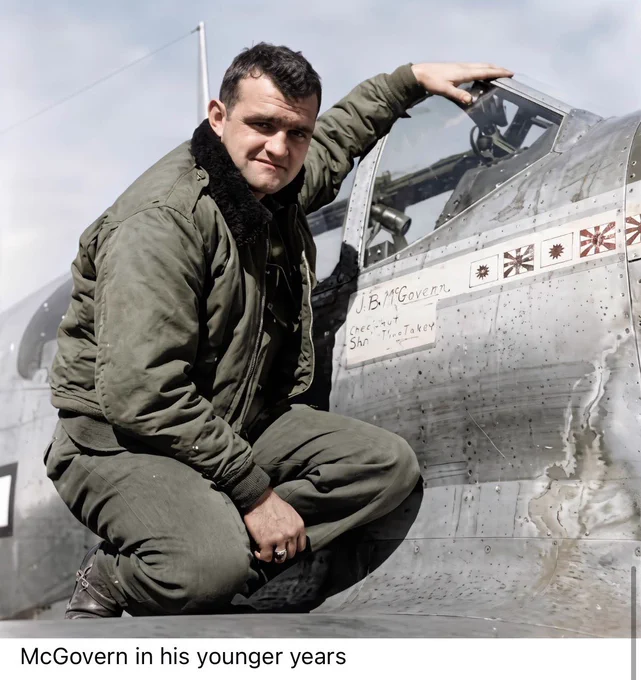
In the pilot's seat sits a massive American who goes by the callsign "Earthquake McGoon." His real name is James B. McGovern Jr. He wears no uniform and carries no dog tags. Officially, he is a civilian pilot working for Civil Air Transport. In reality, CAT is a proprietary airline owned by the CIA, operating directly on behalf of the American government.
In the back of the unpressurised cargo bay, four French servicemen wait for the green light. Below them, thousands of French paratroopers and Foreign Legionnaires are completely surrounded by Viet Minh artillery. They are fighting from flooded, muddy trenches, choked by the stench of the dead, begging for artillery ammunition over the radio to hold off massed infantry assaults.
This is May 6, 1954. It is the final day of the French air resupply operation, and the penultimate day of the battle. For weeks, CAT pilots like McGovern and his 28-year-old co-pilot, Wallace Buford, have been the only lifeline keeping the French garrison alive. Between March and May, CAT crews conduct 682 supply drops into the valley. They fly unarmed, heavy cargo planes through some of the heaviest concentrated ground fire seen since the Second World War.
The Fairchild C-119 was a brutalist piece of aviation engineering built in Hagerstown, Maryland between December 1949 through to 1955. It featured a twin-boom tail and a massive clamshell rear door designed specifically for dropping heavy cargo. But it was entirely unarmoured. Against small arms fire, it was highly vulnerable. Against the Soviet-supplied 37-millimeter anti-aircraft guns ringing Dien Bien Phu, it was a massive, slow-moving target. The Viet Minh had dragged heavy artillery and anti-aircraft guns through the jungle and into the mountains surrounding the valley. It was an operational feat the French high command had deemed impossible. Now, those guns were strangling the French garrison, and pilots like McGovern had to fly directly into the kill zone to feed the guns below.
McGovern is a legend in the Asian skies. An enormous, gregarious man, his massive frame and booming personality earned him a nickname pulled straight from the bearded character in the American comic strip Li'l Abner. He has spent his life in the cockpit. During the Second World War, he flew with the legendary Flying Tigers in China, where he was credited with destroying two enemy aircraft in the air and five on the ground. When the Korean War broke out, he kept flying, eventually being captured by North Korean forces and held as a prisoner of war for several months.
He is a man accustomed to hostile fire and impossible odds. But today, over strongpoint Isabelle, the Viet Minh gunners have their range.
As McGovern wrestles the heavy aircraft toward the drop zone, the sky fills with black bursts of flak. A 37-millimeter shell slams directly into the C-119’s port engine. Shrapnel tears through the metal skin. A second hit strikes the aircraft, inflicting severe damage to the control surfaces on the twin tail booms.
Inside the port engine nacelle, lines sever. The engine rapidly bleeds oil. Within moments, the massive radial engine seizes entirely. The port propeller stops dead, frozen permanently at operational pitch. The mechanical damage is catastrophic. The aerodynamic drag from the frozen propeller pulls heavily on the aircraft, making it nearly impossible to keep level.
In the rear, the French kickers immediately shove the heavy pallets of ammunition out the open doors. The C-119 lurches upward, free of its dead weight, but the aircraft is dying. McGovern is now flying a crippled Boxcar over hostile jungle. He has two options.
French Foreign Legionnaire walks along a dry ridge of rice paddy during a patrol through Viet Minh-held areas of the Red River Delta, between Haiphong and Hanoi. First Indochina War,
Vietnam, 1954.
#TheLegion#FrenchForeignLegion
The point man of "D" Company, 5th Battalion, Royal Australian Regiment, uses his radioman's PRC-25 to contact the section leader during an operation north of Nui Dat. Both men wear Australian issue green boonie hats and carry M16 rifles.
Photo taken: August 1969 by Michael Loehrer
Major Hector Gullan MC — Parachute Regiment, 3 Commando Brigade & 22 Special Air Service (SAS)
Lieutenant Colonel Hector Gullan MC was the legendary, unsung mastermind of Operation Nimrod who planned, coordinated, and commanded the historic live assault on the ground. A revered veteran who earned the Military Cross for gallantry under fire in Dhofar, Oman, he held the rare distinction of wearing three distinct combat berets during his service: maroon for the Parachute Regiment, Green 3 Commando Brigade and sand-coloured for the SAS.
On May 5, 1980, when Iranian terrorists murdered a hostage and threw his body from the Iranian Embassy in London, Major Gullan was ordered to execute his high-stakes rescue plan. Despite a catastrophic communications blackout and a team member getting trapped on a burning rope, Gullan calmly maintained absolute operational control over his 60 operators, pushing them through a chaotic, gas-filled fortress to successfully eliminate the terrorists and rescue 19 hostages in just 16 minutes. Forty-four years after the siege, Gullan and the other surviving SAS veterans from the rescue operation have been granted Ministry of Defence permission to talk about it publicly for the first time, revealing a story more complex and far more intriguing than the popular, gung-ho legend.
Today Gullan is 77, long retired and living quietly on the Cornish coast with his Norwegian wife, Lilli. You might spot him far out at sea fishing for mackerel from his kayak, or gathering nettles from the hedgerows to make a powerful homemade wine. With his long grey hair held back in a bandana, he seems more like an ageing hippie than a representative of the who-dares-wins brigade.
In winter he works as a ski instructor in Norway. Some of his pupils have got wind of his former life and ask if he was really in the special forces. “Do I look like an SAS soldier?” he asks them, and changes the subject.
But in 1980, a veteran of special operations in Northern Ireland and the Middle East, Gullan was the officer in command of B Squadron, 22 SAS, the secret force waiting on standby to deal with terrorist threats beyond the capability of the civilian authorities. 🫡🇬🇧
THE RAVEN WHO BROKE THE RULES
He began by chasing hurricanes. He ended up fighting a war the United States wasn’t supposed to be fighting.
Paul A. Merrick joined the Air Force in 1960. First a navigator on hurricane reconnaissance missions, then a C-130 crewman, he earned his pilot’s wings in 1966. By 1968, he was a forward air controller directing airstrikes over Vietnam.
Then he volunteered for something far more secret.
The Ravens were American pilots flying inside officially neutral Laos under the classified Steve Canyon program. Operating mostly unmarked Cessna O-1 Bird Dogs from airstrips like Long Tieng, they supported CIA backed Hmong forces fighting North Vietnamese troops. Their aircraft were slow, vulnerable, and frequently exposed to enemy fire.
Then came a desperate call from a besieged Hmong hilltop. Bad weather had grounded conventional strike aircraft. According to Christopher Robbins’s The Ravens, Fred Platt and five volunteers, including Merrick, loaded three Bird Dogs with high explosive and flechette rockets, machine guns, grenade launchers, and hand grenades.
Three observation airplanes. Six men. An outpost on the verge of falling.
Flying beneath the clouds, they attacked the North Vietnamese force and helped break the assault. Instead of immediate praise, embassy officials reportedly considered disciplinary action. The men had turned observation aircraft into improvised gunships.
Merrick later flew F-4 Phantoms. His family credits him with more than 700 combat missions, including 144 over North Vietnam, and decorations including the Silver Star and six Distinguished Flying Crosses.
After retiring as a major in 1980, he helped lead technical publications work on Northrop’s B-2 Spirit stealth bomber.
From hurricane hunters to clandestine Bird Dogs to stealth bombers, Merrick’s career crossed three extraordinary eras of American aviation.
And some of his boldest missions were flown in a war Washington barely acknowledged.
Aircraft History Junky: You were never here…
#AircraftHistoryJunky#RavenFAC#SecretWars#O1BirdDog#AviationHistory#laos#Vietnamwar
Operators from Poland's GROM training alongside the Army's SMU and the British SAS in the early 1990s. At the time, GROM was brand new. It was formed in July 1990 under Gen. Sławomir Petelicki, at a moment when Poland was only just emerging from the Warsaw Pact.
To build a counterterrorism unit capable of operating at the highest level, GROM looked West. American and British special operations units helped shape its selection, training, and tactics, sharing hard-earned lessons with men who just a few years earlier had served on the other side of the Iron Curtain. It was a remarkable shift, and photos like this capture it in real time.
That early investment paid off. GROM grew into one of the most respected Special Mission Units in Europe and went on to fight alongside its American and British partners in Iraq and Afghanistan.
Highly informative show tomorrow 🦅
2nd Fleet Anti-Terrorism Security Team Company (2nd FAST Co.)- Ethan Gar... youtube.com/live/mKkYNXoRzks… via @YouTube