
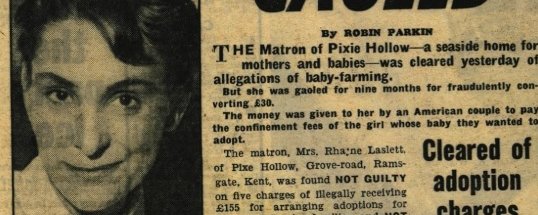
The Jason Ardley-like backstory of the woman who created the Notting Hill Carnival.

Reading around national decline, cultural rot, lost traditions and the British Old New Left, unpicking Whig history. Bluesky: threejacques.bsky.social

The Jason Ardley-like backstory of the woman who created the Notting Hill Carnival.


THE TESTIMONY OF PATIENCE KERSHAW The Unthanks (2009) #folk youtube.com/watch?v=wmhACB1Z…

This was our Miliband's father and grandfather trying to get into the country after the War. In the end the Labour Party Chairman Harold Laski asked the Home Secretary to sort it out for them "as one socialist to another".

Home Office official, handwritten report, 8 March 1949: 'Miliband, father and son, have so misrepresented the case in the past, I am afraid we can place no reliance on their statements.'

Mr Firth on his father's stories of sheep grazing in Bethnal Green. From Family and Kinship in East London by Michael Young and Peter Willmott (1957)

The End of Arthur's Marriage, dir. Ken Loach (1965) "We had a large shipment of army surplus elephants after the last budget. Cuts and squeezes, you know." A satire written by the poet Christopher Logue and directed by Ken Loach for BBC Television's The Wednesday Play, in which a young father sets off to buy his daughter a present and wanders through 1960s London. #KenLoach #film

Young and Willmott on 'Big Nanny' and 'Television Nanny'. From Family and Kinship in East London by Michael Young and Peter Willmott (1957) #history


The historian E. P. Thompson, in his 1963 history of how England's working class was formed between the 1780s and the 1830s, on a Methodist minister in Sheffield in 1808 who was outraged to find Sunday-school children being taught to write. From The Making of the English Working Class by E. P. Thompson (1963) #history #books

Civilisation, Episode 13: Heroic Materialism, presented by Kenneth Clark (BBC, 1969) "The moral and intellectual failure of Marxism has left us with no alternative to heroic materialism, and that isn't enough." In the last episode of his 13-part BBC series on Western art and ideas, the art historian Kenneth Clark looked back over the 19th and 20th centuries and gave his own verdict.


Leonard Thompson on Suffolk before 1914. He said it after putting on nearly a stone in four months of army training, the first time in his life without heavy work. From Akenfield by Ronald Blythe (1969)

From R. A. Butler to Cabinet (1954) In February 1954 R. A. Butler, then Chancellor of the Exchequer in Winston Churchill's government, gave the Cabinet these figures in a paper on recruiting coloured people to the Civil Service: of about 660,000 non-industrial civil servants, coloured staff numbered "not more than a few hundreds". The paper is in The National Archives, CAB 129/65/37.

Daniel Finkelstein, the Times columnist and Conservative peer, in his 2023 family memoir, on his grandfather Alfred Wiener, the German-Jewish campaigner against the Nazis whose archive became the Wiener Library in London, during the Second World War, while his wife and daughters were trapped in occupied Europe. From Hitler, Stalin, Mum and Dad by Daniel Finkelstein (2023)


Mr Adams on feeling like a foreigner on the Greenleigh estate. From Family and Kinship in East London by Michael Young and Peter Willmott (1957) #WorkingClass