Who gets to decide who we are?
Translated by Saba Mahmood Bashir, Razia Sajjad Zaheer’s Darkness and Other Stories examines the habits and prejudices that construct the identities of perceived and perceiver. Explore this incisive essay: buff.ly/AS4SH23
HUMANITIES NOW: Our co-directors, Professor Rita Kothari (@KothariRita) and Professor Arunava Sinha (@arunava), will join Professor Jonathan Gil Harris and Vedika Mehendale in conversation on 'Other Words, Other Worlds.'
This Thursday at @AshokaUniv.
Why AI can’t completely replace translators?
At the inaugural panel of Bhashavaad 3.0, writers, translators, editors and scholars came together to explore a question that feels increasingly urgent: 'Are Translators Redundant?'
The conversations examined what might be gained and lost as AI becomes an increasingly visible part of the translation process. The larger consensus was that AI can’t be simply written off, and the ethical boundaries have to be decided.
Read More: indianexpress.com/article/ci…
(@IndianExpress)
#AshokaUniversity
On Panel ‘Are Translators Redundant?’, translator and author Nishat Zaidi: “Would you then ask will literature become redundant, will authors become redundant. The assumption is that translation is a secondary job, translators reproduce, authors produce and the assumption is that reproductive labor is always secondary to productive labor. I see translators as co-producers of knowledge and then AI can never take that job”.
Join us at Bhashavaad 3.0 at the India International Centre this weekend.
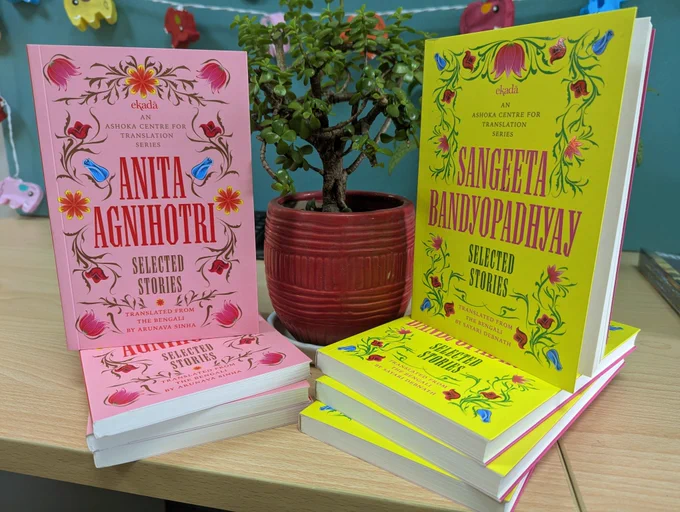
One of the foremost voices in contemporary Bengali literature, Anita Agnihotri creates flesh-and-blood women and men, making them confront the cataclysms that come their way.
Translated by @arunava, this collection is now in bookstores and online.
@TranslationAtAU
Can technology replicate cultural nuance?
'Using AI to simplify a classic for a 5-year-old is fine. But as publishers, we want to retain the nuance, empathy and shared imagination that AI lacks,' said Karthika VK, Publisher, Westland Books, while speaking at a session titled ‘Writing and Publishing in the Age of AI’ at Bhashavaad 3.0, organised by the Ashoka Centre for Translation, part of the Harish and Bina Shah School of Humanities, in partnership with New India Foundation.
Read More: timesofindia.indiatimes.com/…
(@timesofindia, @TranslationAtAU, @newindiafndtion)
#AshokaUniversity
"Which of the five stages of grief are publishers and authors in when it comes to AI and publishing"? Asks @matthan at Bhashavaad @TranslationAtAU@newindiafndtion
The Ashoka Centre for Translation (a part of the Harish & Bina Shah School of Humanities), and The New India Foundation invite you to Bhashavaad: The National Translation Conference, taking place on 29-30 August 2026 at the India International Centre, New Delhi.
Register Now: translation.ashoka.edu.in/bh…
(@TranslationAtAU, @newindiafndtion )
#AshokaUniversity
(1/3)
When translator Banani Chakravarty started translating Gunabhiram Barua’s 1880 biography of Ananda Ram Dhekial Phookan, she encountered something surprising: many phrases sounded as if they’d been thought in English and then translated into Assamese. Gunabhiram knew English, the biography was among the first modern nonfiction prose in Assamese and much of the source material was from Ananda Ram’s personal notebooks, perhaps written in English. With the understanding, her whole approach shifted. Banani was not translating from Assamese to English, but trying to recall what Gunabhiram had meant by the English words he had in mind.
Selections from 'Being Modern: A Biography of Ananda Ram Dhekial Phookan' by Gunabhiram Barua, translated from Assamese by Banani Chakravarty (Penguin, 2025).
@TranslationAtAU
#IndiaInTranslation We bring you some of the finest picks from our search engine for translations from India.
Featured: THE GARDEN OF TALES by Vijaydan Detha, tr. from Rajasthani by Vishes Kothari.
Discover many more translations at bhashavaad.in. Also, read along!
India speaks in hundreds of languages, and every translation bridges us.
We are inviting undergraduate students from Delhi-NCR to be part of the Bhashavaad Edit-a-thon 2026, a hands-on session to build India's growing database of translations (bhashavaad.in). Come celebrate India's multilingual heritage with us.
Scan the QR or click the link below to access the guidelines and register by July 31st.
docs.google.com/forms/d/e/1F…@TranslationAtAU
#IndiaInTranslation We bring you some of the finest picks from our search engine for translations from India.
Featured: SULTANA’S DREAM and PADMARAG by Rokeya Sakhawat Hossain, tr. Barnita Bagchi.
Discover many more translations at bhashavaad.in. Also, read along!
(1/4)
Between 2001 and 2009, eleven Indian language books were translated into Swedish, not from the original languages, but through English, French, and German. None of the Swedish translators knew Kannada, Tamil, Malayalam, or Hindi. And yet the series, Indiska Biblioteket, did something most publishers avoid: it disclosed the indirectness openly and made the case for it. Cecilia Alvstad's research asks the question worth sitting with: what is lost if we never translate a given text at all? What do you think: should indirect translations be treated as compromises, or as bridges?
Gear up for Bhashavaad 3.0 with @newindiafndtion!
The National Translation Conference returns for a third annual edition. Join us on 29th & 30th August at the India International Centre, New Delhi.
To register and to receive further updates: translation.ashoka.edu.in/bh…