Open web. Clear feed.

Futures trader. Read everything. Still traded wrong. Built the fix. Founder @trdforge — Where Discipline is Forged. Launching 2026.
You can't control the market. You can't control the news. You can't control whether your next trade wins. You can control your process. I built TrdForge around that one idea. Here's what it looks like: youtu.be/qKw1QtoAEEk?si=Sspz…

Same thing happens in trading. The second the account starts growing for real, most people switch from taking the trade to protecting the gains. That’s usually when the results start dying. The risk tolerance is not something you gain trading bigger but you have to earn the right to do so with incremental steps.
In 40 years of coaching champions, I've become sure of one thing: the moment you start achieving big things, you start wanting to play it safe. And that's the most dangerous bet you can make. I'll show you why. 🧵

In 40 years of coaching champions, I've become sure of one thing: the moment you start achieving big things, you start wanting to play it safe. And that's the most dangerous bet you can make. I'll show you why. 🧵
This is why the post-session review in TrdForge isn’t just a journal. It’s a structured closure process. What went well first. What to carry forward. A seed for tomorrow. Not to ignore what went wrong. But to process it properly and actually close the session. So the next one starts clean.
I’ve done this. More times than I’d like to admit. Replaying the same bad trade. Analysing the same decision. Arriving at the same conclusion. And then wondering why I felt heavy going into the next session. It wasn’t the loss that was damaging me. It was how I was processing it.
Think about the last time you went back through a bad trade. You didn’t just look at the chart. You felt it again. The frustration. The disbelief. The self-criticism. And then you closed the journal and went into the next session carrying all of that. A review process without resolution doesn’t close the loop. It reopens it.
@AlphaMind102 said something during our interview that I haven’t been able to stop thinking about since. When traders revisit their losses without a proper resolution process, they don’t analyse the experience. They relive it. “Each time you revisit the story, your body relives the moment.”
I haven't posted for 11 days. I spent them building. I write about process drift. Traders don't blow up on one decision. They stop doing the small things first. Skip the review. Skip the prep. Tell yourself you'll catch up later. That's exactly what happened to my posting. Same pattern. Same excuse. "I'll do it when the build is done." So I'm back, with a rule small enough to keep. One post a day. Process over ambition. That's the whole idea.
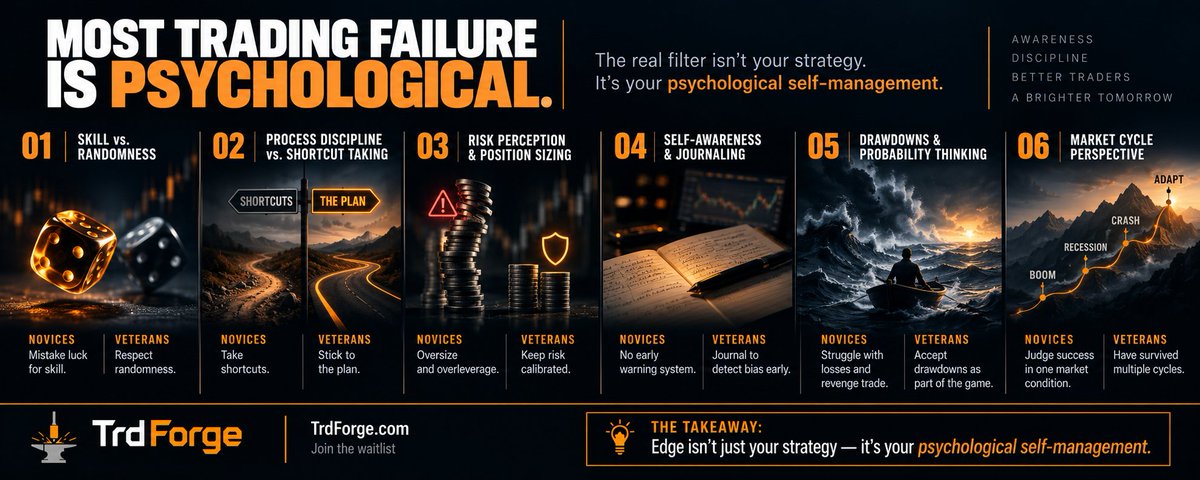
Your most dangerous trading session isn’t the one after three losses. It’s the one after three wins. Took years to actually believe that — it goes against instinct. We tighten up after losses, not after wins. For my dissertation, I asked five world-leading trading psychology coaches — Jared Tendler, Steve Ward, Steven Goldstein, Mark Randall, Louise Bedford — where overconfidence actually shows up most in the traders they’ve coached. Steve Ward: “Markets that offer traders the chance to make above-average gains are often where overconfidence emerges. This overconfidence typically stems from winning streaks.” Above-average returns distort risk perception. The process starts feeling optional — not because you decide to abandon it, but because you start crediting the results to skill instead of discipline. A few clean sessions and the explanation that feels true isn’t “I followed my process.” It’s “I’m reading this well.” That belief is what opens the door. Size creeps up. Entry criteria loosen. The review you’d normally do starts feeling unnecessary — why review what’s already working? This is why the worst drawdowns so often follow the best runs. Not bad luck. Distorted perception, at exactly the moment you’re least likely to notice it. The traders who avoid this aren’t the ones who never get hot streaks. They’re the ones whose process doesn’t change shape depending on whether last week was green or red. Full dissertation — free — trdforge.com/resources

Overconfidence doesn't go away with experience. I used to think it might. Survive enough sessions, and maybe you build some kind of immunity. Five coaches I interviewed for my dissertation told me that's not how it works. Jared Tendler, Steve Ward, Steven Goldstein, Mark Randall, Louise Bedford. I asked each of them, "Does overconfidence fade with experience?" It doesn't. Every trader experiences it. Novice or professional, six months in or twenty years in. What separates the traders who survive it isn't immunity. It's recognition. Jared Tendler put it precisely: "Overconfidence is more common among novice traders; experienced traders do not last long if overconfidence persists." Persists is the key word. Not "if it shows up." If it persists. Every experienced trader still gets overconfident. The ones who last are the ones who catch it before it compounds. Here's what connects it all. The earliest sign overconfidence has crept in usually isn't a feeling. It's a behaviour. Process drift. Slightly early entries. A little more room on a losing trade. Skipping the review you'd normally do. That drift is often the first visible evidence overconfidence has already taken hold — before you've consciously noticed anything has shifted. Which is exactly why every single coach, independently, pointed to the same tool for catching it. Structured journaling. Not to eliminate overconfidence — none of them claimed that was possible. To build the habit of noticing the drift early, before it becomes a pattern. The real finding isn't that experienced traders don't get overconfident. They do. Every one of them. The difference is whether they've built a process that shows them the deviation before the market does. Full dissertation free: trdforge.com/resources

One thing took me far too long to realise. I was getting better at preparing the market, but I wasn’t always preparing myself. I could analyse levels, news and market structure properly, then still trade badly because I was tired, frustrated, impatient or simply too eager to trade. Now I think preparation has two parts: •Prepare the market. •Prepare the trader. The second one is probably the part I ignored for the longest.
Before TrdForge was an app, it was literally a Word document. I made a simple pre-market sheet for myself because I was tired of turning up to the market unprepared and then wondering why my decisions were poor. Economic calendar. News. Higher timeframe analysis. Plan for the day. At the bottom, I had one reminder: “Be aware of the bias!!” It looked basic, but that document became part of the foundation for everything I’m building now.