World leader in information security & digital identity management GlobalGrowthCompany partner of #WEF #iot #cybersecurity #NFC #smartcity #Fintech #Blockchain
A major step toward building a global leader in #QuantumSecurity.
SEALSQ has signed an LOI to acquire QuintessenceLabs, with the ambition to create a vertically integrated quantum security platform built for today’s and tomorrow’s threats.
🔗 Read the announcement : sealsq.com/investors/news-re…#PQC#Cybersecurity#LAES
Quantum security is already a business priority.
At the BMO Capital Markets Technology & Innovation Leaders Conference, Carlos Moreira highlighted how SEALSQ is advancing post-quantum security today while building capabilities for tomorrow’s quantum infrastructure.
Read more 👇
sealsq.com/investors/news-re…#PostQuantum#QuantumSecurity#Semiconductors#SEALSQ#LAES
Our logos are now proudly displayed at Pont-Rouge in Geneva! Our new offices at Esplanade de Pont-Rouge 4–6, 1212 Grand-Lancy, Geneva, Switzerland, are open and ready to welcome our clients.
We are now building our Quantum Center of Excellence, which will be inaugurated in February 2027. Some of the technologies that will be showcased in Geneva will be on display tomorrow at the Quantum Summit in Cannes, including a Quobly quantum computer secured by SEALSQ.
We look forward to welcoming you! sealsq.comwisekey.comwisesat.space
Today in Cannes at the World Quantum Festival, SEALSQ is showcasing its quantum and post-quantum security technologies, including a quantum computer developed by Quobly and secured by SEALSQ.
Quobly uses silicon spin qubits. Its chips trap individual electrons in tiny structures called quantum dots and use a property of each electron, its spin, to encode quantum information. By controlling how neighboring electrons interact, the chip can perform operations on two qubits, a fundamental building block of quantum computing.
What makes this approach particularly interesting is how the chips are made. Quobly works with STMicroelectronics to build quantum chips on industrial 300 mm semiconductor manufacturing lines. It has already demonstrated single-qubit operations, two-qubit operations and qubit readout on one chip made using this process. That is a step toward manufacturing larger quantum processors using the tools and expertise of the semiconductor industry.
Our demonstration in Cannes brings together Quobly’s silicon quantum computing and SEALSQ’s post-quantum security, showing how security can be built into quantum computing infrastructure from the start.
#SEALSQ#Quobly#QuantumComputing#PostQuantumSecurity#WorldQuantumFestival
How do you take digital trust into orbit?
In my @Stocktwits Board Room Exclusives interview, I explain how WISeSat.Space builds on the WISeQey.com Group’s work in digital identity and chip security to deliver secure satellite connectivity.
WISeQey is the parent company. Within the group, @WISeKey provides digital identity and authentication technology, @SEALSQcorp develops secure semiconductors and post-quantum cryptography, and WISeSat.Space operates the low-Earth-orbit satellite network that brings these capabilities to connected devices beyond the reach of terrestrial networks. SEALSQ and WISeSat.Space are separately listed companies within the WISeQey Group. (sec.gov, wisekey.com)
A practical example is a sensor at a remote industrial site. A secure chip can give the sensor a verifiable identity and help protect its data, while WISeSat.Space provides the satellite link that carries those readings back to the operator. The same approach can support organizations that want greater control over how their devices connect and how their data is protected.
The commercial relationship is taking shape as well. SEALSQ and WISeSat.Space AG signed a letter of intent covering satellite capacity associated with 12 satellites and related operations, subject to a definitive agreement. For SEALSQ, this creates a potential route to deploy its security technology in space. For WISeSat.Space, it represents a potential customer commitment for satellite capacity. (sec.gov)
WISeQey, SEALSQ and IC’Alps are bringing post-quantum security to the silicon level at electronica 2026 in Munich.
This week, our @SEALSQcorp and IC’Alps teams are showing how manufacturers can build quantum-resistant security into their products, from device identity and trusted boot to custom chip design.
• VaultIC409 combines a hardware root of trust with support for classical and post-quantum algorithms, giving manufacturers flexibility as they migrate to new standards.
• QVault TPM is a post-quantum Trusted Platform Module designed to protect device identity and support trusted boot and hardware attestation.
• QASIC, developed with IC’Alps, brings NIST-standardized post-quantum cryptography directly into custom silicon, including ML-KEM (FIPS 203) and ML-DSA (FIPS 204).
• QS7001, our post-quantum RISC-V secure chip, will be featured in live demonstrations showing how it can help protect connected medical devices.
📍 Meet the team at Messe München, Hall C6, Booth 670, November 10–13.
🎤 Join SEALSQ at the Embedded Systems World Forum on Friday, November 13 at 11:50 a.m. CET for our keynote, “Embedding certified secure hardware to simplify migration to post-quantum security standards.”
If you’re in Munich, stop by to see the technology in action and discuss what post-quantum migration looks like for your products.
#electronica2026#PostQuantumCryptography#SecureSilicon#SEALSQ#ICAlps#WISeQey
Quantum readiness starts with knowing where to act.
SEALSQ and TechAgency are joining forces to help organizations assess their exposure, define a post-quantum migration roadmap and move through execution.
👉sealsq.com/investors/news-re…#PQC#QuantumSecurity#Cybersecurity#LAES
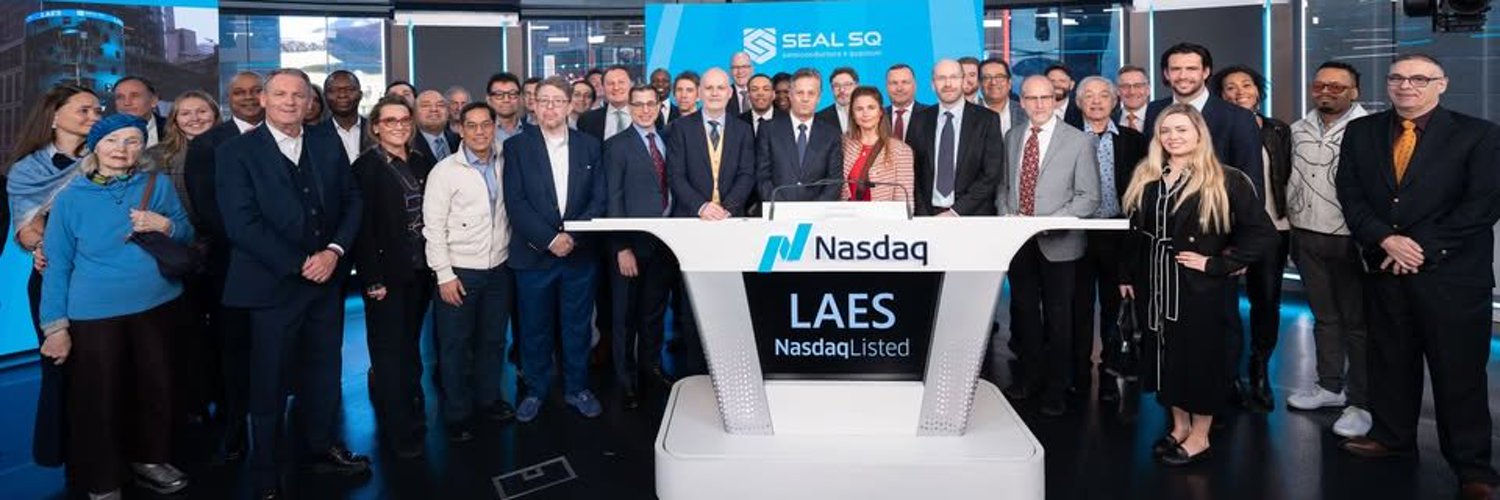
During the WISeSat.Space roundtable at Nasdaq, we discussed how cyber warfare in space is becoming one of the most critical and often invisible frontlines of geopolitical conflict.
Our dependence on satellites extends far beyond communications. Navigation, financial timing, transportation, energy networks and national security all rely on orbital infrastructure. An attack in space can therefore have immediate consequences here on Earth.
An attacker does not need to destroy a satellite to disrupt its mission. Cyberattacks and electronic warfare can interrupt essential services without creating the dangerous debris associated with a missile strike, while making responsibility difficult to establish.
The challenge is that a satellite is part of an interconnected ecosystem. Attackers can target ground stations and control centres through compromised credentials, vulnerable software or unsecured interfaces. They can disrupt communications through jamming, or use counterfeit signals to deceive navigation receivers and corrupt positioning and timing information. They can also exploit weaknesses in onboard software, command authentication or update mechanisms, putting the satellite itself at risk.
Securing this ecosystem requires protection across the entire mission, from ground infrastructure and communications links to onboard computers and payloads. Trusted hardware, secure boot, authenticated commands, protected cryptographic keys, signed software updates and continuous monitoring must be built into the architecture from the beginning. Preparing for future quantum threats also requires planning the migration to post-quantum cryptography throughout the satellite lifecycle.
At WISeSat.Space, our vision is to build sovereign space infrastructure with security embedded from the ground to orbit. As space becomes increasingly contested, sovereignty depends on our ability to trust, control and protect the systems on which we rely.
Protecting space means protecting life on Earth.
#WISeSat#SpaceCybersecurity#SpaceSecurity#DigitalSovereignty#PostQuantum
I am pleased to share that I will be a speaker at Cantor Convergence, taking place November 10–12, 2026, in Miami.
As artificial intelligence, quantum computing, digital assets and space technologies converge, we must ensure that security and trust are built into the infrastructure powering this transformation.
I look forward to sharing our vision at SEALSQ for post-quantum cybersecurity, secure semiconductors and hardware-based digital trust—and discussing how we turn technological breakthroughs into commercial opportunities.
A quantum future requires quantum-ready security. The work starts today.
I look forward to connecting with fellow speakers, investors and industry leaders in Miami.
🔗 cantor.com/conference/cantor…#CantorConvergence#SEALSQ#QuantumComputing#PostQuantumSecurity#Semiconductors#AI#DigitalTrust
🎥 AI Governance, the Future of the Internet, and the Challenge of Exponential Technologies — MIT Media Lab 40th Anniversary @MitMdiaLab
I am pleased to share the video of my participation in the AI Governance Panel at the MIT Media Lab’s 40th Anniversary Celebration.
It was a special moment, bringing together visionary minds to revisit the genesis of the Internet, reflect on how it transformed humanity, and explore what comes next in the age of Artificial Intelligence.
During the discussion, I shared a conviction that I believe will become increasingly important:
“AI cannot be effectively regulated through linear legislative processes when the technology itself evolves exponentially. Exponentiality will always outpace linear systems.”
Traditional regulation was designed for a world where technological change happened at a relatively predictable pace. AI is fundamentally different. By the time conventional legislation is drafted, debated, approved, and implemented, the technology may already have evolved several generations.
We need to rethink AI governance itself.
I believe the future lies in AI-powered self-regulation, operating under continuous human supervision, accountability, and independent auditing.
Just as we use sophisticated automated systems to monitor and audit billions of financial transactions, we should develop intelligent governance mechanisms capable of monitoring AI systems in real time, identifying risks, enforcing safeguards, and ensuring compliance with human-defined ethical principles.
Humans must remain the guardians of AI, but AI itself must become part of the governance solution.
The Internet connected humanity. Artificial Intelligence is now transforming how humanity thinks, creates, and makes decisions.
Our responsibility is not to slow innovation through outdated governance models, but to ensure that exponential technological progress remains aligned with human values.
The future of AI governance will not be humans versus machines. It will be humans and intelligent machines working together to protect humanity.
Thank you to the MIT Media Lab for bringing us together to celebrate 40 years of extraordinary innovation and to imagine the next chapter of our digital civilization.
🎥 Watch the video of our discussion.
#MITMediaLab#MIT40#ArtificialIntelligence#AIGovernance#ResponsibleAI#HumanAI#DigitalTrust#FutureOfTheInternet#Innovation#ExponentialTechnology#WISeQey
Add the video link explicitlyMake the governance argument more balanced
Video Courtesy of MIT Media Lab. Learn more about the Media Lab at media.mit.edu/about.
One idea stayed with me after the Quantum + AI event in New York: quantum computing will not replace the computers we use every day. It will complement them.
Our laptops and smartphones will keep doing what they do best. Alongside them, quantum processors will act as specialized accelerators, stepping in only for the problems where quantum algorithms can make a real difference. And that is an important nuance, because complexity alone does not guarantee a quantum advantage.
Where that advantage does emerge, the impact could be profound. In drug discovery and materials science, simulating molecular interactions could speed up the development of new medicines, better batteries and more efficient catalysts. In logistics and finance, quantum approaches could reshape how we optimize resources, analyze risk and build portfolios. In AI and scientific research, quantum methods may one day improve specific learning and simulation tasks, although here the practical benefits are still to be proven.
Then there is security, where the stakes are immediate. Future quantum computers could break the public-key cryptography that protects our data today. The good news is that post-quantum cryptography runs on the classical computers and chips we already use. We don't have to wait for quantum computing to mature to protect ourselves. We can act now.
The future I see is not quantum versus classical, but classical computing, AI and quantum processors working together, each where it delivers measurable value.
For those of us building this ecosystem, the path forward is clear: practical applications, credible milestones, secure infrastructure and technological sovereignty.
For a clear introduction, I recommend this NIST explainer:
nist.gov/quantum-information…#QuantumComputing#QuantumAI#PostQuantumCryptography#Cybersecurity#QuantumSovereignty#SEALSQ
Great discussion yesterday at MIT Media Lab, where I had the honor of joining a panel on AI governance.
My central message was clear: we cannot govern exponential AI through linear regulation alone. Traditional regulatory processes move through successive stages of drafting, consultation and implementation, while AI capabilities evolve at an accelerating pace.
We must build governance into the technology itself: AI systems capable of continuous monitoring, adaptation and self-regulation, with humans serving as the guardians of that process.
This requires embedding the principles of HUMAN-AI-T into the foundations of these platforms: human dignity, accountability, transparency, privacy and meaningful human control. These principles must shape how systems are designed, how decisions are made and how people can challenge their outcomes.
Self-regulation must remain subject to human oversight, independent scrutiny and enforceable accountability.
As AI becomes more capable, our responsibility grows: to ensure that technology continues to serve humanity, and that humans retain the authority to intervene.
#AIGovernance#MITMediaLab#HumanAIT#ResponsibleAI#HumanCentricAI
The post-quantum transition has already begun.
@CreusMoreira shares why cryptographic agility, digital sovereignty, and PQC readiness are becoming strategic priorities.
#PQC#PostQuantum#Cybersecurity#LAES
@WISeKey and @SEALSQcorp are moving their headquarters to Pont Rouge, Geneva, on November 15, 2026—reinforcing our commitment to Geneva and Switzerland. 🇨🇭
This move will bring together the expertise of our group companies and the Geneva Quantum Center of Excellence, strengthening collaboration across cybersecurity, semiconductors, quantum technologies and secure satellite communications.
By connecting our teams and capabilities in one location, we aim to accelerate innovation and help build the trusted, sovereign digital infrastructure of the future.
Geneva is our home—and a foundation for our global ambitions.
#WISeKey#SEALSQ#Geneva#Switzerland#PontRouge#Quantum#Cybersecurity#DigitalSovereignty