Exciting work led by @sambitghsh and @MadelynMathai on the diminishing returns of data in Sparse Autoencoders. Standard practice often uses millions of activation tokens, but it’s unclear whether that scale is necessary for different SAE goals. We investigate this systematically by training different SAE architectures on different LLM families with training budgets ranging from 5M to 500M activation tokens.
As the #ICLR2027 discussion period ends, a quick plea to our research community:
Authors are reviewers, and reviewers are (mostly) authors. We are the same people, just sitting on different sides of the portal.
My heart goes out to the students pouring their souls into thoughtful rebuttals, only to be met with a wall of silence. At a bare minimum, reviewers should acknowledge the author's response. Even a short "I have read your rebuttal, though my concerns remain" validates their immense effort.
Let’s extend the same respect to others' work that we expect for our own 🙏
Understanding the combined effect of multi-agent systems is one of the most pressing open problems in AI safety today.
Grateful to @mace_ai_corp for funding our lab at @uvadatascience . Our work will focus on keeping AI safety research open, transparent, and independently verifiable. Excited to see the breakthroughs that come from this industry-academic partnership!
News coverage: thestreet.com/crypto/artific…
We are excited to announce our partnership with University of Virginia's Aikyam Lab, part of the School of Data Science @uvadatascience, alongside @_cagarwal and @strnr.
The Mace AI Fellowship in Trustworthy Computing funds AI safety research at the school.
We also find that data selection matters. Random sampling tends to favor reconstruction, while diversity-based sampling frequently improves AutoInterp. If you care about reconstruction or probing, you may not need hundreds of millions of tokens. But if you're making claims about individual features or latents, functional performance alone isn't enough—check that the features reproduce.
But feature-level reproducibility tells a very different story.
The fraction of strictly matched features increases from just 2.2% at 5M tokens → 16.9% at 25M → 28.9% at 50M. In other words, an SAE can appear to have converged according to functional metrics while its individual features are still changing substantially. This adds a new dimension to the ongoing debate over whether SAEs recover a canonical set of features. While prior work has shown that different random seeds can produce substantially different features, we ask: How does feature reproducibility change with the amount of activation data?
Performing the same ≠ learning the same features
We show that with surprisingly small data budgets, SAEs recover much of the functional behavior of a 500M-token reference. Reconstruction and several SAEBench metrics approach the reference well before 500M tokens.
5%.
That's how many of the 136 U.S. prescribing clinicians we surveyed support autonomous AI prescribing without clinician sign-off for new prescriptions.
But while the medical establishment is busy drawing a line in the sand over new scripts, Utah is already running a pilot where an AI quietly handles renewals across 192 different drugs.
The industry is fiercely debating what AI might be allowed to do tomorrow, completely missing what it’s already doing today.
Great work led by Eileanor LaRocco and awesome collaborators Sarah Tan, @_asubbaswamy, Anne Andrews, Andrew Taylor, and Cree Gaskin!
Pre-print: arxiv.org/pdf/2606.25108
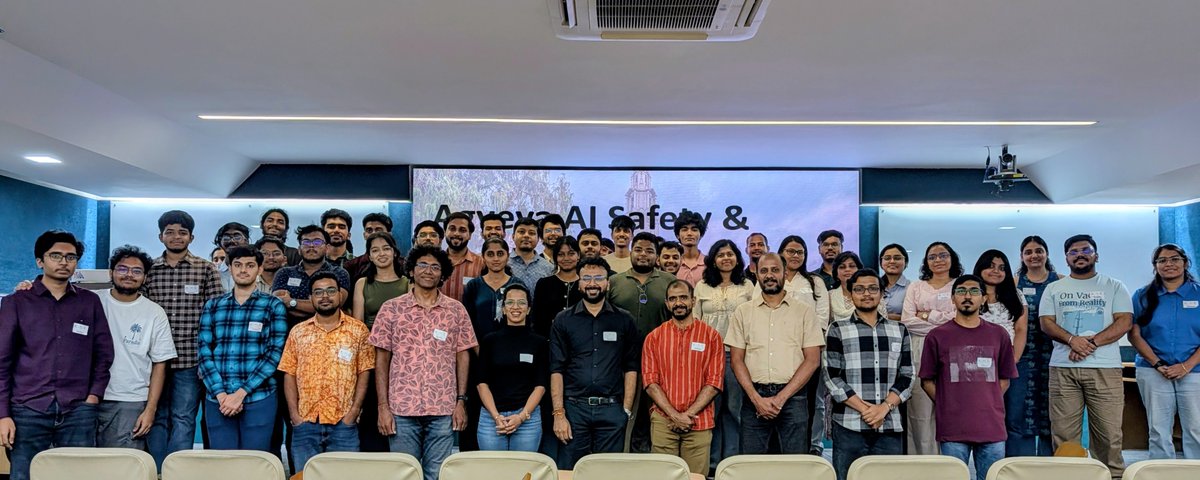
And that's a wrap on the inaugural Agyeya Research Interpretability & Safety Workshop!
Two days ago at @iiscbangalore, we set out to bring together a cohort of brilliant students and researchers around one question — not just how to build AI systems, but how to understand them.
Thank you to every speaker, panelist, and mentor who gave their time, to our program committee and student volunteers, to our hosts at IISc, and to @GoogleIndia and @adaption_ai for supporting this workshop!
We are thrilled to announce the inaugural Agyeya Research Workshop, hosted in partnership with the @iiscbangalore! Our mission is to break down barriers for early-career researchers and cultivate India’s next generation of AI leaders.
As part of the workshop, we are also launching the Agyeya AI Scholar program. This initiative aims to select and train a dedicated cohort of candidates through hands-on research and mentorship in AI Alignment, Interpretability, and Safety.
🗓️ Apply by June 30th and stay tuned for our upcoming mentor announcements!
Find more details and submit your application here:
lnkd.in/efGa44KT@ponguru Sriparna Saha, @rvbabuiisc, @NikitaKharya, @precogatiiith@val_iisc
This work led by @jialicheng123 moves machine unlearning toward a more mechanistic understanding of why some examples, features, or concepts are easier or harder to remove. Today at 2pm PTD:
Excited that our #ACL2026 paper with zihengchen, @_cagarwal, @amirieb on Measuring Unlearning Difficulty with MechInterp!
Time: Sun July 5, 14:00-15:30, Poster Session B
Location: Grand Hall
Looking forward to connecting with everyone!
aclanthology.org/2026.findin…
🚀 Aikyam Lab is heading to @icmlconf and @aclmeeting and continuing its core mission of advancing Trustworthy AI, Interpretability, and Safety. Below are few of the papers:
[ICML] Evaluating Multilingual Trustworthiness in Language Models for Healthcare: arxiv.org/abs/2512.11437
[ICML,MechInterp] When Graph Tokens Sink: A Mechanistic Analysis of Graph Language Models: arxiv.org/abs/2606.03712
[ACL (Oral)] CURE-Med: Curriculum-Informed Reinforcement Learning for Multilingual Medical Reasoning: cure-med.github.io/
Other paper details: chirag-agarwall.github.io/pu…
I am absolutely thrilled to announce that four research papers from our group + collaborations have been accepted to ACL 2026, covering critical areas of Reasoning, Interpretability, Safety, Multimodal AI, and Model Unlearning. Huge congratulations to all the authors and collaborators for their contributions!
Stay tuned for updates and links to our papers soon!
#ACL2026#AikyamLab
We are thrilled to announce the inaugural Agyeya Research Workshop, hosted in partnership with the @iiscbangalore! Our mission is to break down barriers for early-career researchers and cultivate India’s next generation of AI leaders.
As part of the workshop, we are also launching the Agyeya AI Scholar program. This initiative aims to select and train a dedicated cohort of candidates through hands-on research and mentorship in AI Alignment, Interpretability, and Safety.
🗓️ Apply by June 30th and stay tuned for our upcoming mentor announcements!
Find more details and submit your application here:
lnkd.in/efGa44KT@ponguru Sriparna Saha, @rvbabuiisc, @NikitaKharya, @precogatiiith@val_iisc
Today we’re announcing a finding that breaks a core assumption in AI: that bigger models are harder to understand.
We show the opposite. When interpretability is built into training, models become MORE understandable as they become more capable.
🧠🤖 The 2026 New England Mechanistic Interpretability (NEMI) Workshop will be Aug. 14 at Boston University!
Help spread the word and join the New England mech interp community! Registration and submission info in thread:👇
We are thrilled to announce the inaugural Agyeya Research Workshop, hosted in partnership with the @iiscbangalore! Our mission is to break down barriers for early-career researchers and cultivate India’s next generation of AI leaders.
As part of the workshop, we are also launching the Agyeya AI Scholar program. This initiative aims to select and train a dedicated cohort of candidates through hands-on research and mentorship in AI Alignment, Interpretability, and Safety.
🗓️ Apply by June 30th and stay tuned for our upcoming mentor announcements!
Find more details and submit your application here:
lnkd.in/efGa44KT@ponguru Sriparna Saha, @rvbabuiisc, @NikitaKharya, @precogatiiith@val_iisc