With @arcade_ai x @shopify now all you really need is just an idea

Now all you need is just an idea
 Open web. Clear feed.

With @arcade_ai x @shopify now all you really need is just an idea
Now all you need is just an idea

Thanks @arcade_ai for the invite to Sunday’s SF hackathon 🙌 Built a 3D studio for cafés and hotels to design custom table settings and actually get them made. Quite a lot of engineering to stop the napkins clashing. Have a play: editions.company

Spent my Sunday building a personalized journal studio for Como @trycomoapp at @arcade_ai's hackathon! The idea? A physical journal tailored to your emotional eating patterns, with new prompts that grow with you 🫵 Can't wait to take this further and make it real! #sftechweek


Come join us at Shopping 3.0 to build more things like this! partiful.com/e/GmB2RWwfd99Jo…
Built a room designer to plan my space for senior year at Stanford. I can swap bedding, pillows, and lighting, see how they look together, and check out with my favorite pieces using @arcade_ai

I'd love to see more people building commerce and physical product businesses. We're opening Arcade's APIs and manufacturing network so they can. Join me at Arcade's AI Commerce Hackathon on Oct 11. @kirstenagreen a judge; $10,000 1st / $5,000 2nd. Bring an idea! #SFTechWeek
Bring your taste. Build a business. Shopping 3.0: Arcade's AI commerce hackathon. First access to our specialized models and prompt-to-physical APIs. October 11, 2026, $15K in prizes. 100 seats. Apply: partiful.com/e/GmB2RWwfd99Jo… #SFTechWeek 1/3

Have an idea for a product you wish existed? @arcade_ai is opening up the tools and manufacturing network to bring it to life. I’ll be joining @mnaficy as a judge on October 11. Bring your taste, ambition, and ideas.
I'd love to see more people building commerce and physical product businesses. We're opening Arcade's APIs and manufacturing network so they can. Join me at Arcade's AI Commerce Hackathon on Oct 11. @kirstenagreen a judge; $10,000 1st / $5,000 2nd. Bring an idea! #SFTechWeek


Lazy work used to mean too little output. Now, with AI, it often means too much and more work for everyone else. @tobi call it "slop grenades." A "Slop Grenade" is when you let AI produce the work and pass it on without adding any value (including checking it). Someone else has to wade through it, catch the mistakes, and clean up the mess. You save time and look productive but someone else pays for it.
My third conversation with Shopify co-founder and CEO @tobi. 0:00 How Shopify Uses AI 7:18 River: Shopify's Internal AI 8:55 How to Encourage Osmosis Learning 10:52 AI Dreaming and Self-Reflection 11:53 How to Use AI for Strategic Decision Making 14:11 The One Thing AI Cannot Do 16:04 What AI is Making Worse at Shopify 19:46 Predictions: Where AI is Headed Next 21:55 The Future of AI-Powered Software 24:40 Will CEOs Be Replaced with AI? 27:54 Can Superintelligence Be Controlled? 31:13 Critical Skills in AI Age 34:22 Why Complex Solutions are Usually Wrong 36:33 Conditions Needed for True Intuition 38:02 The Best Path Doesn't Have Instant Feedback 44:51 How Affirmations Can Shift Your Behavior 50:44 The Inobvious Thing Hurting Companies 52:37 Relationship Between Beauty and Creation 56:23 How SpaceX Moves Forward By Subtraction 1:00:24 Why Companies Need Refounding Events 1:01:50 Books as Cheat Codes 1:02:39 Three Books to Change Your Thinking Enjoy! (Includes paid promotions.)

one aspires to be able to ship something like this in their lifetime. art and craftsmanship.

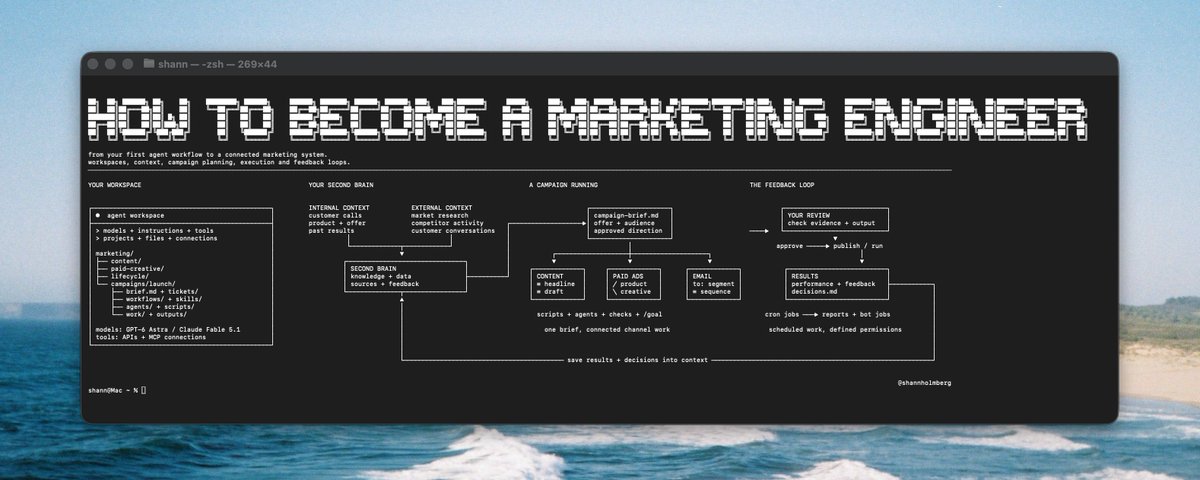
every marketing engineer needs a knowledge base, a second brain a central place for files that contain all the information, data, examples and instructions your agents need to produce quality work here is how to organize it for marketing: 1. start with the files every marketing team needs > company .md: what the business does and who it serves > customer .md: customer problems, buying triggers, objections and their own words > offer .md: what you sell, pricing, deliverables and promises you can support > positioning .md: why someone would choose you over the alternatives > voice .md: how you write, with examples and phrases to avoid > proof .md: case studies, approved claims and links to the evidence build these from material you already have: sales calls, proposals, customer interviews, website copy and previous campaigns for voice .md, include your edits. an approved post helps, but explaining why you changed the opening gives the agent something specific to apply 2. create a folder for each marketing function content, SEO, paid, creator marketing and email all need different instructions inside each folder, keep: > playbook .md: how the work gets done > examples/: approved work and rejected versions, with your feedback > tools .md: which tools and accounts agents can use > checks .md: what to check before returning the work > calendar .md: what's planned, in progress and ready for review reference the shared files when needed. if you change the offer, every team should be able to find the current version 3. organize content by platform an X post, a newsletter and a LinkedIn post need their own examples and writing guidance content/ ├── playbook .md ├── checks .md ├── tools .md ├── calendar .md ├── x/ ├── linkedin/ ├── newsletter/ └── visual/ inside each platform folder, save the formats you use, examples you've approved and drafts you've rejected 4. give agents visual references to work from keep a moodboard and brand book in Figma or Paper, with links in visual/ > moodboard: references for the look you want, with notes on what you like about them > brand book: colors, fonts, logos, layouts and rules for using them > approved examples: previous ads, landing pages and campaign assets give the agent access to those files when it creates visuals, and save your design feedback alongside the references 5. give each campaign its own folder campaigns/product-launch/ ├── brief .md ├── research/ ├── decisions .md ├── production/ └── results .md the brief holds the goal, audience, offer and constraints for that campaign decisions .md records what you've agreed on and why. if you reject an angle or change the offer, save the decision there agents working on the landing page, emails and social posts can then use the same approved direction 6. connect your performance data using a data warehouse a data warehouse stores performance data from your marketing tools in one place your agents can query connect your ad platforms, website analytics, sales tools and content accounts to collect spend, clicks, leads, conversions and campaign results the marketing folders can hold campaign reports and your interpretation of the results, with links to the data behind them for a new campaign, an agent can read the previous brief, inspect the assets and check how they performed include the reporting period and metric definitions so it can make a useful comparison 7. explain how agents should use the folders add an AGENTS .md file with instructions for working in the knowledge base > where to find the relevant files > which sources to trust > where to save drafts and research > how to flag conflicting information > which changes need your sign-off give the agent the files it needs for the task you're asking it to do 8. save what you learn while doing the work when you correct a draft, update the writing instructions or examples when a campaign reveals a new customer objection, add the evidence to customer .md when an offer changes, update offer .md and flag the active campaigns affected I'd keep the markdown files in GitHub so changes can be reviewed and traced back to whoever made them, with large creative files linked from shared storage start with one marketing function and a task you're already doing

Shann³ @shannholmberg Sep 10 Article How to Become a Marketing Engineer marketing engineers build the systems behind the marketing. learn how to connect your knowledge, data and agents into workflows that research, plan and run campaigns. I started bringing more of my

Building a storefront agent in Claude? We built the reference implementation to connect it to your Shopify store
We're open-sourcing Claude Commerce Agents. This is a blueprint for building shopping and merchant agents, with reference implementations across retail, travel, telecom, and entertainment.


to build a cool product now, you really only need two ppl: one dude with exceptional vision & taste who knows what should exist & can provide the right feedback loops for iteration. & one dude who is absolutely relentless about making it real no matter what. that’s it. & sometimes these two are the same.

Agentic commerce doesn't kill Shopify apps. It bypasses the ones whose value lived in the storefront, and routes straight through the ones that own data, logic, or fulfillment. A risk map for app founders: taylorsicard.com/blog/shopif… #ShopifyPartners #AgenticCommerce


I used to sell on @etsy and @shopify, and I wish I had @arcade_ai. I think some of the most interesting stores in this era of generative commerce will design their products after the customer shows up. That’s what I’m excited to see people build with our APIs.
Bring your taste. Build a business. Shopping 3.0: Arcade's AI commerce hackathon. First access to our specialized models and prompt-to-physical APIs. October 11, 2026, $15K in prizes. 100 seats. Apply: partiful.com/e/GmB2RWwfd99Jo… #SFTechWeek 1/3