Between 1979–2019, top pay (90th pct.) rose 53%, middle rose 23%, bottom (10th pct.) rose 17%. (Hourly productivity climbed 73%.)
Since 2019, gains at the bottom reversed 1/3 of this rise in pay inequality. But much more needs to be done!
🧵on my book: The Wage Standard.
The highly classified network that the National Security Agency uses for its internal communications is down, according to six people familiar with the matter.
At this point there is no evidence of a cyberattack, sources said. CNN has asked the National Security Agency for comment. cnn.it/4AA0eTd
NEW: The evidence that the UK is seeing an uptick in productivity is building. New ONS data shows productivity growth accelerated in the 3rd quarter:
- Output per hour worked is up 2.5% over the year
- Output per worker is up 2.0% = strongest growth since 2018 (outside pandemic)
We've entered a zone of fragility, perhaps not unrelated to AI which is sucking up a lot of human IT expertise. In this zone, the AI disruption is even more likely. Overall, a very concerning possibility that we are absolutely not preparing for.
Checking out some taquerias in the state that has seen arguably one of the highest growth in bottom wages in the last decade.
The state with the highest minimum wage relative to state median wage (61%).
Arizona.
This is an important point to consider. If AI is pushing us to (and beyond) capacity constraints in IT this can take a toll on the rest of the economy. And when there are major risks involved, it may not just be a form of crowding-out ("general equilibrium effects"), but it could be a negative externality.
One possible explanation for why so many outages have coincided with the rise of AI is that managing AI-related risks has taken up so much of IT engineers’ time that they’ve struggled to keep up with routine monitoring and maintenance.
CNN: Widespread computer outage for United Airlines. What we're hearing from United Airlines is that there is a widespread system outage that is affecting all of its mainline flights…
New: I went deep on the newly urgent question facing Democrats: how high and how fast to raise the federal minimum wage?
It hasn’t been raised in 17 years, and there are now real opportunities to change that. The last time it was raised was following the blue wave in 2006, signed by President GWB. Trump has said before he thinks the federal minimum is too low, and more recently he said he doesn’t want to just spend the next two years vetoing everything.
As Democrats look to act in 2027 and beyond, the empirical debate over how high the minimum wage can safely go is getting entangled with the populist one over how high the party should aim. We’ve learned a fair bit about the policy from state, local, and international examples, but researchers still disagree about what this means for the American federal minimum.
I lay out the politics + research, with interviews with @arindube, @jasonfurman, Patrick Oakford @michaelstrain, @ryandoube + more.
In the #Amazonia, the cry of the earth and the cry of the poor are inseparable, exposing patterns of exploitation and economic activity that threaten the balance of creation. Protecting the Amazon rainforest cannot be separated from concern for the people who live there. Indeed, integral ecology, social justice, and the spiritual life go hand in hand. #ApostolicJourney#Peruvatican.va/content/leo-xiv/e…
In the #Amazonia, the cry of the earth and the cry of the poor are inseparable, exposing patterns of exploitation and economic activity that threaten the balance of creation. Protecting the Amazon rainforest cannot be separated from concern for the people who live there. Indeed, integral ecology, social justice, and the spiritual life go hand in hand. #ApostolicJourney#Peruvatican.va/content/leo-xiv/e…
I'm visiting Arizona (ASU) this week. A book talk on The Wage Standard, and a seminar on the updated version of The Unexpected Compression (that I'm excited about.)
In preparing for the visit, I looked to see what's happened to wage inequality in Arizona in the past 10 years.
Arizona today has the highest minimum-to-median-wage (Kaitz index) of any state in America.
And as a result, we have seen an incredibly strong wage growth at the bottom in Arizona.
The reason more market power in setting wages or prices means lower costs (to profits) from mistakes in wage and price setting is ... the envelope theorem.
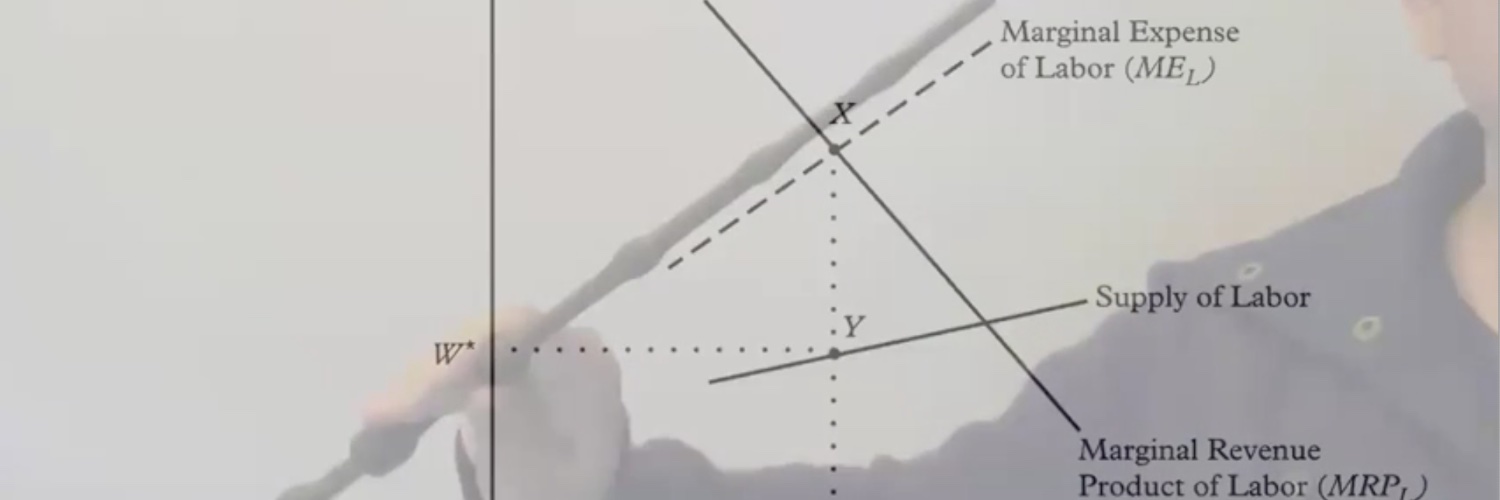
Here is an example using labor market (monopsony) power and "mistakes" in setting wages.
The reason more market power in setting wages or prices means lower costs (to profits) from mistakes in wage and price setting is ... the envelope theorem.
Here is an example using labor market (monopsony) power and "mistakes" in setting wages.