
I'm so excited! My book "Opt Art: From Mathematical Optimization to Visual Design" is out today! If you want to order a copy or check out some endorsements, you can do so at press.princeton.edu/titles/1… or amazon.com/Opt-Art-Mathemati…

 Open web. Clear feed.

The James F. Clark Professor of Mathematics at Oberlin College. Artist. Author of "Opt Art: From Mathematical Optimization to Visual Design." He/him.
I'm so excited! My book "Opt Art: From Mathematical Optimization to Visual Design" is out today! If you want to order a copy or check out some endorsements, you can do so at press.princeton.edu/titles/1… or amazon.com/Opt-Art-Mathemati…
I love this!
Fun Fact - I know my drawing below does not look that crazy, but it was by far the most technically difficult drawing I have completed. This is one non-intersecting line. I drew it with a pen. I wanted to share it. #singlelineart #loop


Último artículo publicado. Me hace especial ilusión porque trata de combinar Matemáticas y Arte. El objetivo era encajar piezas de Tetris para representar imágenes conocidas. Making mosaics from Tetris® tiles tandfonline.com/doi/full/10.… @tandfonline @Tetris_Official @Dimatematicas

An 24-frame animation of a traversal of a Hamiltonian cycle of the permutohedron (truncated octahedron). Each vertex is one of the 4! = 24 ways of assigning four colors (yellow, blue, black, red) to the four 2-factors.
And after swapping yellow and red. Note that the fourth 2-factor is a translation of the third one.

The same decomposition after one additional color swap (yellow and black).
The same decomposition, but with yellow and blue swapped. Note that the second 2-factor is a translation of the first one.

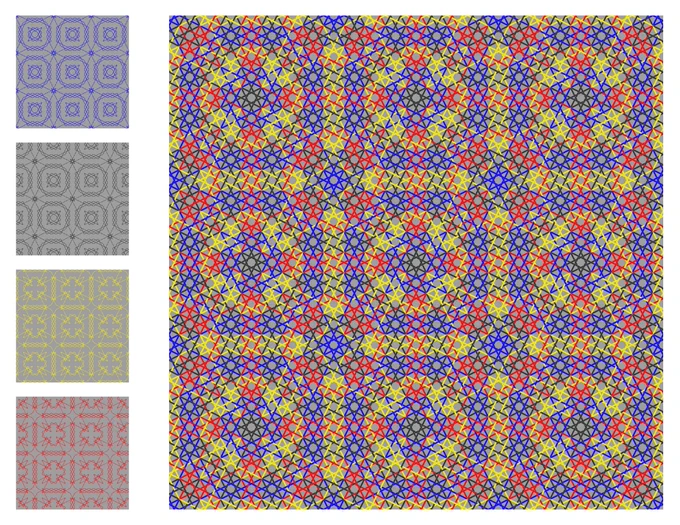
The large image on the right displays a 24x24 section of a decomposition of the infinite knight's graph into four 2-factors (i.e., 2-regular spanning subgraphs). The four smaller images on the left show the four 2-factors.

The same decomposition after one additional color swap (yellow and black).

The large image on the right displays a 24x24 section of a decomposition of the infinite knight's graph into four 2-factors (i.e., 2-regular spanning subgraphs). The four smaller images on the left show the four 2-factors.

I converted a text message into a knight's tour. To decode it, follow the knight's tour, starting in the top left corner. The knight will traverse a succession of 11x11 tours, and each of these 11x11 tours corresponds to a letter. The message is a quote from Ursula K. Le Guin.

"Spiraling to keep myself from spiraling." An open knight's tour of a 99x99 chess board. The tour can be thought of as a tour of 11x11 tours, and it can be extended indefinitely to form an infinite Hamiltonian path through the infinite knight graph.


A tour of tours, an open knight’s tour of a 99x99 chessboard. The tour starts in the bottom left corner and ends near the top right after winding its way through a 9x9 array of 11x11 tours, visiting them in the same order as would a stage-3 Peano curve.


