I was on a bus with my students to dinner yesterday. We overheard (not eavesdropped cos one of them was pretty loud 😅) a conversation between two young chaps in their 20s. Our eyebrows naturally rose when we heard this:
"I had to offload my thinking to AI."
The preceding sentences had to do with some assignment question not specifying enough details for them to know exactly how to tackle it.
What happened to asking the teaching staff?
On a more general note, if the details of a problem in the real world can be laid out precisely and exactly when you're first exposed to it, we can indeed do what the young chap has said above and obtain a reliable response from the AI model. In this regard, what then should they learn? Perhaps, we should rethink our aim of education.
Excited to be called upon again to serve as a Senior Area Chair (SAC) of #ICML2027!
The past year had been a rollercoaster ride (intense level) for @iclr_conf, @NeurIPSConf, and @icmlconf. I'm wondering how these AI conferences will be transforming themselves to accommodate the massive number of submissions and come to a steady state (if at all possible).
There is a real possibility that I won't be able to attend @NeurIPSConf#NeurIPS2026 as my students have all indicated their interests to present their papers (1 registered author per paper).
Grateful that this happened.
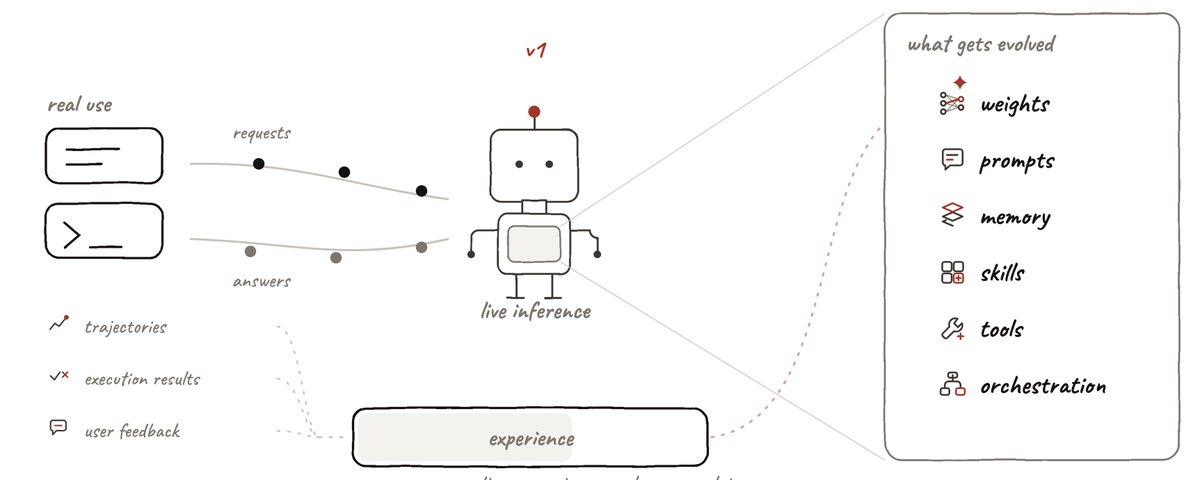
I’ll be presenting CORAL at COLM today from 11 AM to 1 PM!
🚀 Since its release, CORAL has reached 1.1K GitHub stars and is already being used by engineers and researchers at Takeda, Jump Trading, TikTok, Tencent, Symbotic, and many others.
Recent efforts by frontier labs to tackle challenging math problems with multi-agent systems also seem to share many of the design principles behind CORAL.
If you’re interested in multi-agent evolution and AI for open-ended discovery, stop by and chat with us!
#GLOW.AI held a farewell party for Ruth Chew @ruthchewing (I'm pointing at her in the photo) who will be heading to @UW for her Ph.D. in Computer Science and Engineering with Pang Wei @PangWeiKoh.
I've known Ruth since her undergrad days back in 2018 when she did her Senior/Final Year Project on @InverseReinforcementLearning with me. During her DSO stint, she did her Master's thesis with me as well, which led to the joint work on BILBO: BILevel #BayesianOptimization (with Phong @qphong) published in @icmlconf#ICML2025 (see her video presentation at slideslive.com/39042343/bilb…). She has recently led a joint research effort (with Zhiliang @ZhiliangChen94 and Apivich @apivich_h) to develop a benchmark to democratize black-box optimization research for expensive #LLM tasks (chewwt.github.io/bolt/).
Ruth will be dearly missed!
Gregory Lau @greglau (funded by the @AISingapore - CNRS@Create DesCartes Joint PhD Scholarship) had also graduated from #GLOW.AI and recently received the Ministry of Education, Singapore (@MOEsg) Singapore Teaching and Academic Research Talent (START) Award (paired with Nanyang Technological University Singapore @NTUsg) to do an Overseas Post-Doctoral Fellowship at Massachusetts Institute of Technology @MIT. His joint work with Apivich on PINNACLE (#ActiveLearning of #PhysicsInformedNeuralNetworks) was published in @iclr_conf#ICLR2024 (spotlight presentation) and had been recognized with the Best Paper Award in the #ICML2024 Workshop on AI for Science. He is also a great teacher in my CS3264 Foundations of ML course, having received the NUS Computing Teaching Fellowship Scheme award, which is given to those with excellent performance as a tutor.
At this party, we also welcome our new member, Joseph Tze Tzun Teoh, to our #GLOW.AI family. He is a recipient of the @AISingapore Ph.D. Fellowship. Looking forward to his significant contributions in AI research!!!
Ao Qu @ao_qu18465 Sep 1 Article Your Inference Server is Secretly a Learner: Open-Sourcing Reef for Continual Self-Improving Agents Reef is fully open source: https://github.com/Human-Agent-Society/reef 1. Before all the “RSI” hype becomes real Before today's excitement around RSI is fully realized, we want to open-source Reef, an infrastructure
Congrats to Weida Li @ZhuanghuaL Yaoliang Yu for receiving the Best Paper - Runner-up Award at #UAI2026@UncertaintyInAI for our work "Nonlinear Axiomatic Attribution for Cooperative Games"!!!
See what Weida has to say about our work below:
Since digging into the #ShapleyValue, one question has lingered in my mind: To what extent are the Shapley value and its counterparts actually useful in AI? For simplicity, we focus on the AUC metric, the area under the insertion curve, which is commonly used across scenarios to identify the combination of players with the most contributions. We treat this metric as a must-use benchmark to examine the Shapley value and its counterparts, and study how well they perform at maximizing this AUC metric.
As far as we know, the popularity of the Shapley value stems from it being the unique attribution method satisfying a certain set of axioms. However, several works have theoretically demonstrated its unreliability in different aspects. They tell the same story: The linearity axiom makes the Shapley value a linear operator with a large null space. As a result, there exist many significantly different cooperative games (also called utility/characteristic functions) that share the same Shapley value, i.e., the Shapley value can't distinguish between them. This argument also extends to the AUC metric. Since the AUC metric only concerns the ranking of assigned contributions, the efficiency axiom is unnecessary. This raises a question: What would attribution methods look like if we remove only the linearity and efficiency axioms?
The mathematical convenience that the linearity axiom provides is significant. It allows us to break down a cooperative game into a sum of easy-to-tackle simple games as the first step. Without linearity, it's a different story. Still, in our UAI2026 paper, we introduced a class of nonlinear axiomatic attribution methods through additive approximation.
Concurrently, and as something of a happy coincidence, we discovered another class of nonlinear axiomatic attribution methods in "TreeGrad-Ranker: Feature Ranking via O(L)-Time Gradients for Decision Trees", which is accepted to @iclr_conf#ICLR2026. It was derived by heuristically maximizing the AUC metric, and the resulting formula resembles the Shapley value, except that the weights now depend on the cooperative game itself. If you find our UAI2026 work interesting, this one is definitely worth a read too!
It is worth mentioning that our ICLR2026 work also led to a small contribution to the great #XGBoost library, which had just won the Test of Time Award @kdd_news#KDD2026! In our research, we wanted utility functions that are sufficiently complex while still allowing the #ShapleyValue and its counterparts to be computed exactly without approximation. That search led us to the linear TreeSHAP algorithm where we noticed a severe numerical issue and introduced a fix, TreeGrad-SHAP, which was later adopted and efficiently implemented into the #XGBoost library through the excellent work "Quadrature-TreeSHAP: Depth-Independent TreeSHAP and Shapley Interactions".
Alfred @alfredleongwl has famously commented on Aug 4, "If an AI model generated this, 💩. If a human drew it, 🙀."
Seeing that my face turned sullen, he quickly went on to explain himself that the AI model is measured by how well and realistic it can replicate the corresponding photo/image. My natural response is why not look at the photo/image directly then (something which I have taken for granted now with camera technology)?
This artwork is drawn by my child.
She had a somewhat similar concern as Alfred during primary school. She felt something amiss. She commented before that unlike her friends, her artwork did not replicate the realism that was expected of her. Instead, everything she drew has a certain "rustic" feel which I could not articulate precisely.
For example, even when drawing a book, others might additionally use a ruler to outline the book. She would simply trace it out with just a pencil; the drawn book looked as if it had been dried under the sun after being accidentally dropped into the pool.
I saw *her* in the artwork, her interpretation of the world and environment surrounding her. Would you call that her unique signature? Her style? I asked her not to change cos it defines part of who she is.
I have no doubt that such a style of hers can be replicated at scale by AI now (especially after I've uploaded it online). Should it? A question in this century to be debated.
#DataAttribution#DataProvenance
Recently, @OpenAI, @GoogleDeepMind, @ElevenLabs, and @AnthropicAI (support.claude.com/en/articl…) are all pushing #watermarking and #provenance forward.
These efforts raise an important question:
If model owners can watermark the content generated by their AI models for provenance and traceability, shouldn’t data owners be able to do likewise and know whether their personal content is used by the AI models?
In other words, alongside asking,
“Is this content generated by that AI model?”
shouldn’t we also be able to ask,
"Is that AI model trained on my personal content?”
Back in 2023 (i.e., well before data provenance for LLM training became a mainstream conversation), we were already thinking seriously about this equally important problem.
If the personal content of a data owner could be watermarked, its downstream use could be traced, including whether it was used to train an LLM.
At that time, existing text watermarking methods were not robust nor practical enough for protecting arbitrary data at scale. That motivated us to develop a text watermarking framework, Waterfall, specially designed for data owners.
Just like how watermarking can give model owners visibility into whether their generated content is being used, Waterfall can give data owners visibility into whether their personal content is being used.
Check out our post from back then: x.com/bryanklow/status/18512…
Great to see @OpenAI join @ElevenLabs in adopting @Google's SynthID for audio, enabling their users to have access to the same robust, imperceptible safeguards that power our own products.
For years, we at @GoogleDeepMind have been pioneering research on SynthID watermarking to address the risks of AI-generated media (particularly acute for audio and voices).
We had successfully integrated SynthID to safeguard our product surfaces - Gemini Live, Lyria, and Veo, but protecting the ecosystem requires an industry-wide effort to build foundational safety infrastructure together which is now gaining momentum!
SynthID: deepmind.google/models/synth…
OpenAI Verification Portal: openai.com/research/verify
ElevenLabs: elevenlabs.io/blog/synthid
Homecoming for Zhongxiang Dai!!!
He is currently an Assistant Professor (Presidential Young Fellow) at The Chinese University of Hong Kong, Shenzhen @cuhksz and recently received the award of 国家级高层次青年人才.
GLOW.AI is hosting him for the months of July and August at @NUSComputing Computing!
Want to know more about how to use Multi-Armed Bandits to optimize Agentic Workflow? Check out his recent works @icmlconf#ICML2026!
#AgenticAI