←
Dr Claudia C. Weber1,530 posts
Dr Claudia C. Weber avatar

Dr Claudia C. Weber

@cc7740

Genomes, molecular evolution. Often seen wielding camera. she/her. Find me at bsky.

◷ Joined March 2009▧ 25 Photos and videos
Dr Claudia C. Weber avatar
Dr Claudia C. Weber@cc7740·4 Jun 2024

Have long-read data and want to know what you've really sequenced, and how much of it? Reliable taxonomic labels are often scarce if the target is from a less well-explored group. VAE embeddings can tease apart different organisms in read sets: biorxiv.org/content/10.1101/…

Dr Claudia C. Weber avatar
Dr Claudia C. Weber@cc7740·16 Aug 2024

Now out in G3: academic.oup.com/g3journal/a… (thanks to the editors and reviewers for attention to detail and efficiency!)

Have long-read data and want to know what you've really sequenced, and how much of it? Reliable taxonomic labels are often scarce if the target is from a less well-explored group. VAE embeddings can tease apart different organisms in read sets: biorxiv.org/content/10.1101/…

Dr Claudia C. Weber avatar
Dr Claudia C. Weber@cc7740·5 Jun 2024

For more microsporidian content and tricky genomes, also see this new review from @KhalafAmjad1, @orefrancis & @blaxterlab onlinelibrary.wiley.com/doi/…

Dr Claudia C. Weber avatar
Dr Claudia C. Weber@cc7740·4 Jun 2024

Given compositional differences, sequences from different sources form distinct clusters in the VAE’s latent space. For example, the pictured moth (blue) is infected with Wolbachia (red). No labels? Discrepancies in coverage and coding density (second image) can provide clues.

Post attachmentPost attachment
Dr Claudia C. Weber avatar
Dr Claudia C. Weber@cc7740·3 Oct 2023

For more from @KhalafAmjad1 on microsporidian polyploidy, check out the Meio- and Micro-Eukaryotes session tomorrow at #BG23, 10am BST! events.venue-av.com/e/BG23_r… Also featuring myxozoans (me), and nematodes (Erna King) @SangerToL

First preprint of my PhD is out! We survey all publicly available microsporidian datasets on the SRA and show that polyploidy is widespread in Microsporidia! biorxiv.org/content/10.1101/…

Post attachment
Dr Claudia C. Weber avatar
Dr Claudia C. Weber@cc7740·6 Jan 2022

To bin sequences by composition, I count tetranucleotide patterns and reduce them to 2D with a Variational AutoEncoder for visualisation. In this animation, reads from buff tip (red) readily separate from those of its Wolbachia endosymbiont (blue; labels from MarkerScan).

Dr Claudia C. Weber avatar
Dr Claudia C. Weber@cc7740·6 Jan 2022

Here's an overview of how the MarkerScan pipeline (developed by @EmmelienV ) uses conserved markers to generate a streamlined database to identify possible cobiont reads, and distinguish between contamination and horizontal transfers (important for Wolbachia!)

Post attachment
Dr Claudia C. Weber avatar
Dr Claudia C. Weber@cc7740·6 Jan 2022

...databases can be contaminated and may not include close relatives of the species of interest, reducing decontamination performance. To address this, we combine reliable taxonomic hints from ribosomal markers with reference-free composition-based clustering.

Post attachment
Dr Claudia C. Weber avatar
Dr Claudia C. Weber@cc7740·6 Jan 2022

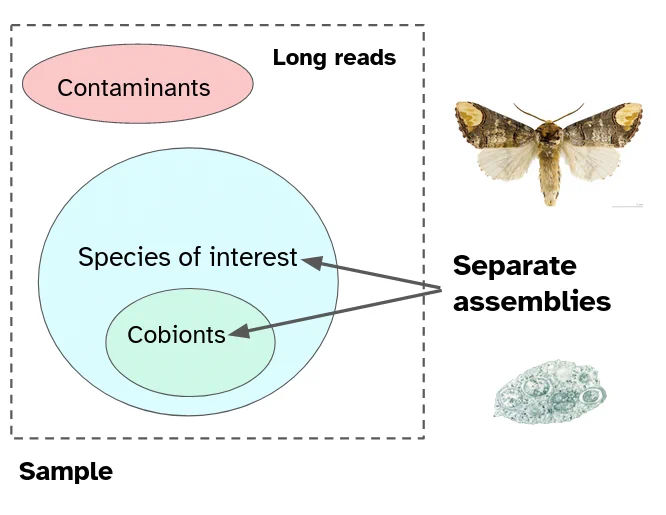
Our samples often come with “extras”, e.g. contaminants or sequences from cobionts interacting with our target species, which we would like to separate out and assemble independently. The current decontamination process includes database-based checks. However...

Post attachment