One2x Datalab @One2xDatalab Nov 13 Article How to Choose the Right AI Video Model? We Tested 7 Models Across 12 Cases In 2026, video generation models have been updated so quickly that it has become hard to keep track of their names. According to gen-ai.news’s public release timeline, as of November 5, 26
Building a continuous-surface modeling RL env, our v1 verifier got reward-hacked in an interesting way. We scored deviation from the reference mesh. The model can't infer true scale from screenshots, so it nudged every control point locally until the error fit within tolerance. High score, bumpy surface. Fix: render zebra stripes, the same check modelers use to inspect surface continuity, and have a vision model judge stripe flow. Distance alone can't grade smoothness.
Working on creative / aesthetic RL envs where judgment has to hold across a multi-step trajectory, not just one pretty frame. Single-frame prefs are everywhere; the trajectory layer is still weirdly empty. Early days — if you’re in this lane too, would love to compare notes.
So with Taste Machine integrated, the agent uses it to explore directions, then build models, render drafts, and uses image models to turn them into realistic renders. Without seeing the good options, models tends to collapse into safer options.
So with Taste Machine integrated, the agent uses it to explore directions, then build models, render drafts, and uses image models to turn them into realistic renders. Without seeing the good options, models tends to collapse into safer options.
LLMs are getting really good with blender and 3D modelling, but it still outputs generic design with no character. When you integrate Taste Machine's creative exploration ability to your blender workflow, you will get much better results. 👇
LLMs are getting really good with blender and 3D modelling, but it still outputs generic design with no character. When you integrate Taste Machine's creative exploration ability to your blender workflow, you will get much better results. 👇
My grok bot sign in flow on X is like this: open grok bot on X->
sign in with Cursor ->
sign in with X ->
sign in with Google ->
auth by google, then by X, then by cursor, then welcome! I also didn’t quite catch the SpaceXAI part, clicked too fast.
It looks like it’s the shortest route in 2026.
@grok
As a comparison, I tested the same coffee maker brief using Lovart's latest 2.0 version. With a more prescribed workflow, Lovart produced a very limited set of result, and doesn't quite make much sense. The designs in the three technical drawings are not even the same design.
Been experimenting with a long-horizon design environment over the past few days.
The starting question was simple: Does prescribing the workflow limit what an agent can discover on its own?
So the setup is intentionally simple: give the agent a physical product design goal, then expose a set of tools — Taste Machine API for creative exploration, image generation API, web search, terminal/bash, Blender, etc.
A typical run is 150+ turns, 30–40 Blender tool calls, and ~1 hour.
What surprised me was how much workflow emerged on its own.
Beyond research, the agent did structural and lighting analysis, iterated geometry in Blender, locked a direction, then used its renders as references for an image model to push the final visuals further.
None of this was explicitly scripted.
Another interesting part: if we simply imitate a human design workspace, we naturally think in terms of computer use — Photoshop, Rhino, Illustrator, etc.
But the agent mostly used code, search, Blender scripting and generative models to accomplish the same design tasks. It started to form a much more agent-native toolchain.
There are still obvious failures.
Taste Machine could provide several strong and diverse creative directions, yet the agent would always abandon the more distinctive ones and converge on the safer and more generic direction.
That makes judgement feel increasingly important in subjective long-horizon tasks.
As agents get better at doing, how do they get better at knowing what’s worth doing?
Been experimenting with a long-horizon design environment over the past few days.
The starting question was simple: Does prescribing the workflow limit what an agent can discover on its own?
So the setup is intentionally simple: give the agent a physical product design goal, then expose a set of tools — Taste Machine API for creative exploration, image generation API, web search, terminal/bash, Blender, etc.
A typical run is 150+ turns, 30–40 Blender tool calls, and ~1 hour.
What surprised me was how much workflow emerged on its own.
Beyond research, the agent did structural and lighting analysis, iterated geometry in Blender, locked a direction, then used its renders as references for an image model to push the final visuals further.
None of this was explicitly scripted.
Another interesting part: if we simply imitate a human design workspace, we naturally think in terms of computer use — Photoshop, Rhino, Illustrator, etc.
But the agent mostly used code, search, Blender scripting and generative models to accomplish the same design tasks. It started to form a much more agent-native toolchain.
There are still obvious failures.
Taste Machine could provide several strong and diverse creative directions, yet the agent would always abandon the more distinctive ones and converge on the safer and more generic direction.
That makes judgement feel increasingly important in subjective long-horizon tasks.
As agents get better at doing, how do they get better at knowing what’s worth doing?
Can we post train taste?
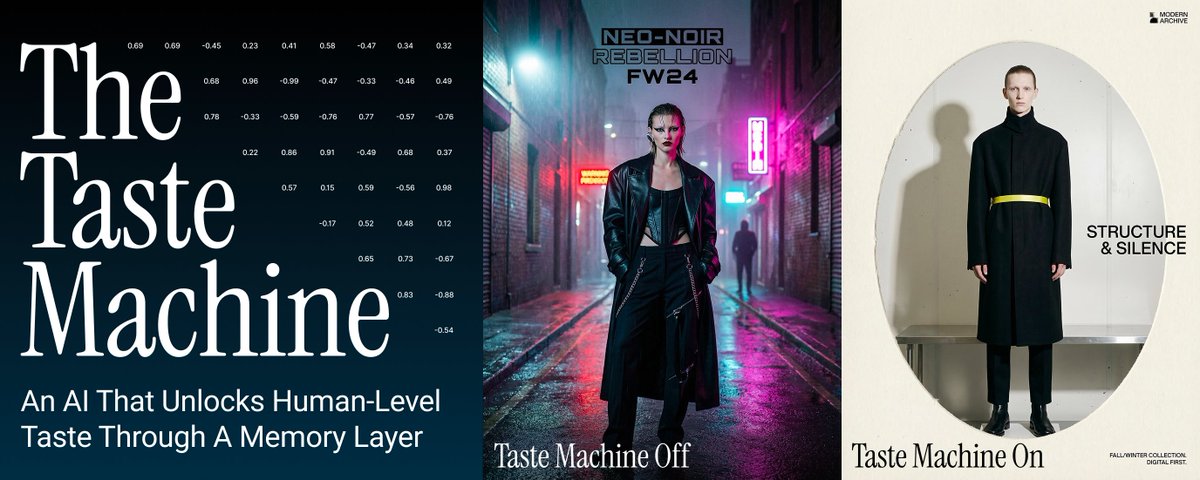
I’ve been working on a system called Taste Machine since March
It teaches an LLM on what is a better taste (not just visually)
and guides LLM to create much better design
I created a batch of design through Taste Machine
and used it to train a 4B model with SFT
And asked the 4B model to skip the heavy design reasoning and output a design directly
It successfully demonstrated the ability to design with certain taste
And it can be done on tasks it has never seen before
Based on the diverse result it generated
We can see that it didn’t learn a visual style
But a certain type of underlying design judgement
Limited to the model size and dataset size
There is still a gap between this and the Taste Machine’s output
But as least it proved that
Taste can be post trained
There is a way to get rid of AI slop
Been working on an agent version of the Taste Machine idea, realising how important it is to have the correct harness: after adding the "view image" tool allowing the agent to take a look at the generated result, it started to review and iterate on the output without me asking.
So much hate going around. It's probably the expected reaction when you announce that you solved the taste problem after people are just getting used to the saying that taste is the only human moat.
We’re excited to introduce Taste Labs.
Our mission is to end AI slop. We’re building the data and infrastructure layer to give AI models and agents taste.
And today we’re coming out of stealth, announcing our $18.5M seed funding, co-led by @CRV and @AmplifyPartners
AI has nailed objective domains and made it easy to generate anything. But it still feels off. Now, the challenge is judgement. What fits, what feels like you, what’s GREAT. This requires turning a fuzzy, subjective domain into something we can measure and codify. We’re starting with design.
There are two sides to cracking this, the foundation model layer and the agent layer:
- We’ve already been working with the top frontier labs to evaluate and improve their models, crafting the right post-training data and RL environments.
- We’ve also been working with app-layer companies to build the context and verification tools for their agents to produce better, more on-brand, more creative outputs.
We want a future where AI feels right.
If you’re passionate about this mission, join us!
Mostly agree — for taste as signaling. That's positional and yeah, it eats itself. But when taste is grounded in an outcome (an ad or a product photo that converts), the reference point is reality, not other people's outputs. Slop is relative. Outcomes aren't.
most of what is considered "taste" (read: design) is in the realm of zero sum signaling games
your tasteslop will just be the next AI slop
and then your anti-tasteslop will become the next tasteslop
taste is defined in terms of slop and therefore can never transcend slop.
Everyone's debating whether AI can have taste. Here is a solid example that shows slaping an agent layer alone doesn't solve the problem, the taste is essentially the will to go away from the most probable outcome. it is the same thing for human and for AI.
Finally got some more time to upgrade taste machine to its 2.0 version, which now runs on a much larger training set than the original version, and it shows some significant difference in its choice of design language. (the fourth image on each is the v2.0 result vs the third being the v1.0 result)
Finally got some more time to upgrade taste machine to its 2.0 version, which now runs on a much larger training set than the original version, and it shows some significant difference in its choice of design language. (the fourth image on each is the v2.0 result vs the third being the v1.0 result)
Dabo @chendabo Mar 20 Article The Taste Machine: I built a memory layer for AI, and it started showing human-like design judgment Taste is about choice, not raw intelligence Not context engineering, but probability engineering When not chasing the most probable, results feel more human This article explains what I have been