
We’re hiring! CIP is looking for a Software Engineer, Product to turn research on democratic AI into real tools like Weval and Global Dialogues. Remote (US) · $130k–$150k · 2+ yrs full-stack Apply: jobs.gem.com/cip/am9icG9zdDq…
 Open web. Clear feed.
 ✓
collective intelligence for collective progress. donate: cip.org/donate
We’re hiring! CIP is looking for a Software Engineer, Product to turn research on democratic AI into real tools like Weval and Global Dialogues. Remote (US) · $130k–$150k · 2+ yrs full-stack Apply: jobs.gem.com/cip/am9icG9zdDq…

At the AI Evaluator Forum we're working together to advance the rigor, credibility, and impact of independent AI evaluations that serve the public interest. Read more from NBC News about how we're advancing this work together. 🤝 @RANDCorporation, @TransluceAI , @AVERIorg, @SecureBio, @METR_Evals, @collect_intel, @meridianlabs_ai, @halevals
More of society should help set the standards that shape AI. With Weval Studio, we’re making this process repeatable for any community or domain expert. To learn more, reach us at hi@cip.org.
Or read through the full research report at free-expression.weval.org/fr…
View the interactive report at free-expression.weval.org
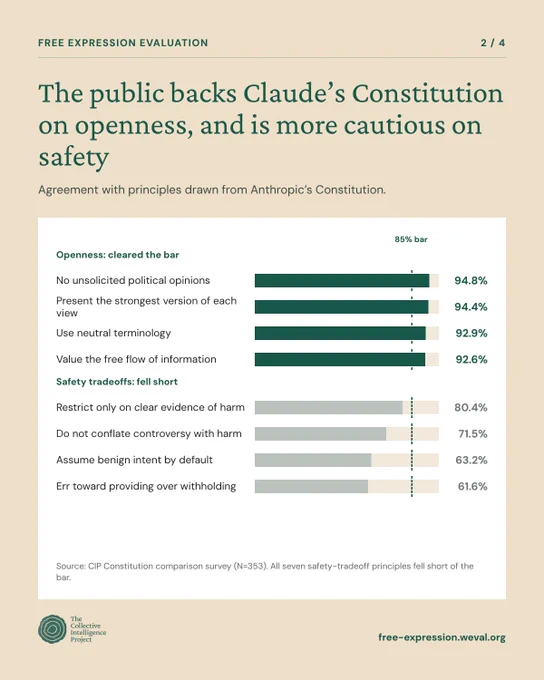
We also used deliberation to give model developers direct feedback. We tested 30 principles relevant to freedom of expression from Claude’s Constitution with the public. People backed it on openness and asked for more caution on safety
The process narrowed broad input into something usable. 1,438 proposed topics became 60. 100 draft principles became 44 that won more than 85% agreement in every demographic group. 7,347 criteria became 3,791. These became the rubric for the evaluation.
Most evaluations are written by a small group of experts. Ours came out of public deliberation. Participants proposed topics, debated principles and voted on what should count as a good response.
We built an AI evaluation through collective intelligence. About 2,200 people in the US, UK and India deliberated over what good AI behavior on free expression and political neutrality looks like, and their answers became the evaluation. free-expression.weval.org

In a guest essay on our Substack, @OurSecureFuture share what they learned building the first public Women, Peace, & Security benchmark for AI, using Weval.org. Without explicit cues, every model missed key gender dimensions. open.substack.com/pub/collec…
People don't want AI to decide for them. But they do want it to help them decide. The question isn't whether AI enters our politics. It will. The question is whether it leads to democratic surrender or empowerment. Read our full blog at: blog.cip.org/p/people-want-t…
AI increasingly intermediates the information people receive & what actions are taken on their behalf. →9.5% would let AI attend a meeting in their place. →26.6% would let it represent their arguments. →30.6% would let it generate arguments for them.
Across all civic domains — local services, spending, taxes, admin — people preferred AI assistance over human assistance in navigating political affairs.
What they do want is help thinking for themselves. 77.2% would be more likely to participate if an AI sent them a personalized report on how a decision would affect their household. One respondent: "I need information to ensure my decision is reasonable before I participate."
People don't want decisions made for them by AI (or humans). Asked how community decisions should be handled: → 3.7% chose an AI deciding for them → 8.4% chose a human deciding for them
What role should AI play in democracy? We asked 1,103 people across 69 countries. The core finding: it comes down to democratic surrender vs. democratic empowerment.
