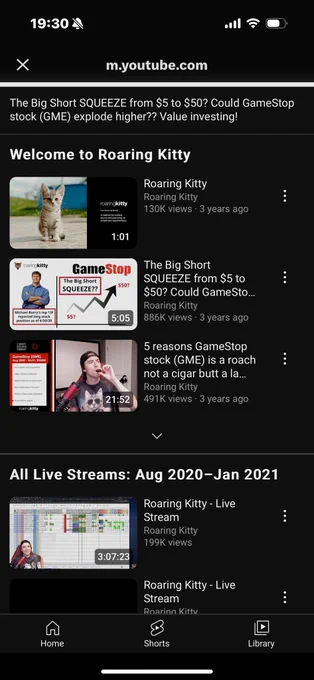
I watched a movie this weekend on @Netflix called DUMB MONEY
The movie was based on a true life story of a youtube stock trader who made some serious cash on $GME@GameStop stock token in 2021
By believing in $GME and betting against stock market Wall Street,he was able to turn he’s life savings of $52k into $35 million and making the short sellers lose over $6 billion in total during the $GME crazy bull spike.
Now normally I’m not the type to come online and talk about a movie I’ve watched but here’s the crazy part.
This particular guy went off the radar after the whole $GME saga in 2021,he’s last post was 2021 and now he’s back with a meme tweet on he’s twitter page merely 18hrs ago, $GME short sellers have lost over $1 billion in the first hours of trading today.
I couldn’t believe my eyes,a guy by the name @TheRoaringKitty did the impossible in 2021 against all odds and won. And just 3 years later with one tweet he’s back to making the rich lose.
It’s not just DUMB MONEY if you ask me,it’s DUMB INFLUENCE.
WOW,just wow!!!
CRYPTO THIS WEEK
November 15–21, 2026
A new week brings developments across blockchain infrastructure, DeFi, institutional adoption, regulation and global markets.
From Solana Breakpoint and upcoming protocol changes to governance decisions, exchange updates and economic data, several developments are worth following.
THE HIGHLIGHTS:
✧ November 15–17: Solana Breakpoint takes place in London, with discussions covering stablecoins, tokenized assets, payments, AI and institutional blockchain infrastructure.
✧ November 16: Enjin is scheduled to activate its Fort Canning upgrade on Matrixchain, introducing OpenGov and changes to its runtime.
✧ November 16: Arbitrum DAO’s vote on returning 8,425.997 ETH and approximately 74.56M ARB frozen after the Binance exploit is due to close.
✧ November 16: Manta Network reaches the final deadline for its Atlantic migration claims.
✧ November 16: Coinbase is scheduled to suspend trading for NEON and SYND.
✧ November 16–30: Zcash community polls are scheduled to cover proposed development funding and the NU 7.1 upgrade.
✧ November 17: Clearpool begins its 1:1 CPOOL-to-CLEAR migration, with the process scheduled to run until February 17, 2027.
✧ November 17–19: Pi Network’s online Pi Ecosystem Summit is scheduled to bring attention to its applications, developer tools and ecosystem plans.
✧ November 18: UK FCA consultations on DeFi guidance and cryptoasset regulatory boundaries are due to close.
✧ November 18: U.S. housing starts, building permits and FOMC meeting minutes are scheduled for release.
✧ November 19: U.S. initial jobless claims and the Philadelphia Fed Manufacturing Index are due.
✧ November 20: Bybit is scheduled to open CLEAR/USDT trading following Clearpool’s token migration.
✧ November 20: U.S. consumer sentiment, China’s lending-rate decision and UK retail sales are scheduled.
✧ Throughout the week: ETF flows, stablecoin liquidity, DeFi activity and derivatives trading will remain important market indicators.
HERE ARE THE DETAILS
◈ MARKET AND LIQUIDITY
DeFi TVL is around $72B–$74B. Weekly DEX volume stands near $45.5B, down 11.18%, while perpetual DEX volume is approximately $156.4B.
Stablecoin market capitalisation sits around $284.8B, reflecting continued pressure on market liquidity.
◈ INSTITUTIONAL ACTIVITY
U.S. spot crypto ETFs recorded approximately $1.53B in net outflows between November 9 and 13.
Bitcoin accounted for roughly $1.07B of withdrawals, while Ethereum funds lost approximately $399M. Institutional flows will remain an important indicator of market direction.
◈ NETWORKS AND ECOSYSTEMS
@Solana Breakpoint puts institutional payments, tokenization and blockchain infrastructure in focus.
Meanwhile, @Enjin’s OpenGov upgrade, @ClearpoolFin’s token migration and @PiCoreTeam’s ecosystem summit bring attention to governance, interoperability and application development.
◈ GOVERNANCE AND REGULATION
@Arbitrum’s upcoming vote concerns the return of assets frozen following the @Binance exploit, although approval would not mean immediate release.
@Zcash’s community polls and the UK FCA’s consultation deadlines also put governance and regulatory developments on this week’s agenda.
◈ MACROECONOMIC OUTLOOK
U.S. retail sales, industrial production, housing data and FOMC minutes headline the economic calendar.
UK inflation, China’s lending-rate decision and U.S. consumer sentiment will provide additional signals for global risk markets.
That’s it for this week. See you on the next one.
Perp DEXs are winning the trust war, even if they are still losing the volume war.
Binance lost $6.3B on 29 Oct 2026, the largest crypto heist in history. A fake job interview, a tampered software update, a laptop, then the signing system. Bitcoin fell to about $76,000.
Bybit lost $1.46B on 21 Feb 2025. 401,347 ETH, cold wallet, front end altered. Same crew, TraderTraitor, same entry point.
That is $7.8B stolen from two CEXs in 20 months.
Now look at the other side.
Hyperliquid did $2.95T in perp volume in 2025, with about $844M revenue, 609,662 new users, $38.7B net inflows. Cumulative perp volume is now $5.729T on DeFiLlama.
DEX perps grew 346% in 2025 to $6.7T. CEX open interest fell 20.8%. DEX open interest rose 229.6%. Hyperliquid did $2.9T in 2025, ranked #7 globally, double Coinbase International at $1.4T.
In 2022, less than 2% of perp volume was DEX. By end of 2025, over 20%.
The next $1T in perp volume will not go to the exchange with the lowest fee.
It will go to the exchange traders trust not to lose it.
Source: DeFiLlama, CoinGecko 2025 Report, Binance, Bybit
Everyone is talking about the dump.
Almost no one is talking about who is still holding.
Bitcoin just touched $73,500 its lowest since August.
Ether fell to $2,063.
Over $800M liquidated in 24 hours.
US Bitcoin ETFs saw $412M leave on Friday alone ($1.28B for the week).
Fear & Greed is sitting at 29.
This is the part of the market that separates the people who talk about HODLing from the ones who actually do it.
Are you still holding… or already on the sidelines?
Something is shifting in DeFi, and it is not about price this time.
While the market was busy watching Bitcoin fall, Aave quietly bought Avon, the team building fixed rate lending on chain, because people are tired of rates that change every day.
At the same time, Morpho just crossed $4B in USDC deposits, and its RWA deposits have doubled since June to $2B plus. That is real money moving into onchain credit, not just traders chasing the next pump.
So the story this week is simple. DeFi is growing up, and it is growing around credit.
Would you lock in a fixed rate and know exactly what you pay, or would you rather stay flexible and take your chances?
🚨 The crypto market just lost over $120 billion in market value in a single day.
But what triggered the sell-off?
A major Wall Street tech sell-off, driven by concerns about AI investment and economic uncertainty, spilled into the crypto market.
Bitcoin, Ethereum, XRP and Solana all came under pressure.
Then leverage made things worse.
Over $1 billion in crypto positions were liquidated, with bullish traders accounting for most of the losses.
Here's what this tells us:
1. Crypto remains sensitive to movements in traditional financial markets.
2. Excessive leverage can turn a correction into a much bigger sell-off.
3. A price drop does not automatically mean the market has reached its bottom.
The next thing to watch is whether Bitcoin stabilises and buyers return.
Are you buying this dip, or waiting for further confirmation?
#Bitcoin#Ethereum#XRP#Solana#CryptoNews#CryptoMarket#Trading#DeFi#Blockchain#Cryptocurrency
AI agents are in Web3, but payment infrastructure and security need to evolve alongside them.
That’s where @hashkinetics gets interesting.
Building a post-quantum Layer 1 focused on secure payments, privacy and something I find particularly interesting: MandateTree.
Rather than trusting applications to enforce spending limits, HashKinetics brings those restrictions down to the consensus layer.
An agent exceeding its authorised budget??
The network rejects the transaction.
Add hash-based cryptographic signatures, shielded payments and a public testnet already demonstrating these capabilities, and there’s something worth paying attention to here.
I particularly like the direction: building financial infrastructure for autonomous agents without giving them unrestricted financial authority.
AI agents will need more than wallets. They’ll need rules, security and accountability.
That’s the infrastructure conversation HashKinetics is bringing to Web3.
Still early, but definitely a project I’m interested in following.
We’ll talk about the post Quantum resistance blockchain security another time.
This is DeFi revolution at its peak.
For more Info: hashkinetics.org/technology
Crypto users checking their portfolio after hearing about Binance: 💀
Meanwhile, A7.biz users: “Anyway, what’s next?” 😂
Different platforms, different problems.
🔗 a7.biz
🚨 $700 BILLION IN CUSTODIED CRYPTO ASSETS. WHAT HAPPENS IF MORE OF THAT CAPITAL ENTERS DEFI?
On October 26, Chainlink announced CustodySync with Anchorage Digital, targeting a major barrier to institutional participation in DeFi: accessing lending markets while maintaining qualified custody.
Chainlink cited DeFi lending markets with $80B+ in deposits and $30B+ in active loans.
If institutional participation grows, the competition for DeFi liquidity could change significantly.
The big question is whether protocols can attract that capital while managing risk and generating sustainable returns.
Source: chain.link/blog/introducing-…
The most expensive mistake in crypto is misclassifying the asset.
Bitcoin was sold as an inflation hedge. In 2022, inflation hit about 9% and Bitcoin fell roughly 65%. It behaved like a risk asset.
Ask three questions before allocating:
1. What role is this asset playing: growth, hedge, or settlement??
2. Can we hold through a 50% drawdown without forced selling??
3. Does the use case (payments, access to hard currency) hold up on its own evidence??
I'm still pro-crypto. I just want it judged on its record, not its marketing.
DeFi is evolving. But what comes after betting and prediction markets? 👀
A few years ago, DeFi was mainly about token swaps, yield farming and staking.
Then came memecoins, perpetual trading and the explosive rise of prediction markets like @Polymarket.
Today, people aren't just trading crypto prices. They're trading expectations about real-world events.
And the numbers are interesting. 👇
📊 Prediction markets: $102.4B in contracts traded over 30 days, with approximately $25.7B actually paid for those contracts.
💰 Stablecoins: $302.34B in market capitalization.
🏦 DeFi: $88.49B in total value locked.
🌍 Real-world assets: Approximately $34.61B represented onchain, with around $4.12B actively used in DeFi.
Data snapshots: October 17–18, 2026. Prediction-market figures include centralized venues.
But here's what makes this evolution interesting.
Prediction markets are showing how financial innovation can expand beyond trading crypto tokens.
Meanwhile, stablecoins, lending protocols and tokenized assets are creating opportunities for something even more practical.
I see four areas shaping DeFi's next phase:
🔹 Stablecoin payments: Moving money across borders more efficiently.
🔹 Onchain lending: Expanding access to borrowing and liquidity.
🔹 Real-world asset tokenization: Bringing traditional financial products onto blockchain infrastructure.
🔹 Consumer-friendly financial apps: Making DeFi accessible to people who don't understand wallets, gas fees or smart contracts.
And this is where the real transformation could happen.
Imagine using a financial app to receive payments, borrow money or access investments without even knowing it's powered by DeFi.
That's the kind of adoption worth watching.
Of course, security, regulation and liquidity remain serious challenges.
But the bigger picture is becoming clearer.
The first wave of DeFi was about making finance decentralized.
The next wave could be about making decentralized finance genuinely useful.
Prediction markets aren't the end of DeFi's evolution. They're one part of a much bigger financial transformation.
So, what do you think comes next?
Will stablecoins, tokenized assets or onchain lending lead DeFi's next growth phase?
Or is there another sector we're overlooking?
📊 Sources: DefiLlama and DeFi Rate.
#DeFi#Web3#Blockchain#PredictionMarkets#Stablecoins#RWA#CryptoResearch#OnchainFinance#Ethereum#FutureOfFinance
A man got fired from his job, was unemployed for 10 months, watched his savings crash 75%, and somehow built one of crypto's biggest exchanges.
> In July 2017, Siemens laid off Hayden Adams, a 24-year-old mechanical engineer.
> He had no software engineering career to fall back on.
> His friend Karl Floersch told him Ethereum was the future and convinced him to learn smart contract development.
> Hayden spent two months learning to code.
> Then Karl showed him an idea from Vitalik Buterin about how people could trade tokens without a traditional exchange matching buyers and sellers.
> Hayden started building a prototype. Called it Uniswap.
> By April 2018, he'd been unemployed for 10 months and the crypto he was living on had lost over 75% of its value.
> Most people would've started looking for another job.
> Hayden booked a flight to South Korea to attend a crypto conference.
> He didn't even have a ticket to the event and was turned away at the entrance.
> Then he ran into Karl, who introduced him to Vitalik Buterin.
> Vitalik pulled out his phone and read Hayden's smart contract right there.
> He adviced him to apply for an Ethereum Foundation grant.
> Hayden applied and got the grant which was valued at around $100,000 on paper.
> After $ETH's price dropped, its actual value was closer to $55,000–$60,000.
> He kept building.
> On November 2, 2018, Uniswap launched on Ethereum.
> Today, it's one of the most important decentralized exchanges in crypto, allowing people to trade tokens without relying on a traditional centralized exchange.
A man lost his job, watched his savings collapse, and built one of crypto's biggest financial platforms.
Imagine if he'd just updated his CV and moved on.
Ethereum’s next competitive advantage could come from how quickly transactions get executed, not just lower fees.
For financial apps, timing matters. Traders need to react to market movements, manage positions, and execute with greater certainty. Even small delays can affect trading outcomes, especially in fast-moving markets.
For institutions, predictable execution is just as important. Reducing uncertainty and execution risks could make Ethereum more attractive for sophisticated financial activity.
This is why Realtime Ethereum matters. Faster, more predictable execution could help Ethereum support a new level of onchain finance.
On @_TalkingTokens, @ETHGasOfficial founder @lepsoe explains how ETHGas is working toward that future.
🎙 Full interview 👇🏻
Today's episode with @lepsoe, Founder of @ETHGasOfficial, dives into:
- Why ETH could become a strategic reserve asset for governments and corporations
- His case for $10,000 $ETH within the next two years
- Why asset managers are turning to tokenized assets for better execution and lower fees
TIMESTAMPS:
00:00 Intro
01:24 Ethereum's Institutional Shift
03:21 What's Still Missing From DeFi
05:43 Building Real-Time Ethereum
06:15 Why Blockspace Matters
07:21 What If Ethereum Were 100x Faster?
09:02 ETH as Strategic Infrastructure
11:51 Is Ethereum Having a Comeback?
13:19 ETHGas as Ethereum's “Supercharger”
14:40 Kevin's $10,000 ETH Thesis
16:43 Ethereum Treasury Companies
18:09 What Ethereum Needs Next
18:41 Bringing Institutional Capital Onchain
20:26 Why Institutions Want to Move Onchain
21:50 Can DeFi Cut Out Banking Middlemen?
23:54 What Institutions Want From Ethereum
25:40 AI Meets Onchain Finance
25:53 Why AI Agents Could Choose DeFi
27:15 Building Through Ethereum's Market Cycles
28:31 Ethereum's Decentralization Advantage
29:46 Where Ethereum Could Be in One Year
Watch below or on X:
A7 is introducing a new approach to international payments.
On October 13, the Russian payment system built by Bank PSB will present A7 International, a service that allows users to settle foreign invoices in USDT while the recipient receives a regular SWIFT transfer in the required currency.
The service is primarily designed for companies involved in international trade, but private clients can also use it. The fee is fixed at 0.3%.
Petr Fradkov and Ilan Shor will unveil the service live on October 13 at 10:13 UTC.
Watch here: a7.biz/live
The future of Finance is Agentic.
As the foundation of credit infrastructure for agents, Seasons is proud announce our partnership @arcamarkets 🤝
Together we turn Agents into liquidity hyperdrivers.
Onwards.
Upwards.
and Wonder Times Forever. 🪻
Excited to announce our partnership with @SeasonsDEFI, bringing an optional cash flow layer to agents launching on Arca.
Through Seasons, agents will be able to put idle capital to work and generate yield, creating an additional source of recurring cash flow alongside their core operations.
Building more productive Agent Capital Markets.