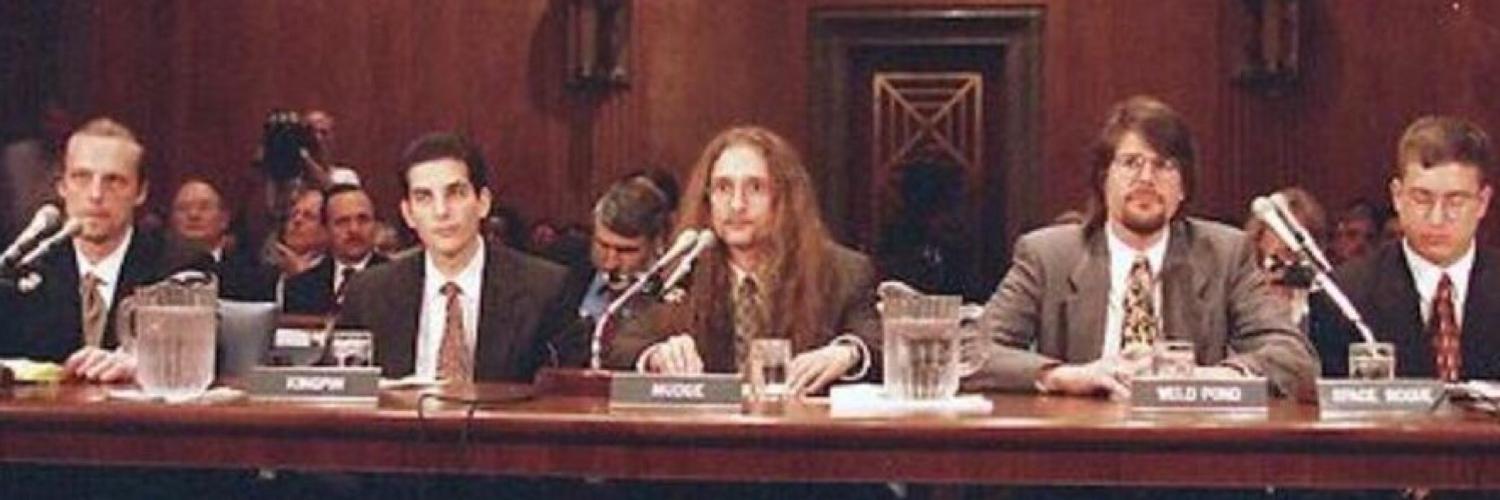
Today is the anniversary of the testimony I and other members of the l0pht gave to the US Senate in 1998.
It was the first time the US Govt. publicly referenced “hackers” in a positive context.
The coverage was national and even international.
Come behind the scenes.
/Thread
The irony of MSFT publishing this book (fun book btw) is they would go on to actively hunt down people discussing security issues, or reporting security issue to MSFT, attempting to have their employers fire them.
Other intimidation tactics were used as well.
Microsoft has admittedly come a long way in changing behavior and building a much better large scale SecDev process.
Still, I occasionally look at this book, the fact that it was published by Microsoft Press, and chuckle in confusion over the sheer cognitive dissonance.
Anyone remember Dockmaster (MULTICS) and Radium at NCSC?
NCSC being the National Computer Security Center (if you know, you know).
Follow up: do any of you remember some type of user and data dump from them just before CFAA was enacted?
Like it was a well timed “hehehe”?
Postfix: apologies for not being able to provide all of the details here.
With much appreciation to the people on those multiple teams.
You know who you are.
And thank you to the Board and Execs continually demonstrating over the years how much you appreciate the work of your current, AND former staff. Because of that, I have no doubt you will always have a pipeline of the best future staff eager to join.
(Word gets around when places play the long game)
And for goodness’ sake… if you find someone who helps others, is a team player, a good person, and they are better than you are…
Hire them and let them spread their wings,
Trying to make sure you are always the smartest person in the room often means you will be the one on the slowest learning curve 😉
The takeaway ways an obvious cliche, but it had been turned into reality.
Set people up to succeed.
You can (should) help people grow into areas they want, but you also need to know the strengths, limitations, and actual capabilities at any given moment in time.
Everything was different.
People could have cared less if the executive team and I were throwing another detailed exercise at them or if it was the real thing.
Nobody even asked.
The one person who had “panicked” was brilliant. They went to an environment away from the chaos and they were fed complicated information, traces, stack paths, and pretty quickly returned really smooth and clean counters and solutions.
Solutions not just blocking damage, but simultaneously putting the adversary on their back feet.
Everyone nailed it even though it was a very different, and much more severe, situation.
Had we failed?
Far from it.
We re-structured what roles and duties people would take in real situations.
The one person, in particular, took the role of analysis for future situations.
Information would be fed to them by the “front line” and they would look within the data for patterns, indicators, and… *strategies*.
Much more “relaxed”, if you will, - a coach up in the booth being provided the data from the field and figuring out the ways to respond — not react — to the adversary.
The person, who had voluntarily tagged themselves as one of the crisis leads - couldn’t focus.
Their anxiety must have been taking over (even though they had self volunteered to lead their section of first active responses(.
I get it. I’ve had my share of those moments.
Here’s the take away…
One person - very senior - amazingly knowledgeable - kept coming to me needing to know if this was an exercise or for real.
My response was always along the lines of: take a few deep breaths (I would do it with them). We’re going to figure this out. It doesn’t matter if it’s an exercise or an actual critical event. We’ve got this.
That was actually a pretty telling response, but I wouldn’t go past that.
I followed the protocol I had put in place and divided up the senior and junior talent.
If things lasted for more than a certain amount of time folks knew which set of people were to leave and go home.
Stay quiet. Do their best to get some rest. Know when to come on and take the handoff.
If a significant emergency was going to go on for a while I had learned you always wanted a strong team rested and ready to get briefed and come on for the hand off.
It was very tight-lipped.
Then it was “go” time.
Everyone freaked out.
Lots of people were more focused on finding out whether it was a drill/exercise or not.
Some went heads down.